Top Stories
SpaceX Launches 21 York Space Systems Satellites for SDA Transport Layer
SpaceX put 21 York Space Systems satellites into orbit for the Space Development Agency’s Tranche 1 Transport Layer. The launch brings SDA’s data-relay constellation to roughly half its planned size.
Tranche 1 Transport Layer is designed to move targeting data and sensor feeds between military users in low Earth orbit, cutting out ground relay delays. SDA has been iterating fast on this architecture - Tranche 0 proved the concept, Tranche 1 scales it, and Tranche 2 is already in planning.
Read the full story: SpaceNews
Schiess Heads to Confirmation Vote With Little Opposition for Space Force Chief
Lt. Gen. Doug Schiess cleared his Senate Armed Services Committee hearing with minimal pushback. Sen. Angus King, I-Maine, called the low turnout at the hearing a “compliment” to the nominee, signaling smooth sailing toward confirmation as the next Chief of Space Operations.
Schiess currently commands Space Operations Command and has been the public face of orbital warning operations. A quiet confirmation means continuity for Space Force’s current modernization push rather than a shakeup.
Read the full story: Breaking Defense
Nature Astronomy Study Proposes New Method to Detect Nuclear Warheads in Orbit
A study published last week in Nature Astronomy outlines a satellite design and detection technique aimed at spotting thermonuclear warheads placed in space. The research was partly funded by government sources tracking compliance with orbital weapons bans.
Detecting a warhead in orbit has been a hard problem - no active radiation signature strong enough for standard sensors at range. If the proposed method holds up, it gives treaty verification and space situational awareness programs a tool they’ve lacked since the debate over orbital nuclear weapons resurfaced this year.
Read the full story: SpaceNews
Air Force Chief Pushes Congress for Supplemental Funding, $1.5T Budget Ask
Gen. Kenneth Wilsbach told Breaking Defense the Air Force has stopped spending on “a wide array of things” just to cover costs tied to Epic Fury operations. He’s pressing Congress for a supplemental appropriation this year rather than waiting for the next budget cycle.
The ask lands as GOP lawmakers argue over the shape of a $1.5 trillion defense topline. Space Force programs, which sit inside the Air Force Department’s budget lines, are exposed to whatever gets traded away in that fight.
Read the full story: Breaking Defense
Defense Innovation Unit Opens Solicitation for Space-Based Solar Power
DIU issued a solicitation seeking commercial paths to deliver electrical power beamed from orbit to military users on the ground. The goal is fielding usable capability by fiscal 2030 - an aggressive timeline for a technology that’s been studied since the 1970s without a fielded system.
DIU’s approach leans on existing commercial satellite manufacturing and beaming research rather than a from-scratch government program, betting private investment can close the gap faster than another in-house demo.
Read the full story: SpaceNews
CMMC Phase II Pause Won’t Last, Says Program’s Own Architect
Katie Arrington, credited as the creator of the Cybersecurity Maturity Model Certification program, said the current pause on Phase II audits “shouldn’t be a shocker to anybody.” She expects the Pentagon to reinstate the requirement once it concludes there’s no substitute for third-party compliance checks.
For space contractors handling SDA, Space Force, and classified payload work, CMMC compliance touches supply chain security across the board. A reinstated audit regime would hit satellite bus manufacturers and ground segment vendors alike.
Read the full story: Breaking Defense
Satellite of the Day
THURAYA-2
THURAYA-2 is a mobile satellite communication platform operated by Thuraya (THUR), a UAE-based satellite operator, providing L-band and C-band services across the Middle East, Africa, and Asia. Launched on June 10, 2003, aboard a Zenit-3SL rocket from the Sea Launch platform, this satellite was designed to deliver voice, data, and fax services to maritime, aviation, and remote land-based users. With a launch mass of 5,177 kg and a design life of 12 years, THURAYA-2 marked an important milestone in regional satellite connectivity during the early 2000s.
Positioned in geostationary orbit at an 8.88° inclination, THURAYA-2 carries sophisticated L-band and C-band transponders - 128 active L-band elements with 17W SSPAs and dual C-band channels - making it capable of supporting thousands of concurrent mobile communications. The satellite’s unique configuration, featuring a box body with a large dish reflector and two solar panel arrays spanning 40.4 meters, was engineered to maximize coverage and power efficiency. THURAYA-2 represents an early example of dedicated mobile satellite service architecture and remains a significant asset in the operator’s constellation.
| Detail | Value |
|---|---|
| NORAD ID | 27825 |
| Operator | THUR (UAE) |
| Launch Date | June 10, 2003 |
| Orbit | Geostationary, 8.88° inclination |
| Purpose | Mobile Communication (L-band & C-band) |
| Status | Active |
Track this satellite in real-time: Track THURAYA-2
Upcoming Space Launches
July 17
- China Aerospace Science and Technology Corporation Long March 7A:
- Unknown Payload from Wenchang Space Launch Site (11:42 UTC) Details TBD. Launch Preview
July 18
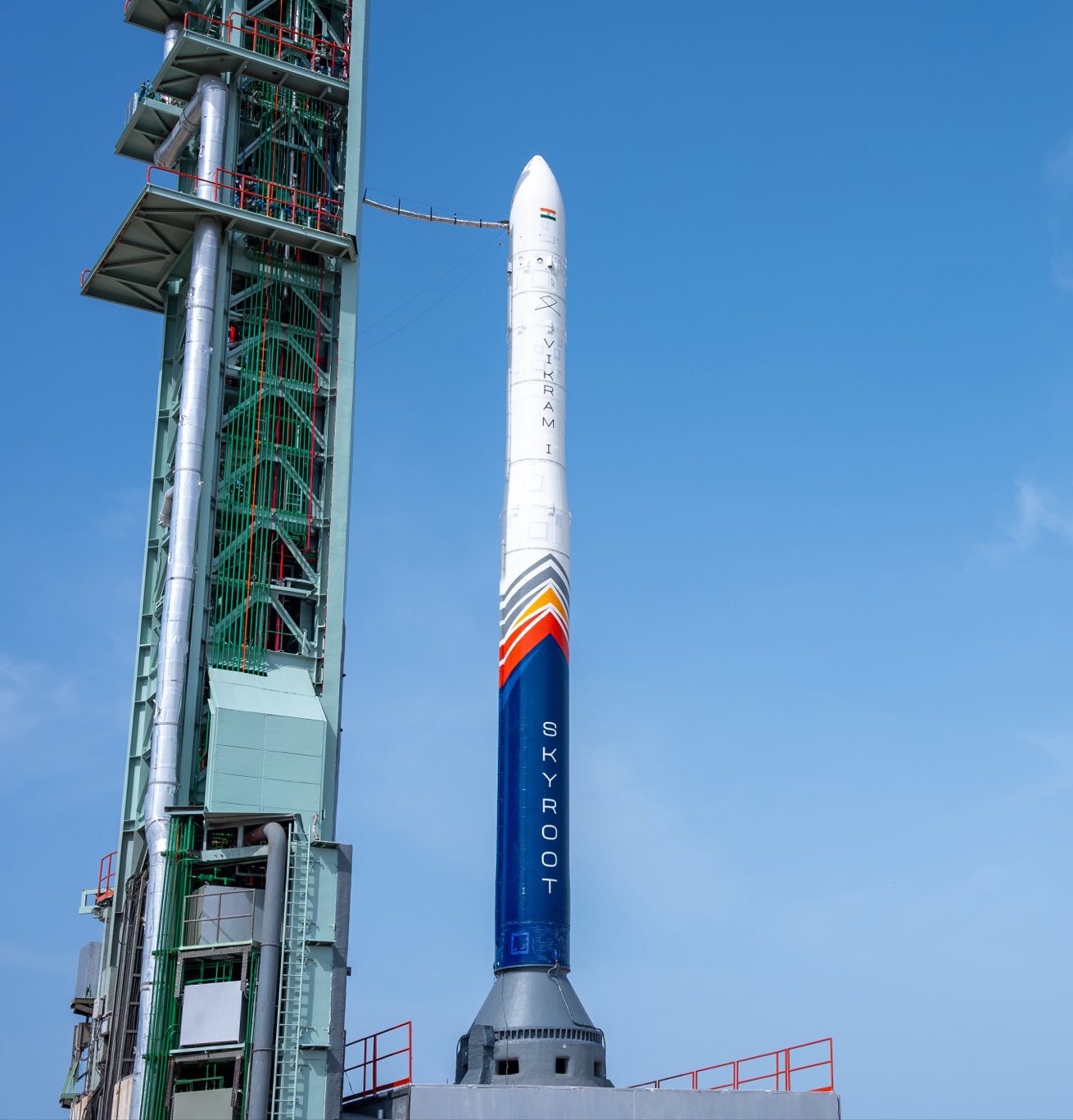
- Skyroot Aerospace Vikram-I:
- Demo Flight from Satish Dhawan Space Centre First Launch Pad (05:00 UTC) Demo flight of Skyroot Aerospace’s 4-stage orbital launch vehicle, capable of delivering up to 350 kg to Low Earth Orbit. The first three solid-fueled stages are topped by a hypergolic upper stage in this test mission. Launch Preview
July 20
- SpaceX Falcon 9 Block 5:
- Starlink Group 17-39 from Space Launch Complex 4E, Vandenberg Space Force Base (14:00 UTC) A batch of 24 Starlink V2 Mini satellites will be deployed to low Earth orbit; booster B1082 will attempt its 23rd landing on the droneship “Of Course I Still Love You.” Watch Live
July 22
- Orienspace Technology Gravity-1:
- Unknown Payload from Haiyang Oriental Spaceport (02:44 UTC) Details TBD. Gravity-1 is a 4-stage solid-fueled launch vehicle developed by Chinese private company OrienSpace, consisting of five clustered solid rocket motors with a liftoff capacity of 6,500 kg to LEO. Launch Preview
July 23
- China Aerospace Science and Technology Corporation Long March 3B/E:
- Unknown Payload from Xichang Satellite Launch Center (11:52 UTC) Details TBD. The Long March 3B/E is one of China’s most successful medium-range launchers, specially developed for transporting heavy communications satellites to geostationary transfer orbit. Launch Preview
July 24
-
CAS Space Kinetica 1:
- Unknown Payload from Jiuquan Satellite Launch Center (02:00 UTC) Details TBD. Kinetica 1 is a Chinese solid-propellant light launch vehicle capable of placing about 2 tons into low Earth orbit, developed by CAS Space, a subsidiary of the Chinese Academy of Sciences.
-
China Aerospace Science and Technology Corporation Long March 8A:
- Unknown Payload from Wenchang Space Launch Site (11:00 UTC) Details TBD. The Long March 8A is an upgraded orbital launch vehicle with increased capability of up to 7 tonnes to sun-synchronous orbit, featuring a larger liquid hydrogen/liquid oxygen second stage.
-
SpaceX Falcon 9 Block 5:
- Starlink Group 17-51 from Space Launch Complex 4E, Vandenberg Space Force Base (14:00 UTC) A batch of 24 Starlink V2 Mini satellites will be deployed to low Earth orbit; booster B1082 will attempt its 23rd landing on the droneship “Of Course I Still Love You.” Watch Live
July 28
- SpaceX Falcon 9 Block 5:
- Starlink Group 17-52 from Space Launch Complex 4E, Vandenberg Space Force Base (02:00 UTC) A batch of 24 satellites for the Starlink mega-constellation, SpaceX’s space-based internet communication system. Watch Live
Schedule Changes
- Added: Kinetica 1 | Unknown Payload, now scheduled (To Be Confirmed) for July 24, 2026.
- Added: SpaceX Falcon 9 Block 5 | Starlink Group 17-52, now scheduled (Go for Launch) for July 28, 2026.
- The SpaceX Falcon 9 Block 5 mission carrying the SDA Tranche 1 Transport Layer E satellites (MRV-1) has completed successfully and has been removed from the upcoming launch calendar.
- Skyroot Aerospace’s Vikram-I Demo Flight status updated from “To Be Confirmed” to “Go for Launch.”
- The Long March 3B/E mission carrying an unknown payload updated from “To Be Confirmed” to “Go for Launch.”
Note: Launch dates and times are subject to change due to technical or weather considerations.