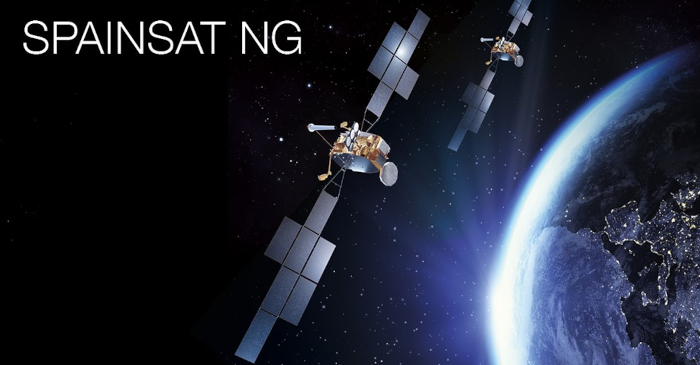
SpainSat NG I, also known as SpainSat NG-1, is a satellite built by Airbus Defence and Space under the OBJECT_ID 2025-021A. Launched on January 30, 2025, from Kennedy Space Center's LC-39A using a Falcon 9 Block 5 launch vehicle, it entered operational status shortly after. The satellite is part of the SpainSat NG constellation and its twin SpainSat NG II is expected to follow. Its mission focuses on providing secure communications for Spanish military forces and governmental agencies.
SpainSat NG I utilizes an Eurostar Neo bus configuration, with dimensions including a length of 7.2 meters, diameter of 2.7 meters, and span of 42.8 meters due to its deployable solar arrays. It has a dry mass of 5,500 kg and launched at a mass of 6,100 kg. The satellite is powered by solar arrays generating approximately 25 kW of power and equipped with PPS-5000 motors for propulsion.
The satellite's payload includes X-band, military Ka-band, and UHF communication systems, along with active antennas that can be reconfigured in orbit, an onboard digital processor enabling band crossover capabilities, and a high-speed service link for rapid reconfiguration. Its structure is made from lightweight composite materials and aluminum alloys to ensure durability in space.
SpainSat NG I operates with a three-axis stabilization system, has a silver and white color scheme, and its reflectivity results in an estimated visual magnitude of 5.5. The satellite aims to serve over two-thirds of Earth's surface for effective command and control operations, with an expected operational lifetime of 15 years. It is owned by Hisdesat Servicios Estratégicos S.A., the Spanish governmental space agency responsible for the program.
Sources include official statements from Airbus Defence and Space, Thales Alenia Space, and Hisdesat itself, among others, providing comprehensive coverage on the launch and mission objectives of SpainSat NG I.