



CelesTrak.org
An in-depth look at CelesTrak, the leading non-profit provider of orbital element sets and collision assessment tools, trusted by space professionals worldwide.



Launch Date
January 13, 2025
Launch Site
Launch Pad
LC40
Launch Vehicle
NORAD ID
62603
International Designator
2025-008S
Epoch
Sun, 19 Jul 2026 05:07:08 GMT
Apogee
Calculating...
Perigee
Calculating...
Inclination
43.00°
Right Ascension
255.63°
Eccentricity
Calculating...
Argument of Perigee
212.30°
Period
94.27 min
Mean Motion
15.28 rev/day
Latitude
Calculating...
Longitude
Calculating...
Altitude
Calculating...
Velocity
Calculating...
Name
STARLINK-32778
Alternative Name
Starlink 32778
Type
Status
Owner
SPXS
Country
United States
Constellation
N/A
Related Satellites
Major Events
N/A
1 62603U 25008S 26200.21328929 .00010982 00000+0 40770-3 0 9998
2 62603 42.9979 255.6285 0001478 212.2967 147.7795 15.27605207 85672
Source: Celestrak
Length
0.3
Diameter
4.1
Span
29
Dry Mass
700
Launch Mass
730
Shape
Box + pan
Radar Cross Section
Unknown
Visual Magnitude
Unknown
Color
Unknown
Material Composition
Unknown
Payload
Starlink Group 12-4-17
Purpose
Unknown
Mission
Unknown
Manufacturer
SPXS
Life Expectancy
Unknown
Bus
Starlink V2M
Configuration
Unknown
Motor
Unknown
Equipment
Unknown
Power System
Unknown
ADCS
Unknown
Transmitter Frequency
Unknown
Learn more about satellites and other related topics.
An in-depth look at CelesTrak, the leading non-profit provider of orbital element sets and collision assessment tools, trusted by space professionals worldwide.

Pentagon selects SpaceX and xAI for $100M autonomous drone competition. Two Falcon 9 rockets launch Starlink sats from California and Florida. 11,215 total Starlink satellites launched.
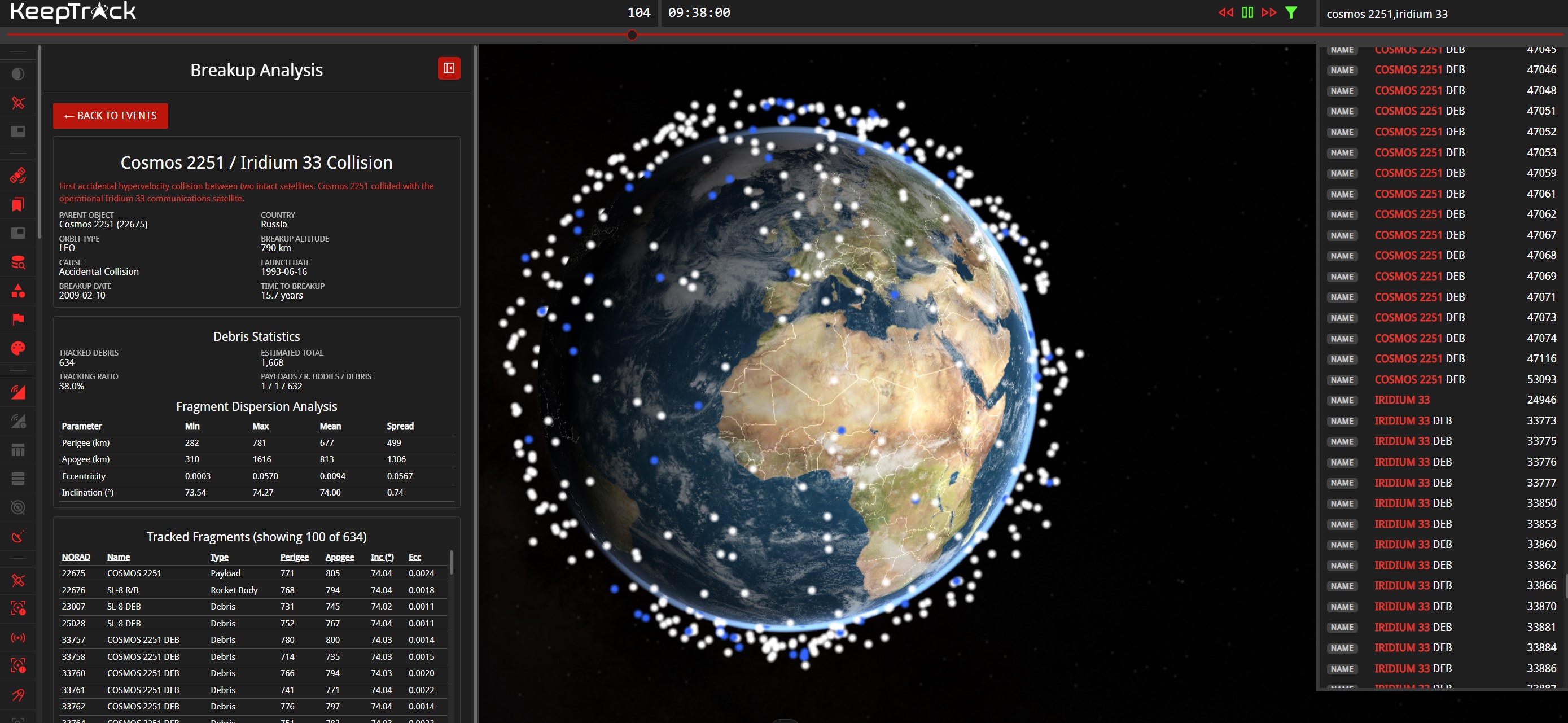
On February 10, 2009, an active Iridium communications satellite and a derelict Soviet military spacecraft slammed into each other 789 kilometers above Siberia. The collision produced more than 2,300 pieces of trackable debris that are still up there. Seventeen years later, the Iridium-Cosmos collision remains the event that made space debris a policy problem the world could no longer ignore.
Today's Space Brief explores new satellite launches, significant reentries, funding milestones, and critical policy updates.

Today's brief covers a new Space Force contract for advanced tracking systems, innovative debris removal strategies, pivotal new satellite launches, and significant updates in air quality tracking from orbit.
Varda Space's W-5 mission lands safely in Australia. Leonardo DRS wins SDA Tracking Layer Tranche 3 infrared payload contract. Senate passes $839B defense bill.

Space Force awards $3.2 billion to 12 companies for Golden Dome boost-phase missile interceptor prototypes. Initial operational capability targeted for 2028.

Blue Origin prepares for New Shepard flight, SpaceX completes second launch tower, Supreme Court ruling impacts space debris regulations, and updates on lunar habitats and NASA personnel. Plus, featuring CAPELLA-13 (ACADIA) as our Satellite of the Day.