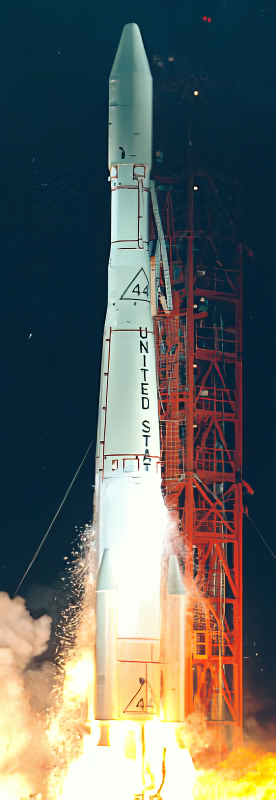
EXPLORER 33 (AIMP-D) (02258)

COSPAR: 1966-058A | Alt Name: Explorer 33

Image
EXPLORER 33 (AIMP-D) Satellite Image
Additional Sources
Launch Details

Launch Date

July 1, 1966

Launch Pad

LC17A

Launch Vehicle

Thor Delta E1

Orbital Elements

NORAD ID

02258

International Designator

1966-058A

Epoch

Wed, 12 May 1971 12:00:00 GMT

Apogee

Calculating...

Perigee

Calculating...

Inclination

24.14°

Right Ascension

173.54°

Eccentricity

Calculating...

Argument of Perigee

119.20°

Period

38792.36 min

Mean Motion

0.04 rev/day

Latitude

Calculating...

Longitude

Calculating...

Altitude

Calculating...

Velocity

Calculating...

Polar Plot
3D Visualization
Basic Satellite Info

Name

EXPLORER 33 (AIMP-D)

Alternative Name

Explorer 33

Type

Payload

Status

Unknown

Owner

GSFC

Country

United States

Constellation

N/A

Related Satellites

Major Events

N/A

Latest TLEs
1 02258U 66058A   71132.50000000  .00000700  00000+0  10000-3 0  9991
2 02258  24.1400 173.5399 2833030 119.2000  21.7899 00.03712071  1423

Source: Celestrak

Summary

Apologies, there is no summary for this satellite yet. I am working to generate these for every object in the catalog, but it is going to take time.

Physical Characteristics

Length

0.5

Diameter

0.7

Span

4.4

Dry Mass

57

Launch Mass

57

Shape

Oct Cyl + 4 Pan + 2 Ant

Radar Cross Section

0.003

Visual Magnitude

Unknown

Color

Unknown

Material Composition

Unknown

Technical Details

Payload

AIMP D

Purpose

Unknown

Mission

Unknown

Manufacturer

GSFC

Life Expectancy

Unknown

Bus

AIMP

Configuration

Unknown

Motor

Unknown

Equipment

Unknown

Power System

Unknown

ADCS

Unknown

Transmitter Frequency

Unknown

Map
This tool will help you track the satellite's position and predict its upcoming passes over your location. Simply input the coordinates or click the geolocation button to get started.
Next Pass
Azimuth Elevation Time (Local)
Start Azimuth
Max Elevation
Stop Azimuth
Time Until
Pass Duration

Satellite Articles

View All Posts »

Learn more about satellites and other related topics.

SpaceX to Launch GPS Satellite After Mission Reassigned From ULA | KeepTrack X Report

SpaceX to Launch GPS Satellite After Mission Reassigned From ULA | KeepTrack X Report

SpaceX set to launch GPS 3-9 for Space Force after strategic switch from ULA's Vulcan to Falcon 9. 25 Starlink satellites deployed to polar orbit. Musk explains SpaceX exponential growth trajectory.
Crew-11 Emergency Evacuation Raises Space Rescue Alarm | KeepTrack X Report

Crew-11 Emergency Evacuation Raises Space Rescue Alarm | KeepTrack X Report

SpaceX Crew-11 made an emergency return from the ISS on Jan. 15 after a medical crisis, spotlighting gaps in space rescue infrastructure.

X Report 15 Jul 2025

X Report 15 Jul 2025

Crew-11 launch preparations ramp up, Starship propellant production begins, and a global launch roundup highlights upcoming missions.

Space Brief 26 Apr 2025

Space Brief 26 Apr 2025

Today's brief covers major developments including the introduction of BAHA drones, increased defense spending by Estonia, and consequential announcements on military budgets impacting space-related activities.

Space Brief 13 May 2025

Space Brief 13 May 2025

China expands its classified satellite series, Space Force advances cloud-based ground station marketplaces, and the Pentagon grows its satellite network partner list. Highlighting new roles for sensor technology in tracking space debris.

X Report 16 Dec 2025

X Report 16 Dec 2025

SpaceX successfully launched its 100th Falcon 9 flight, deploying 29 Starlink satellites, while NASA plans to test SpaceX’s Starshield. Additionally, SpaceX engages in social media commentary regarding American Airlines' interest in Amazon's Starlink rival.

X Report 9 Jan 2025

X Report 9 Jan 2025

Exciting advancements from SpaceX as Starshield satellites prepare for launch, Starship Flight 7 faces a short delay, and new Starlink satellites enter orbit.

The Rocket That Refused to Sink

The Rocket That Refused to Sink

On April 18, 2014, a Falcon 9 first stage did something no orbital rocket had ever done before. It fired its engines on the way down, steered itself through the atmosphere using grid fins that did not yet exist, and touched the Atlantic Ocean softly enough to survive the impact. Nobody recovered it. The data was the whole point.