· x report · 4 min read
Starship All 6 Engines Fire for 60 Seconds Before Flight 13 | KeepTrack X Report
SpaceX ignited all 6 Starship engines for a full minute at Starbase, while a Falcon 9 added 24 more Starlinks from Vandenberg on July 1.
Latest Developments
SpaceX reached a significant pre-flight milestone this week by successfully firing all six of Starship’s engines simultaneously for a full 60 seconds at its Starbase facility in South Texas, clearing a key hurdle ahead of the vehicle’s 13th integrated test flight. The static fire marks a strong signal that Flight 13 preparations are well advanced, with engineers now analyzing engine data before committing to a launch date. Meanwhile, the Starlink constellation continues its steady expansion — with 12,414 satellites launched to date, 10,738 currently in orbit, and 10,722 actively working — following a fresh batch of 24 satellites lofted by a Falcon 9 from Vandenberg Space Force Base on July 1, 2026.
Space Safety
The Starlink conjunction environment for early July 2026 presents one HIGH risk event requiring immediate attention, alongside four MODERATE risk conjunctions and five LOW risk events. The critical conjunction involves STARLINK-35722 and the ARIANE 40 R/B on Jul 3, 2026 at 03:01 UTC with a minimum range of only 8 meters and collision probability of 1.0, representing an exceptionally dangerous close approach to non-operational debris. Concurrently, eight Starlink satellites are predicted to reenter Earth’s atmosphere between Jul 2-4, 2026, with decay windows ranging from 44 to 840 minutes, distributed across southern and equatorial ground tracks.
| Risk | Starlink Sat | Other Object | Status | Min Range (km) | Rel Speed (km/s) | Max Prob | Time of Closest Approach |
|---|---|---|---|---|---|---|---|
| HIGH | STARLINK-35722 | ARIANE 40 R/B | Non-operational | 0.008 | 13.803 | 1.0000 | Jul 3, 03:01 UTC |
| MODERATE | STARLINK-30463 | STARLINK-30468 | Partially Operational | 0.021 | 1.243 | 0.4531 | Jul 5, 11:01 UTC |
| MODERATE | STARLINK-30331 | FENGYUN 1C DEB | Non-operational | 0.014 | 9.578 | 0.3355 | Jul 2, 23:18 UTC |
| MODERATE | STARLINK-5106 | STARLINK-32786 | Operational | 0.049 | 6.927 | 0.1327 | Jul 5, 08:43 UTC |
| MODERATE | STARLINK-1477 | FLOCK 4H-13 | Partially Operational | 0.024 | 13.690 | 0.1126 | Jul 5, 18:38 UTC |
| LOW | STARLINK-32640 | FENGYUN 1C DEB | Non-operational | 0.030 | 13.773 | 0.0741 | Jul 2, 20:17 UTC |
| LOW | STARLINK-36211 | SL-14 R/B | Non-operational | 0.044 | 0.786 | 0.0723 | Jul 3, 15:26 UTC |
| LOW | STARLINK-3694 | HST | Operational | 0.085 | 8.476 | 0.0717 | Jul 3, 01:26 UTC |
| LOW | STARLINK-6211 | STARLINK-36396 | Operational | 0.066 | 10.175 | 0.0716 | Jul 1, 17:00 UTC |
| LOW | STARLINK-6312 | NESS | Operational | 0.040 | 7.828 | 0.0646 | Jul 1, 21:49 UTC |
| Satellite | NORAD ID | Predicted Decay | Window (min) | Inclination | Lat | Lon |
|---|---|---|---|---|---|---|
| STARLINK-4681 | 53594 | Jul 2, 23:45 UTC | 44 | 53.2° | -52.5° | 23.7° |
| STARLINK-2021 | 47604 | Jul 3, 00:17 UTC | 240 | 53.0° | -49.7° | 73.0° |
| STARLINK-5875 | 57221 | Jul 3, 03:31 UTC | 300 | 43.0° | -33.7° | 60.8° |
| STARLINK-2093 | 47374 | Jul 3, 10:28 UTC | 120 | 53.0° | -11.0° | 293.2° |
| STARLINK-1741 | 46567 | Jul 3, 18:07 UTC | 240 | 53.0° | -43.8° | 16.4° |
| STARLINK-1997 | 47592 | Jul 3, 22:03 UTC | 540 | 53.0° | -45.8° | 113.1° |
| STARLINK-1667 | 46155 | Jul 4, 08:18 UTC | 840 | 53.0° | 46.4° | 79.8° |
| STARLINK-4693 | 53605 | Jul 4, 18:06 UTC | 840 | 53.2° | -6.6° | 196.3° |
Detailed Coverage
Starship Flight 13 Gets Green Light Signal as All 6 Engines Roar for 60 Seconds
SpaceX conducted a full six-engine static fire of the Starship upper stage at its Boca Chica, Texas facility, sustaining ignition for approximately one minute — the kind of endurance test that directly precedes an integrated flight attempt. The test validates the health of the Raptor engine cluster and the vehicle’s propellant management systems under near-flight conditions, giving the SpaceX team the data needed to press toward Flight 13 with confidence.
The milestone is particularly notable given that previous flights have refined the vehicle’s reusability architecture significantly, including the mechanical catch system for the Super Heavy booster. With a successful full-duration engine fire now on the books, all eyes turn to Starbase for a launch window announcement, as Flight 13 is expected to push the boundaries of Starship’s operational profile even further.
Read the full story: Space.com
Falcon 9 Adds 24 Starlinks to Growing Constellation in July 1 Vandenberg Launch
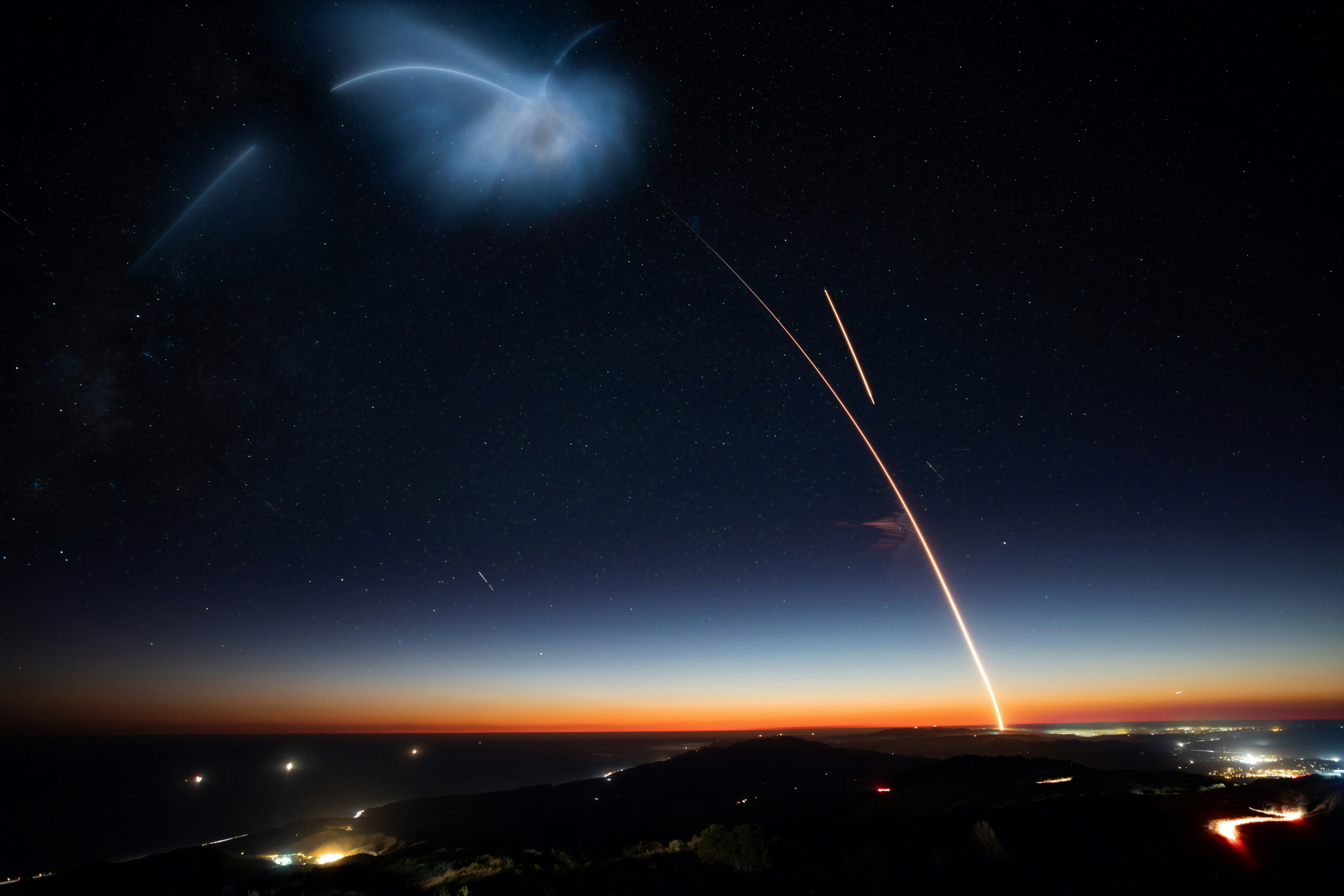
A SpaceX Falcon 9 rocket lifted off from Vandenberg Space Force Base in California on Wednesday, July 1, 2026, delivering 24 Starlink satellites to low Earth orbit and continuing the relentless cadence of constellation-building missions that has defined SpaceX’s launch schedule in 2026. The booster, B1100, completed another successful flight and landing, further demonstrating the mature reusability of the Falcon 9 first stage. The 24 newly deployed satellites are expected to complete orbital raising maneuvers over coming days before being tracked as operational nodes in the constellation.
With 10,722 satellites currently working and 10,738 in orbit, each incremental launch tightens coverage density and improves service redundancy across Starlink’s global user base. Satellite trackers monitoring the deployment can expect to observe the fresh stack in a low-altitude phasing orbit before the spacecraft fan out to their operational shells — a predictable and well-documented pattern now familiar to observers worldwide.
Read the full story: Space.com
Constellation Status
The Starlink constellation remained unchanged since the last check, maintaining a total of 12,414 launched satellites with 10,738 currently in orbit and 10,722 operational, while 1,676 satellites have decayed from orbit.
- Total Launched: 12414
- Total On Orbit: 10738
- Total Working: 10722
Track Starlink satellites in real-time: Track Starlink
B1049