· x report · 6 min read
Musk Denies SpaceX AI Phone Report; EchoStar Bankruptcy | KeepTrack X Report
SpaceX hits 77 Falcon 9 launches in 2026 as EchoStar subsidiaries file Chapter 11 and Musk disputes WSJ AI phone claims.

Latest Developments
Elon Musk publicly denied a Wall Street Journal report claiming SpaceX demonstrated an AI-powered phone prototype to investors ahead of its record-breaking IPO, calling the story “utterly false” — injecting fresh controversy into an already closely watched post-listing period. Meanwhile, EchoStar’s satellite TV and 5G wireless subsidiaries filed for Chapter 11 bankruptcy protection, a direct consequence of selling off spectrum assets to SpaceX and AT&T, reshaping the competitive landscape for satellite-based connectivity. On the launch front, SpaceX continued its relentless cadence, executing the Starlink 17-46 mission from Vandenberg Space Force Base on Tuesday — the 77th Falcon 9 flight of 2026 — adding 24 more satellites to a constellation now numbering 10,703 operational craft out of 10,719 in orbit across 12,390 total launched. Wall Street is also taking notice of the newly public company, with Wedbush Securities initiating coverage and signaling bullish long-term sentiment.
Space Safety
Current Starlink conjunction and reentry activity presents a mixed threat picture with one HIGH-risk event requiring immediate monitoring. The HIGH-risk conjunction involves STARLINK-35722 and the inert ARIANE 40 R/B on Jul 3, 2026 at 03:01 UTC, with a minimum range of just 8 meters—well below safe separation thresholds. Beyond this critical event, four MODERATE-risk conjunctions are identified involving Starlink satellites with other operational or partially-operational objects, while thirteen Starlink satellites are predicted to reenter between Jul 1-4, 2026, with decay windows ranging from 1 to 840 minutes.
| Risk | Starlink Sat | Other Object | Status | Min Range (km) | Rel Speed (km/s) | Max Prob | Time of Closest Approach |
|---|---|---|---|---|---|---|---|
| HIGH | STARLINK-35722 | ARIANE 40 R/B | Non-operational | 0.008 | 13.803 | 1.0000 | Jul 3, 03:01 UTC |
| MODERATE | STARLINK-30463 | STARLINK-30468 | Partially Operational | 0.021 | 1.243 | 0.4531 | Jul 5, 11:01 UTC |
| MODERATE | STARLINK-30331 | FENGYUN 1C DEB | Non-operational | 0.014 | 9.578 | 0.3355 | Jul 2, 23:18 UTC |
| MODERATE | STARLINK-5106 | STARLINK-32786 | Operational | 0.049 | 6.927 | 0.1327 | Jul 5, 08:43 UTC |
| MODERATE | STARLINK-1477 | FLOCK 4H-13 | Partially Operational | 0.024 | 13.690 | 0.1126 | Jul 5, 18:38 UTC |
| LOW | STARLINK-32640 | FENGYUN 1C DEB | Non-operational | 0.030 | 13.773 | 0.0741 | Jul 2, 20:17 UTC |
| LOW | STARLINK-36211 | SL-14 R/B | Non-operational | 0.044 | 0.786 | 0.0723 | Jul 3, 15:26 UTC |
| LOW | STARLINK-3694 | HST | Operational | 0.085 | 8.476 | 0.0717 | Jul 3, 01:26 UTC |
| LOW | STARLINK-6211 | STARLINK-36396 | Operational | 0.066 | 10.175 | 0.0716 | Jul 1, 17:00 UTC |
| LOW | STARLINK-6312 | NESS | Operational | 0.040 | 7.828 | 0.0646 | Jul 1, 21:49 UTC |
| Satellite | NORAD ID | Predicted Decay | Window (min) | Inclination | Lat | Lon |
|---|---|---|---|---|---|---|
| STARLINK-4679 | 53782 | Jul 1, 19:38 UTC | 1 | 53.2° | -50.1° | 107.6° |
| STARLINK-1663 | 46535 | Jul 2, 00:12 UTC | 120 | 53.0° | -28.6° | 334.1° |
| STARLINK-3858 | 52553 | Jul 2, 01:26 UTC | 60 | 53.2° | 24.5° | 165.6° |
| STARLINK-5034 | 53888 | Jul 2, 03:14 UTC | 60 | 53.2° | -4.0° | 337.9° |
| STARLINK-4498 | 53434 | Jul 2, 15:29 UTC | 300 | 53.2° | 31.6° | 265.9° |
| STARLINK-5875 | 57221 | Jul 2, 16:57 UTC | 480 | 43.0° | -30.2° | 126.6° |
| STARLINK-4681 | 53594 | Jul 3, 00:14 UTC | 300 | 53.2° | 14.7° | 131.3° |
| STARLINK-2021 | 47604 | Jul 3, 00:17 UTC | 240 | 53.0° | -49.7° | 73.0° |
| STARLINK-2093 | 47374 | Jul 3, 19:39 UTC | 540 | 53.0° | -50.9° | 257.4° |
| STARLINK-1997 | 47592 | Jul 3, 22:03 UTC | 540 | 53.0° | -45.8° | 113.1° |
| STARLINK-1741 | 46567 | Jul 4, 06:03 UTC | 780 | 53.0° | -17.2° | 226.8° |
| STARLINK-1667 | 46155 | Jul 4, 08:18 UTC | 840 | 53.0° | 46.4° | 79.8° |
| STARLINK-4693 | 53605 | Jul 4, 18:06 UTC | 840 | 53.2° | -6.6° | 196.3° |
Detailed Coverage
Musk Flatly Denies WSJ Report of SpaceX AI Phone Prototype
A Wall Street Journal report published Wednesday alleged that SpaceX showed a “handset-like prototype” — thinner than an iPhone and running a Qualcomm Snapdragon chip — to select investors prior to its IPO, with claims the device would feature an AI-enabled operating system powered by Musk-owned xAI. Elon Musk swiftly rejected the account as “utterly false,” though the denial came amid a separate Financial Times report that SpaceX COO Gwynne Shotwell had told investors the company is exploring mobile hardware.
The dispute arrives at a sensitive moment for the newly public SpaceX, where investor expectations are high and any product roadmap signals carry significant market weight. Whether a device exists in any form remains unconfirmed, but the public back-and-forth between Musk and major financial press is itself a story worth watching as SPCX shares find their early trading footing.
Read the full story: The Verge
EchoStar Subsidiaries File Chapter 11 as Spectrum Deal With SpaceX Reshapes Industry
EchoStar’s satellite TV and abandoned 5G wireless subsidiaries have filed for Chapter 11 bankruptcy protection under a prepackaged restructuring plan, a move designed to retire debt following the sale of spectrum assets to SpaceX and AT&T. The bankruptcy marks the practical end of EchoStar’s ambitions as a terrestrial wireless competitor, and transfers valuable mid-band spectrum into the hands of two companies with very different — but equally aggressive — connectivity visions.
For Starlink watchers, the spectrum acquisition is particularly notable. SpaceX’s growing direct-to-device ambitions depend heavily on licensed spectrum access, and securing former EchoStar holdings could accelerate Starlink’s ability to offer true mobile broadband without relying solely on its satellite constellation’s inter-beam handoffs. The restructuring is expected to advance quickly given its prepackaged nature.
Read the full story: SpaceNews
Starlink 17-46 Mission Marks 77th Falcon 9 Launch of 2026
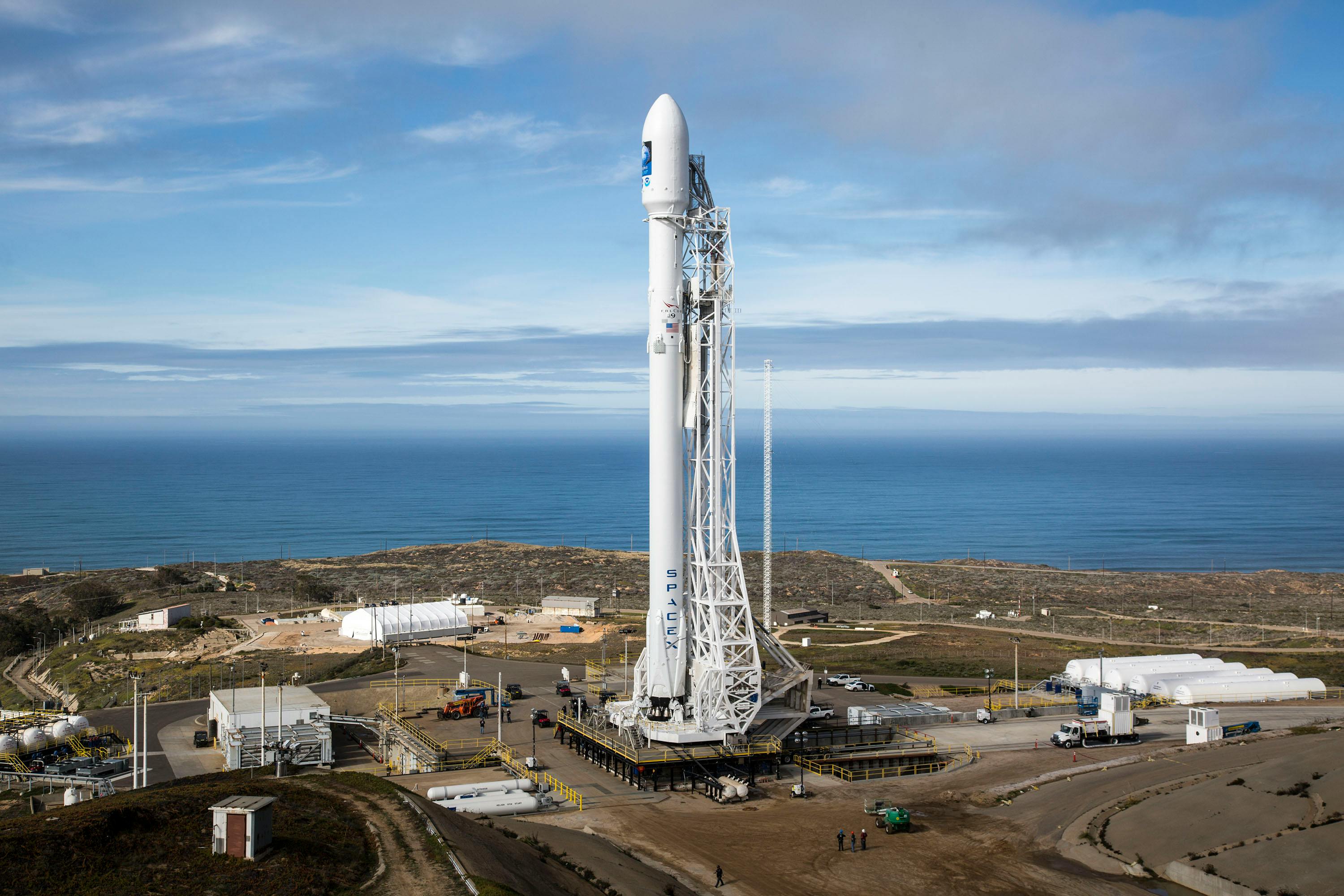
SpaceX launched 24 Starlink satellites aboard a Falcon 9 rocket from Space Launch Complex 4E at Vandenberg Space Force Base on July 1st, lifting off at 7:58 p.m. PDT. The mission, designated Starlink 17-46, was the 77th Falcon 9 launch of the year, underscoring the program’s extraordinary operational tempo as it sustains constellation growth and replenishment simultaneously.
The freshly deployed satellites will enter their phasing orbits before raising to operational altitude, joining a constellation tracking at 10,703 working satellites. Ground observers and tracking platforms like KeepTrack can typically resolve the deployment string within hours of separation, with objects appearing as a compact line of closely spaced targets before gradually dispersing across their orbital plane.
Read the full story: Spaceflight Now
Wedbush Initiates SpaceX Coverage — Tesla’s Bull Takes Aim at the Stars
Wedbush Securities analyst Dan Ives, best known as one of Tesla’s most persistent institutional bulls, has initiated coverage of SpaceX shares (NASDAQ: SPCX), marking one of the first formal Wall Street notes on the company since it began trading publicly weeks ago. The initiation signals that major brokerages are now treating SpaceX as a legitimate equity coverage target rather than a private market curiosity.
Ives’ bullish track record on Musk ventures will generate attention, though SpaceX’s fundamentals differ substantially from Tesla’s — built on recurring launch contracts, Starlink subscription revenue, and expanding government partnerships rather than vehicle sales cycles. How analysts model the constellation’s subscriber growth and launch economics will set the tone for institutional sentiment in the months ahead.
Read the full story: Teslarati
The SpaceX IPO’s Deeper Signal: What the Listing Really Means for the Industry
Beyond the valuation headlines and personality coverage that dominated SpaceX’s public listing, SpaceNews argues the more consequential story is what the IPO reveals about the structural maturation of the commercial space industry. A company built on reusable rockets and satellite internet now trades alongside legacy aerospace primes — a shift that would have seemed implausible a decade ago.
The piece highlights that SpaceX’s public listing creates a new financial benchmark against which every other launch provider, satellite operator, and in-space services firm will now be measured. For a sector long dependent on government contracts and patient private capital, the arrival of a liquid, publicly traded SpaceX changes the competitive and capital dynamics in ways that will take years to fully resolve.
Read the full story: SpaceNews
Constellation Status
No changes have occurred in the Starlink constellation since the last check. The constellation maintains 12,390 total satellites launched, with 10,719 currently in orbit, 10,703 operational, and 1,671 that have decayed.
- Total Launched: 12390
- Total On Orbit: 10719
- Total Working: 10703
Track Starlink satellites in real-time: Track Starlink
B1049