Latest Developments
SpaceX’s post-IPO era is already reshaping the commercial space landscape: the company has agreed to acquire AI coding platform Cursor in an all-stock deal valued at $60 billion, its first major corporate acquisition since debuting on the Nasdaq and minting Elon Musk as the world’s first trillionaire. On the launch front, a Falcon 9 lifted off from Cape Canaveral’s Pad 40 in the early hours of June 17, delivering three Block 2 BlueBird direct-to-cell satellites for AST SpaceMobile — the largest and most capable iteration yet of the constellation that aims to bring broadband connectivity directly to unmodified smartphones. Meanwhile, the Dragon CRS-34 cargo capsule undocked from the International Space Station on June 16, beginning its 20-hour return journey to Earth with a haul of science experiments and hardware. With 10,655 working Starlink satellites currently on-orbit out of 10,671 in the operational shell, SpaceX continues to run the most capable broadband megaconstellation in history even as its corporate ambitions expand dramatically beyond connectivity.
Space Safety
The current Starlink conjunction picture presents a manageable but evolving threat landscape, with two MODERATE risk events identified in early-to-mid June 2026 and no HIGH risk conjunctions at present. The most significant conjunction involves STARLINK-30526 and STARLINK-35247 on Jun 10 at 18:10 UTC with a 30.26% collision probability and minimum range of only 0.029 km, followed by STARLINK-1133 approaching STARLINK-34975 on Jun 7 with a 10.47% probability. Meanwhile, reentry tracking shows one Starlink asset (STARLINK-1815) predicted to decay in mid-June 2026 with a 480-minute uncertainty window, which will reduce the active constellation by one unit.
| Risk | Starlink Sat | Other Object | Status | Min Range (km) | Rel Speed (km/s) | Max Prob | Time of Closest Approach |
|---|---|---|---|---|---|---|---|
| MODERATE | STARLINK-30526 | STARLINK-35247 | Operational | 0.029 | 1.352 | 30.26% | Jun 10, 18:10 UTC |
| MODERATE | STARLINK-1133 | STARLINK-34975 | Operational | 0.054 | 9.686 | 10.47% | Jun 7, 16:23 UTC |
| LOW | STARLINK-30585 | FALCONSAT-6 | Operational | 0.034 | 7.762 | 8.64% | Jun 13, 01:24 UTC |
| LOW | STARLINK-3060 | COSMOS 2221 | Unknown | 0.027 | 14.628 | 7.52% | Jun 9, 06:53 UTC |
| LOW | STARLINK-6263 | FLOCK 4G-7 | Operational | 0.029 | 14.277 | 7.43% | Jun 11, 23:42 UTC |
| LOW | STARLINK-30385 | ELECTRON KICK STAGE R/B | Non-operational | 0.031 | 13.435 | 7.40% | Jun 11, 04:00 UTC |
| LOW | STARLINK-36171 | COSMOS 1275 DEB | Non-operational | 0.036 | 11.423 | 6.59% | Jun 11, 08:28 UTC |
| LOW | STARLINK-36648 | QMR-KWT-2 (RS95S) | Operational | 0.037 | 12.875 | 5.54% | Jun 8, 05:44 UTC |
| LOW | STARLINK-1262 | STARLINK-35484 | Operational | 0.085 | 0.077 | 5.51% | Jun 9, 13:02 UTC |
| LOW | STARLINK-35892 | YAOGAN-35 01A | Operational | 0.049 | 3.857 | 4.92% | Jun 9, 13:34 UTC |
| Satellite | NORAD ID | Predicted Decay | Window (min) | Inclination | Lat | Lon |
|---|---|---|---|---|---|---|
| STARLINK-1815 | 46713 | Jun 17, 18:21 UTC | 480 | 53° | -9.4° | 228.9° |
Detailed Coverage
SpaceX Pulls Off $60 Billion Cursor AI Acquisition — Its First Since Going Public
Less than weeks after its Nasdaq debut, SpaceX has signed an all-stock agreement to acquire Anysphere, Inc. — the company behind the popular AI coding assistant Cursor — in a deal worth $60 billion. The transaction marks a bold pivot: SpaceX is no longer just a launch provider and satellite operator but is now positioning itself as a vertically integrated AI powerhouse, directly challenging the likes of Anthropic and OpenAI. The two companies had been collaborating closely for months prior to the announcement, with Cursor’s tools reportedly already embedded in SpaceX engineering workflows.
The strategic logic is compelling on paper. SpaceX generates enormous volumes of proprietary engineering data across Starship development, Falcon 9 operations, and Starlink network management — data that a purpose-built AI coding platform could leverage in ways no general-purpose model can. Whether regulators will scrutinize a newly-public aerospace giant absorbing a $60 billion software firm remains an open question, but the deal signals that the SpaceX IPO was not an endpoint — it was a launchpad.
Read the full story: Ars Technica
SpaceX IPO Crowns Musk World’s First Trillionaire as Starship Towers Over NYC
The spectacle of SpaceX’s Nasdaq IPO reached its cultural peak when a Starship vehicle was positioned prominently in New York City to mark the occasion, producing what may be the most striking image of the commercial space age to date. The listing pushed Elon Musk’s net worth past the $1 trillion threshold, making him the first individual in recorded history to reach that milestone — a figure that would have seemed satirical even five years ago.
For the satellite tracking community, the IPO carries real implications: a publicly traded SpaceX will face quarterly disclosure pressures that could force greater transparency around Starlink constellation health, collision avoidance maneuver rates, and deorbit timelines — data that operators and researchers have long sought. Whether that transparency materializes remains to be seen, but the capital markets now have a direct stake in how well SpaceX manages 10,655 active satellites threading through an increasingly crowded low Earth orbit.
Read the full story: Space.com
Falcon 9 Delivers Three Giant Block 2 BlueBird Satellites in AST SpaceMobile’s Boldest Launch Yet
A Falcon 9 rocket lifted off from Space Launch Complex 40 at Cape Canaveral Space Force Station at 2:39 a.m. EDT on June 17, carrying three Block 2 BlueBird satellites for AST SpaceMobile. The mission marks the third time SpaceX has launched hardware for AST and the first deployment of the upgraded Block 2 design, which features significantly larger phased-array antennas capable of delivering higher throughput directly to standard, unmodified smartphones — no specialized hardware required on the ground.
Block 2 represents a meaningful jump over the earlier BlueBird generation, and tracking these objects post-deployment will be of particular interest to the conjunction assessment community given their substantial physical size. AST SpaceMobile’s satellites are among the largest commercial objects in low Earth orbit by cross-sectional area, and their orbital insertion parameters will be closely watched as the constellation expands. SpaceX’s consistent role as launch partner underscores how tightly the commercial direct-to-cell sector is intertwined with Falcon 9 cadence.
Read the full story: Spaceflight Now
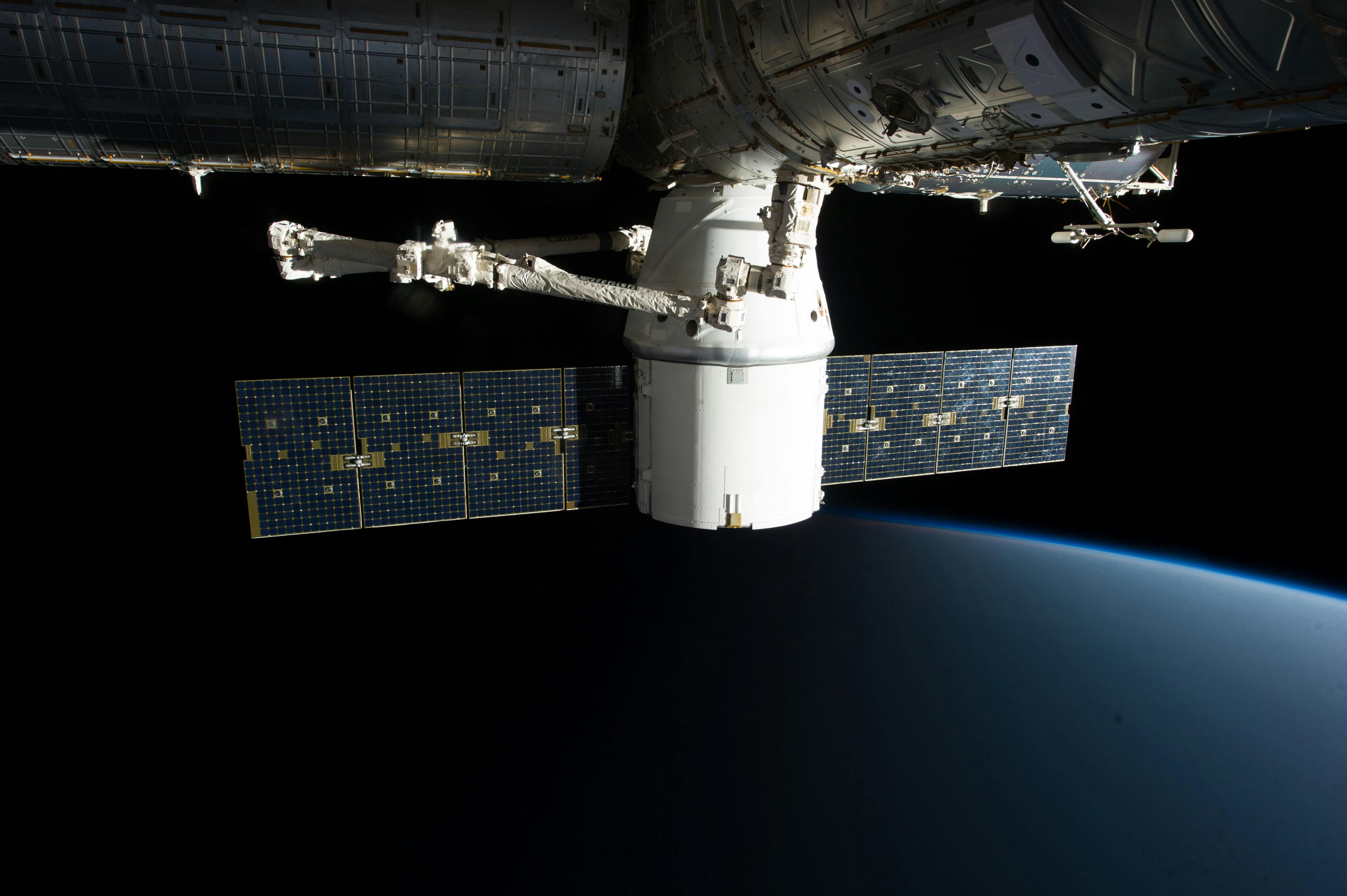
Dragon CRS-34 Undocks from ISS, Begins 20-Hour Journey Home
The SpaceX Dragon cargo capsule serving the CRS-34 mission undocked from the International Space Station on June 16, closing out another successful resupply rotation and beginning the roughly 20-hour deorbit sequence that will culminate in a splashdown off the U.S. coast. The capsule is returning a complement of completed science experiments, biological samples, and hardware for refurbishment — the routine but essential logistics work that keeps the ISS program operational.
CRS-34’s departure also serves as a reminder of Dragon’s unmatched reliability in the cargo resupply role: the vehicle has now logged dozens of successful ISS missions across both the original Dragon 1 and pressurized Dragon 2 configurations. From a tracking perspective, the undocked capsule’s precisely computed deorbit burn and reentry corridor represent one of the more predictable — and well-monitored — reentry events in the commercial sector.
Read the full story: Space.com
Constellation Status
The Starlink constellation remained stable since the last check, with no new launches or orbital adjustments recorded. The constellation currently comprises 12,318 total satellites launched, of which 10,671 remain in orbit and 10,655 are operational, while 1,647 have decayed from their orbits.
- Total Launched: 12318
- Total On Orbit: 10671
- Total Working: 10655
Track Starlink satellites in real-time: Track Starlink