Latest Developments
SpaceX made history on June 12, 2026, debuting on the Nasdaq under ticker symbol SPCX at $135 per share and raising a record $75 billion — the largest IPO ever — while shares surged nearly 20% on the first day of trading to push the company’s valuation to $1.77 trillion. The offering simultaneously made Elon Musk the world’s first trillionaire, with his 4.8 billion SPCX shares alone vaulting his net worth well past the $1 trillion threshold. In a characteristically SpaceX fashion, the company didn’t just launch a stock on IPO day — it also launched 29 Starlink satellites from Cape Canaveral at 8:27 a.m. ET, roughly an hour before trading began. With 12,294 Starlink satellites launched to date and 10,636 currently operational, the constellation underpins the revenue case that convinced public markets to assign SpaceX a valuation larger than the economies of most nations.
Space Safety
The current Starlink conjunction threat picture shows two MODERATE risk events over the next four days, with the highest concern being a Jun 10, 18:10 UTC pass between STARLINK-30526 and STARLINK-35247 carrying a 30.26% collision probability. Meanwhile, reentry predictions indicate eight Starlink satellites scheduled for decay between Jun 13-16, 2026, with prediction windows ranging from 10 to 19 hours; none are flagged as high-interest objects, though the concentrated reentry period warrants continued monitoring of orbital decay rates and atmospheric density forecasts.
| Risk | Starlink Sat | Other Object | Status | Min Range (km) | Rel Speed (km/s) | Max Prob | Time of Closest Approach |
|---|---|---|---|---|---|---|---|
| MODERATE | STARLINK-30526 | STARLINK-35247 | Operational | 0.029 | 1.352 | 30.26% | Jun 10, 18:10 UTC |
| MODERATE | STARLINK-1133 | STARLINK-34975 | Operational | 0.054 | 9.686 | 10.47% | Jun 7, 16:23 UTC |
| LOW | STARLINK-30585 | FALCONSAT-6 | Operational | 0.034 | 7.762 | 8.64% | Jun 13, 01:24 UTC |
| LOW | STARLINK-3060 | COSMOS 2221 | Unknown | 0.027 | 14.628 | 7.52% | Jun 9, 06:53 UTC |
| LOW | STARLINK-6263 | FLOCK 4G-7 | Operational | 0.029 | 14.277 | 7.43% | Jun 11, 23:42 UTC |
| LOW | STARLINK-30385 | ELECTRON KICK STAGE R/B | Non-operational | 0.031 | 13.435 | 7.40% | Jun 11, 04:00 UTC |
| LOW | STARLINK-36171 | COSMOS 1275 DEB | Non-operational | 0.036 | 11.423 | 6.59% | Jun 11, 08:28 UTC |
| LOW | STARLINK-36648 | QMR-KWT-2 (RS95S) | Operational | 0.037 | 12.875 | 5.54% | Jun 8, 05:44 UTC |
| LOW | STARLINK-1262 | STARLINK-35484 | Operational | 0.085 | 0.077 | 5.51% | Jun 9, 13:02 UTC |
| LOW | STARLINK-35892 | YAOGAN-35 01A | Operational | 0.049 | 3.857 | 4.92% | Jun 9, 13:34 UTC |
| Satellite | NORAD ID | Predicted Decay | Window (min) | Inclination | Lat | Lon |
|---|---|---|---|---|---|---|
| STARLINK-3004 | 48880 | Jun 13, 04:52 UTC | 1140 | 97.7° | -82.2° | 67° |
| STARLINK-3729 | 52135 | Jun 13, 21:43 UTC | 1020 | 53.2° | 45.7° | 234.1° |
| STARLINK-1795 | 46696 | Jun 14, 09:36 UTC | 600 | 53.0° | 52.1° | 113.2° |
| STARLINK-2114 | 47393 | Jun 14, 18:26 UTC | 1140 | 53.0° | -42.7° | 352.8° |
| STARLINK-1736 | 46585 | Jun 15, 17:51 UTC | 1080 | 53.0° | 53° | 256.2° |
| STARLINK-1494 | 45760 | Jun 15, 19:51 UTC | 1080 | 53.0° | 48.9° | 230.4° |
| STARLINK-1764 | 46343 | Jun 16, 02:06 UTC | 1140 | 53.0° | -29.9° | 220.3° |
| STARLINK-1654 | 46326 | Jun 16, 13:57 UTC | 1020 | 53.0° | 48.7° | 201.6° |
Detailed Coverage
SpaceX’s $75 Billion IPO Is the Largest in History — And It’s Priced on AI Promises
SpaceX priced its IPO at $135 per share on June 12, raising $75 billion in what immediately became the biggest public offering ever recorded. The combined entity — folding together SpaceX’s rocket business, Starlink, xAI infrastructure, and social media platforms — opened trading on Nasdaq under SPCX and quickly climbed, closing the day up nearly 20%. The S-1 filing framed the company’s mission in sweeping terms: “building the systems and technologies necessary to make life multiplanetary,” but analysts note the IPO is structurally a bet on orbital AI data centers rather than traditional launch revenue. Elon Musk retains approximately 85% of voting control, meaning public shareholders are buying exposure to his vision with limited governance leverage.
Read the full story: The Verge
Elon Musk Becomes the World’s First Trillionaire as SPCX Opens
When SPCX shares opened at $150 and held above the $138 threshold needed to cross the milestone, Elon Musk’s net worth officially surpassed $1 trillion — a figure with no precedent in recorded economic history. His SpaceX stake alone accounts for a substantial portion of that wealth, compounding on top of his Tesla holdings and other assets that were already near $800 billion before the IPO. The scale defies easy comprehension: a trillion seconds stretches back roughly 31,700 years to the Paleolithic era. The concentration of that wealth in a single individual who simultaneously controls launch infrastructure, satellite internet, AI compute, and social media platforms is already drawing scrutiny from economists and regulators watching the IPO’s aftermath.
Read the full story: The Verge
IPO Day Didn’t Stop SpaceX From Launching 29 Starlink Satellites
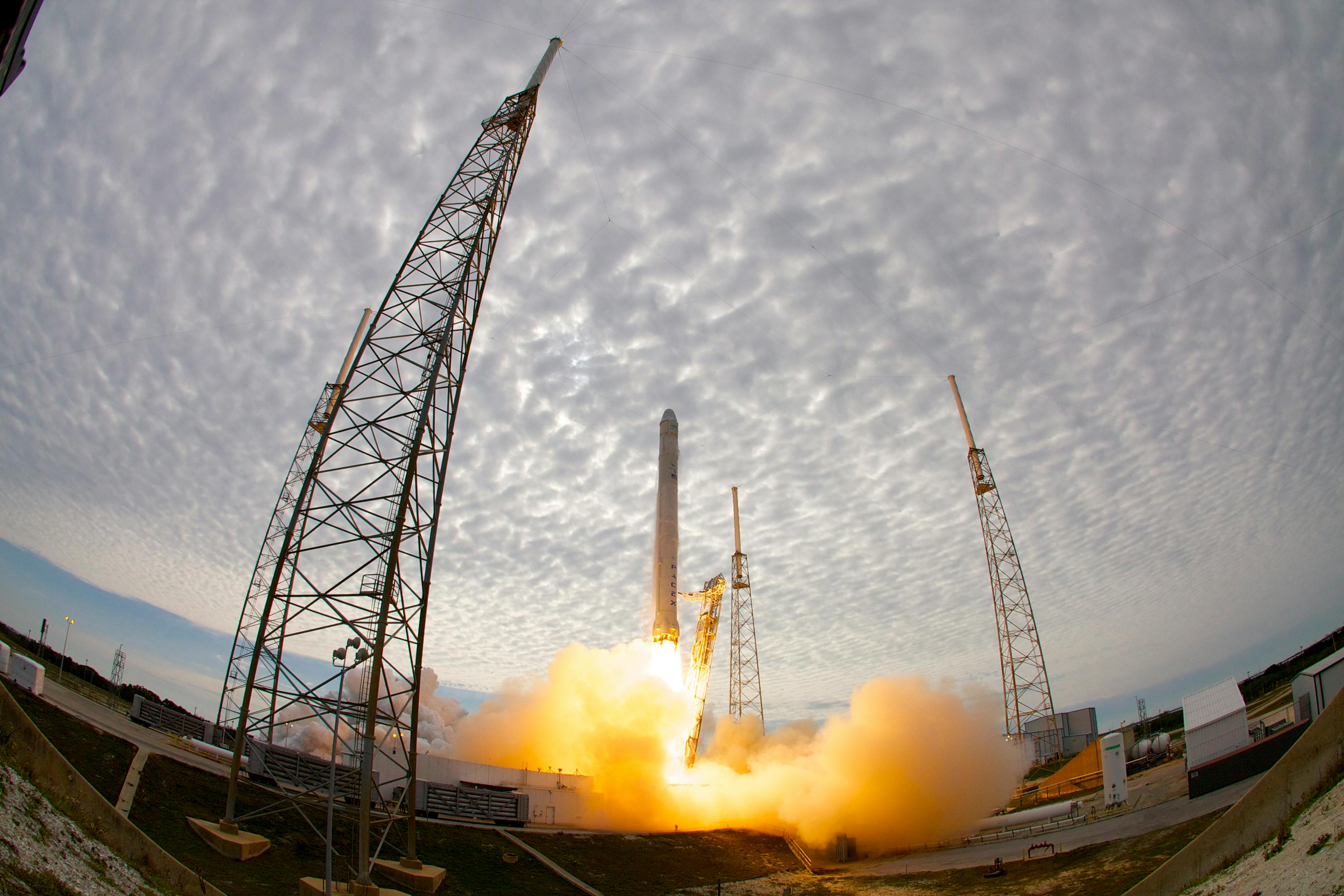
While bankers and traders watched SPCX tick upward on the Nasdaq, a Falcon 9 booster — B1080 — lifted off from Pad 40 at Cape Canaveral Space Force Station at 8:27 a.m. ET carrying 29 Starlink satellites on the Starlink 10-54 mission. Liftoff came roughly 70 minutes before SpaceX’s stock began trading, a symbolic demonstration that the company’s operational tempo doesn’t pause for financial milestones. The mission adds to a constellation now numbering 10,636 working satellites in orbit, each one a revenue-generating node in the broadband network that forms the financial backbone of the newly public company.
Read the full story: Space.com
Astronomers Raise Alarm Over SpaceX’s Planned Orbital Data Centers
Even as the IPO celebration unfolded, astronomers escalated warnings about SpaceX’s next major infrastructure push: orbital data centers that the company plans to begin launching as early as 2027. Unlike Starlink satellites, which primarily reflect sunlight, data center spacecraft would carry active thermal and radio-frequency signatures that researchers say could seriously degrade ground-based optical and radio observations. The concern is compounded by scale — if orbital data centers follow the same deployment cadence as Starlink, the cumulative interference could affect observatories worldwide. Astronomers are calling for binding brightness and radio-frequency limits before any launches occur, arguing that voluntary mitigation measures have proven insufficient with the existing Starlink constellation.
Read the full story: SpaceNews
What Going Public Actually Means for SpaceX’s Future
Ars Technica offers a measured counterpoint to the IPO euphoria: SpaceX now answers to public shareholders who expect returns, and the tension between Musk’s long-term multiplanetary mission and quarterly earnings pressure is no longer theoretical. The company’s valuation is built almost entirely on projections for orbital AI compute revenue — a business line that doesn’t yet exist at commercial scale — rather than on Starlink’s current cash flows or Falcon 9 launch contracts. Analysts note that while Musk’s voting control insulates management from hostile shareholder pressure, debt covenants, regulatory scrutiny, and market sentiment will impose new disciplines that the private SpaceX never faced. The space industry, long accustomed to SpaceX operating as a fast-moving private company, is adjusting to a new reality where every mission, anomaly, and contract award becomes a market-moving event.
Read the full story: Ars Technica
SpaceX Secures $4 Billion Golden Dome Missile-Tracking Satellite Contract
Buried within the IPO news cycle, SpaceX confirmed a $4 billion contract to build missile-tracking satellites for the U.S. government’s Golden Dome defense architecture. The award significantly expands SpaceX’s national security satellite portfolio beyond its existing Starshield agreements and positions the company as a primary sensor-layer provider for next-generation missile defense. From a satellite tracking perspective, Golden Dome spacecraft will join an already crowded low Earth orbit environment where SpaceX assets — Starlink, Starshield, and now Golden Dome — constitute an increasingly dominant share of active objects. The contract reinforces the investment thesis embedded in the IPO: that SpaceX’s value lies not just in launch or broadband, but in becoming foundational infrastructure for both commercial AI and sovereign defense networks.
Read the full story: The Verge
The Space Industry Recalibrates Around a $1.77 Trillion Public Competitor
Space.com’s analysis frames the SpaceX IPO as a structural inflection point for the broader industry — one that will reshape how competitors raise capital, how launch contracts are valued, and how governments negotiate with commercial providers. A publicly traded SpaceX with a $1.77 trillion market cap dwarfs every other space company combined, creating a gravitational pull on talent, investment, and regulatory attention that smaller operators will struggle to escape. For satellite trackers and conjunction analysts, the concern is more immediate: a company of this scale, with the resources of a public offering behind it, can accelerate constellation growth faster than debris mitigation frameworks can adapt. The IPO doesn’t just mark SpaceX’s past success — it funds whatever comes next, at a velocity the industry has never seen.
Read the full story: Space.com
Constellation Status
The Starlink constellation has remained stable since the last check, with no new launches or orbital changes reported. As of June 12, 2026, SpaceX maintains 12,294 total satellites launched, of which 10,652 remain in orbit and 10,636 are operational, while 1,642 have decayed from their orbits.
- Total Launched: 12294
- Total On Orbit: 10652
- Total Working: 10636
Track Starlink satellites in real-time: Track Starlink