Latest Developments
SpaceX is signaling a generational shift in its launch operations, with Vandenberg Space Force Base positioned to become the company’s highest-tempo site even as the legendary Falcon 9 — the world’s most successful rocket by any measure — begins its gradual step back from center stage. The transition underscores how rapidly SpaceX’s infrastructure ambitions are evolving beyond launch cadence alone: the company is now drawing major AI players like Anthropic into its orbital data center ecosystem, adding a commercial computing dimension to a constellation that already numbers 10,374 satellites in orbit, 10,358 of them operational. That broader commercial pivot, from satellite internet to space-based AI compute, may ultimately define the next chapter of Starlink’s growth as much as any single launch milestone. With 11,955 Starlinks launched to date, the network’s sheer scale is now attracting enterprise-level partnerships that would have seemed speculative just two years ago.
Space Safety
The current Starlink conjunction and reentry threat landscape shows manageable but persistent risk through mid-April 2026. While no HIGH-risk conjunctions are currently assessed, four MODERATE-risk events pose collision threats to operational Starlink satellites, with STARLINK-33563 facing the most significant probability (0.397) against COSMOS 2251 debris on Apr 13. Additionally, four Starlink satellites are predicted to reenter Earth’s atmosphere between May 8-10, 2026, with decay windows ranging from 16 to 48 hours—typical for Starlink’s controlled deorbiting operations.
| Risk | Starlink Sat | Other Object | Status | Min Range (km) | Rel Speed (km/s) | Max Prob | Time of Closest Approach |
|---|---|---|---|---|---|---|---|
| MODERATE | STARLINK-33563 | COSMOS 2251 DEB | Non-operational | 0.012 | 11.318 | 0.3973 | Apr 13, 21:44 UTC |
| MODERATE | STARLINK-5601 | DELTA 1 DEB | Non-operational | 0.014 | 8.499 | 0.3479 | Apr 11, 06:26 UTC |
| MODERATE | STARLINK-33680 | FLOCK 4G-17 | Operational | 0.024 | 12.627 | 0.1287 | Apr 9, 13:55 UTC |
| MODERATE | STARLINK-35339 | THEA | Operational | 0.022 | 14.11 | 0.1272 | Apr 11, 01:33 UTC |
| LOW | STARLINK-32841 | YAOGAN-43 01D | Operational | 0.038 | 9.497 | 0.0672 | Apr 11, 14:30 UTC |
| LOW | STARLINK-36431 | WT 1B | Unknown | 0.052 | 1.153 | 0.04499 | Apr 14, 13:45 UTC |
| LOW | STARLINK-32376 | OBJECT AD | Operational | 0.046 | 11.243 | 0.04409 | Apr 12, 08:38 UTC |
| LOW | STARLINK-30245 | SL-19 R/B | Non-operational | 0.037 | 14.371 | 0.04406 | Apr 7, 16:55 UTC |
| LOW | STARLINK-35657 | ION SCV-008 | Operational | 0.041 | 13.969 | 0.03903 | Apr 12, 19:09 UTC |
| LOW | STARLINK-31383 | TEVEL2-7 | Operational | 0.038 | 14.746 | 0.03837 | Apr 8, 19:55 UTC |
| Satellite | NORAD ID | Predicted Decay | Window (min) | Inclination | Lat | Lon |
|---|---|---|---|---|---|---|
| STARLINK-1733 | 46564 | May 8, 07:32 UTC | 2880 | 53.0° | 50.4° | 303.3° |
| STARLINK-1567 | 46038 | May 8, 19:14 UTC | 960 | 53.1° | -46.5° | 343.3° |
| STARLINK-6070 | 56802 | May 9, 21:45 UTC | 1440 | 70.0° | 22.6° | 323.7° |
| STARLINK-34061 | 63876 | May 10, 01:46 UTC | 1440 | 70.0° | 11.4° | 357.4° |
Detailed Coverage
SpaceX Begins Transitioning Away from Falcon 9 as Vandenberg Rises to Prominence
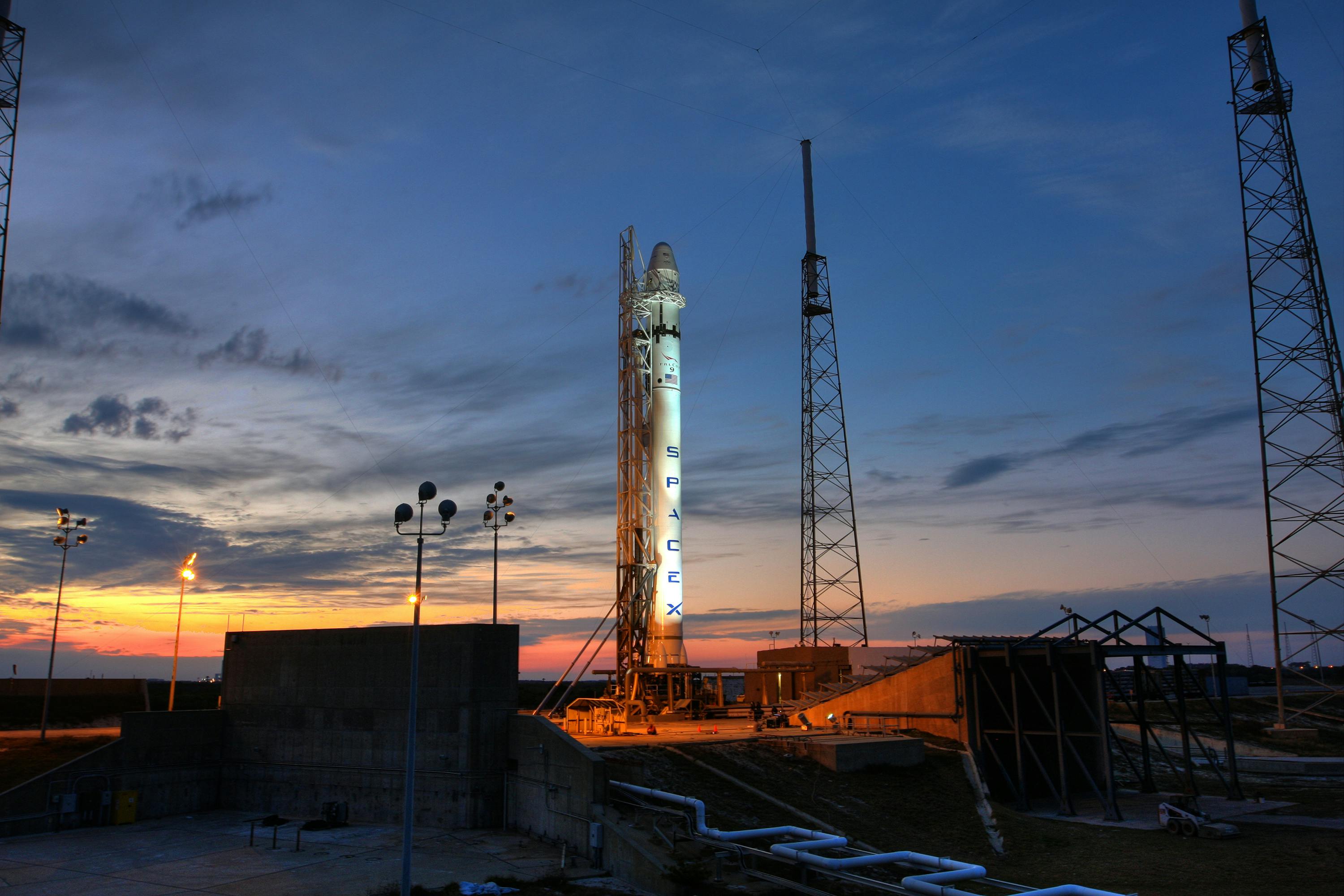
After years of record-breaking performance, Falcon 9 is beginning its slow sunset — and SpaceX is already repositioning its infrastructure accordingly. Vandenberg Space Force Base in California is on track to become the company’s busiest launch site in the near term, a shift that reflects both the growing demand for high-inclination and polar orbits and the long-term migration of launch volume toward Starship. Falcon 9 remains the most successful orbital rocket in history by flight count, and its retirement will be gradual rather than abrupt, but the directional signal from SpaceX’s site investment decisions is unmistakable. For satellite trackers, the shift matters: Vandenberg launches tend to populate Sun-synchronous and high-inclination shells, which carry distinct conjunction and tracking profiles compared to the Florida-based equatorial manifests.
Read the full story: Ars Technica
Anthropic to Study SpaceX Orbital Data Centers for AI Workloads
Anthropic, the AI safety company behind the Claude family of models, has agreed to formally evaluate SpaceX’s orbital data center satellites as a potential compute platform — a deal that adds serious institutional credibility to what was until recently a speculative concept. SpaceX has been quietly developing the infrastructure to host processing workloads aboard satellites in low Earth orbit, and Anthropic’s involvement suggests the use case is maturing faster than the broader industry anticipated. The arrangement follows a pattern of major cloud and AI players — including Microsoft and Amazon — formalizing relationships with SpaceX around compute and connectivity infrastructure.
From a constellation-management perspective, dedicated data-processing satellites would occupy orbital slots and generate conjunction risk profiles distinct from the Starlink broadband shells, raising new questions for space traffic coordination. If orbital compute becomes commercially viable at scale, the pressure on already-congested LEO bands could intensify significantly.
Read the full story: SpaceNews
SpaceX Deal Triggers Immediate Capacity Boost for Anthropic’s Claude Code
The commercial relationship between Anthropic and SpaceX is already producing tangible near-term effects: Anthropic cited its new SpaceX agreement as a direct factor in its decision to raise usage limits for Claude Code, its AI-assisted software development product. The move follows a broader trend of AI firms leveraging infrastructure partnerships to unlock capacity headroom, with Microsoft and Amazon having previously struck similar arrangements with SpaceX. The speed with which the partnership translated into a customer-facing product change signals that the financial terms of the deal were substantial enough to immediately shift Anthropic’s internal resource allocation.
For the space industry, the episode illustrates how SpaceX’s ambitions have expanded well beyond launch services and satellite internet — the company is now a meaningful node in the global AI compute supply chain, with deals that ripple outward into developer tooling and enterprise software in ways that would have been difficult to predict even 18 months ago.
Read the full story: Ars Technica
Constellation Status
No changes have occurred in the Starlink constellation since the last check. The constellation maintains its current totals of 11,955 satellites launched, with 10,374 currently in orbit, 10,358 functioning as intended, and 1,581 having decayed from their operational status.
- Total Launched: 11955
- Total On Orbit: 10374
- Total Working: 10358
Track Starlink satellites in real-time: Track Starlink