For three decades the United States ran a space program it would not admit existed. The National Reconnaissance Office was founded in 1961, spent billions of dollars a year, and put hundreds of spy satellites in orbit before the government even acknowledged the agency’s name in 1992. The Soviet Union played the same game with different paperwork, hiding its reconnaissance flights inside the endless anonymous Kosmos numbering series.
Then the files started opening. President Clinton’s 1995 executive order dumped some 800,000 CORONA images into the National Archives. The Naval Research Laboratory got to reveal in 1998 that it had beaten everyone to orbit with an eavesdropping satellite. In 2011 the NRO wheeled an actual school-bus-sized HEXAGON into public view.
Some ground rules for this list. Every program here has been officially declassified or officially acknowledged by the government that flew it - no rumors, no “everybody knows” entries. Within that pool, the ranking is editorial judgment, weighing historical impact against pure story quality. A satellite that changed the Cold War outranks one that merely worked, and a space station with a cannon gets credit for being a space station with a cannon.
One caveat before the countdown. Everything currently operational remains classified, and it doesn’t much matter, because a worldwide network of hobbyists with stopwatches and telescopes keeps finding the “secret” satellites anyway. Several of the objects below are still in orbit, still tracked, and sitting in KeepTrack’s catalog right now under their USA designations.
| # | Program | Country | Flew | Declassified | Job |
|---|---|---|---|---|---|
| 1 | CORONA | USA | 1959-1972 | Feb 1995 | Film-return imagery |
| 2 | KH-11 KENNEN | USA | 1976-present | Never (acknowledged) | Digital optical imagery |
| 3 | HEXAGON (KH-9) | USA | 1971-1986 | Sep 2011 | Wide-area film search |
| 4 | GAMBIT (KH-7/KH-8) | USA | 1963-1984 | Sep 2011 | Close-look film imagery |
| 5 | GRAB | USA | 1960-1962 | Jun 1998 | Radar eavesdropping |
| 6 | Zenit | USSR | 1961-1994 | After 1991 | Film-return imagery |
| 7 | Almaz | USSR | 1973-1977 | After 1991 | Crewed reconnaissance |
| 8 | DSP | USA | 1970-2007 | Acknowledged | Missile early warning |
| 9 | Lacrosse/Onyx | USA | 1988-2005 | Jul 2008 (existence) | Radar imaging |
| 10 | POPPY | USA | 1962-1971 | Sep 2005 | Radar eavesdropping |
1. CORONA
Program years: 1959-1972 | Declassified: February 1995 | Mission: Film-return photo reconnaissance
CORONA failed twelve times in a row. The first dozen Discoverer launches, the program’s public cover name, ended in explosions, tumbling capsules, and film buckets lost at sea. Then in August 1960, Discoverer 13’s capsule was fished out of the Pacific as the first object ever recovered from orbit, and a week later Discoverer 14 came back with actual film. A C-119 transport snagged its parachute in mid-air, and that single bucket held more photographic coverage of the Soviet Union than all two dozen U-2 flights combined.
The pictures settled the era’s scariest question. The feared “missile gap” turned out to be a few dozen Soviet ICBMs, not hundreds, and American planning changed accordingly. Roughly 145 missions later, CORONA retired in 1972, and in February 1995 its 800,000-image archive became public property that scientists still mine for glacier, forest, and archaeology data today.
2. KH-11 KENNEN
Program years: 1976-present | Declassified: Never - acknowledged in pieces | Mission: Electro-optical imaging | NORAD ID: 37348 (USA-224)
The KH-11 replaced film buckets with a digital sensor and a downlink, which meant photos in near real time instead of weeks-old film. Its telescope carries a 2.4-meter mirror, the same diameter as Hubble’s - no coincidence, and when the NRO handed NASA two spare KH-11-class telescopes in 2012, one became the core of the Roman Space Telescope.
No government ceremony ever declassified KENNEN. The public learned about it sideways, first when CIA employee William Kampiles sold its technical manual to the Soviets for $3,000 in 1978, then when analyst Samuel Morison leaked KH-11 photos of a Soviet carrier to Jane’s in 1984. The best reveal came on August 30, 2019, when President Trump tweeted an intelligence image of a burned-out Iranian launch pad. Within a day, satellite tracker Marco Langbroek and fellow amateurs matched the viewing angle to USA-224, a KH-11 they had been tracking for years with backyard gear. It also ranks among the largest objects in Earth orbit.
Track USA-224 live in KeepTrack.
3. HEXAGON (KH-9)
Program years: 1971-1986 | Declassified: September 2011 | Mission: Wide-area film-return search
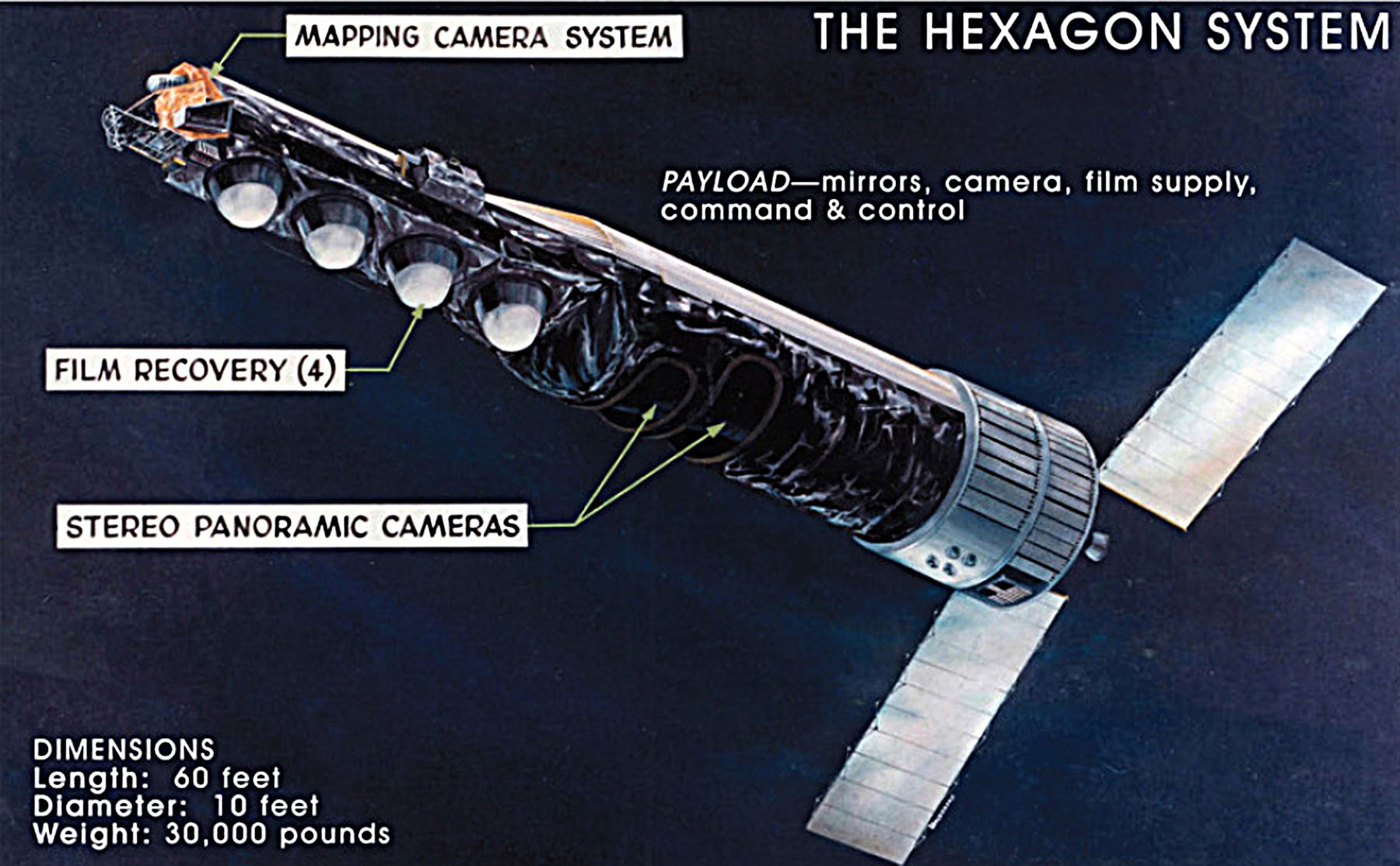
Nicknamed “Big Bird,” HEXAGON was the largest film camera ever flown. Each vehicle stretched about 60 feet, weighed on the order of 30,000 pounds, and carried roughly 60 miles of film feeding four return capsules. A single mission could photograph hundreds of millions of square miles, which made HEXAGON the workhorse behind verifying Soviet compliance with the SALT arms-control treaties.
Nineteen missions flew successfully; the twentieth exploded seconds after liftoff in 1986. When the NRO declassified the program on its 50th anniversary in September 2011, it displayed a HEXAGON in a museum parking lot for exactly one day. Since 2012 one has lived permanently at the National Museum of the U.S. Air Force in Dayton.
4. GAMBIT (KH-7 and KH-8)
Program years: 1963-1984 | Declassified: September 2011 | Mission: High-resolution film imagery
GAMBIT was the magnifying glass to HEXAGON’s map. While the big search satellites scanned continents, GAMBIT’s job was to come back with close-ups of specific targets - a new submarine in a Soviet shipyard, a radar site, a missile silo. The KH-7 flew 38 missions in the 1960s, and its successor, the KH-8, flew 54 more through 1984, making it one of the longest-serving reconnaissance designs of the film era.
The NRO’s declassified fact sheets say GAMBIT resolution was “better than two feet.” The actual figure remains classified four decades later, which tells you the engineers did something they’re still proud of. Both GAMBIT models stand next to their HEXAGON sibling in Dayton, three formerly nonexistent spacecraft in one room.
5. GRAB
Program years: 1960-1962 | Declassified: June 1998 | Mission: Electronic intelligence | NORAD ID: 46 (GRAB 1)
America’s first operational spy satellite was not a camera. GRAB, the Galactic Radiation and Background experiment, was an eavesdropper built by the Naval Research Laboratory, the same lab behind Project Vanguard. Launched June 22, 1960, the little sphere flew a genuine solar science payload as cover while its real electronics collected Soviet air-defense radar signals - electronic intelligence, or ELINT - and relayed them to ground huts. It reached orbit weeks before CORONA returned usable film, making it first across the operational line.
The Navy kept the secret for 38 years, until the NRL revealed the program in June 1998. GRAB 1 itself never came down. It circles at roughly 600 by 850 kilometers and holds a spot on our list of the ten oldest satellites still in orbit, where it sits at number seven under catalog number 46.
6. Zenit
Program years: 1961-1994 | Declassified: Cover blown by the Soviet collapse | Mission: Film-return photo reconnaissance
The Soviet answer to CORONA was charmingly literal. Engineers took the Vostok capsule that carried Yuri Gagarin, pulled out the cosmonaut couch, and bolted in cameras. The whole spacecraft came home after a mission of a week or two, film, cameras, and all, which meant the expensive optics got reused while CORONA’s burned up.
Every flight hid behind an anonymous Kosmos number, starting with Kosmos 4 in April 1962. The disguise was thin - Western analysts noticed that certain Kosmos “science” satellites kept landing after eight days - but Moscow never confirmed anything until the Soviet Union itself dissolved. By the time the last variant flew in 1994, more than 500 Zenits had launched. No satellite design flew more often until SpaceX started mass-producing Starlinks.
7. Almaz
Program years: 1973-1977 | Declassified: Revealed after 1991 | Mission: Crewed orbital reconnaissance
The Soviets also tried spying with people. Almaz was a military space station whose crews operated a giant camera and a film-development lab, flying under the civilian Salyut label to hide among the science stations. Salyut 3 and Salyut 5 hosted crews in 1974 and 1976-77 before the program lost out to automation, the same verdict the Americans reached when they cancelled their own crewed MOL station in 1969.
Almaz keeps one record nobody else wants. Salyut 3 carried a modified R-23 aircraft cannon, and on January 24, 1975, after the crew had gone home, ground controllers remotely fired roughly 20 rounds into space. It remains the only gun ever fired in orbit. The test reportedly worked, in the sense that the station did not shake itself apart.
8. Defense Support Program (DSP)
Program years: 1970-2007 | Declassified: Acknowledged; details still classified | Mission: Missile early warning | NORAD ID: 4630 (DSP 1)
DSP satellites don’t take pictures of bases. They stare at the whole planet from near-geosynchronous altitude with an infrared telescope, spinning slowly, watching for the heat bloom of a rocket launch. Twenty-three went up between November 1970 and 2007, and for decades they were the tripwire that would have given the president his first warning of a Soviet missile attack.
The program stepped partially into the open during Desert Storm in 1991, when DSP detections gave Israeli and Saudi civilians precious minutes of warning before Iraqi Scud impacts. The very first DSP bird, launched in 1970, is still drifting tens of thousands of kilometers up, too high for any atmosphere to ever bring it down.
9. Lacrosse/Onyx
Program years: 1988-2005 (launches) | Declassified: Existence only, July 2008 | Mission: Radar imaging | NORAD ID: 28646 (Lacrosse 5)
Optical satellites go blind over cloud cover, which describes Russia much of the year. Lacrosse solved that with synthetic aperture radar, building images from radio echoes that punch through clouds and darkness alike. The first one deployed from the shuttle Atlantis in December 1988, on the same STS-27 mission that nearly ended in disaster from launch debris tearing up the orbiter’s heat shield.
The NRO formally admitted its radar satellite fleet existed in July 2008 and said nothing else. It didn’t need to. Amateur observers had been logging the five Lacrosse spacecraft for years, and hobbyists documented Lacrosse 5’s odd habit of abruptly going dark mid-pass, a trick the tracking community still debates. Lacrosse 5, launched in 2005, remains in orbit at about 720 kilometers.
Track Lacrosse 5 in KeepTrack.
10. POPPY
Program years: 1962-1971 | Declassified: September 2005 | Mission: Electronic intelligence
GRAB’s successor scaled the eavesdropping mission up. POPPY flew seven missions between 1962 and 1971, its satellites riding shared launches and hiding among legitimate science payloads, listening for Soviet radars and eventually helping track the radar emissions of Soviet warships at sea.
The NRO acknowledged POPPY’s existence in September 2005 and kept nearly everything else sealed. Even now, matching specific cataloged objects to specific POPPY payloads takes detective work, because they went up under bland cover names that persist in the satellite catalog to this day. Several are still in orbit near 900 kilometers, anonymous little spheres with a former secret life.
The ones that just missed
MIDAS, the 1960s missile-warning pioneer, laid the groundwork for DSP but barely worked. SAMOS, CORONA’s failed radio-relay rival, mostly proved film buckets were the right call. The Navy’s Parcae ocean-surveillance triplets got their own declassification in 2023. And Misty, the rumored stealth imaging satellite that amateur trackers claim to have lost and found repeatedly, doesn’t qualify for this list for the best possible reason. It has never been acknowledged at all.
Watching the watchers
Secrecy has a shelf life. Governments declassify programs decades late, and in the meantime, amateurs fill the gap. The tracking community that identified USA-224 from a presidential tweet maintains orbital data on classified satellites that official sources refuse to publish, and networks like the International Scientific Optical Network do the same at professional scale. Keeping tabs on who is overhead is the whole point of space domain awareness, and it works on spy satellites too.
KeepTrack’s catalog carries the USA-designated objects alongside everything else, so you can pull up a live view of the sky and watch a two-billion-dollar classified telescope cross your horizon on a published schedule. Browse the rest of the fleet on our satellites page, or see how these Cold War veterans stack up against the oldest satellites still in orbit.
What was the first spy satellite?
The first operational spy satellite was GRAB 1, a US Navy electronic intelligence satellite launched June 22, 1960, that eavesdropped on Soviet radars. The first imaging success came weeks later, when CORONA's Discoverer 14 returned the first photographs from orbit in August 1960.
Are spy satellites still classified?
Yes. Current US reconnaissance satellites carry anonymous USA designations, and their capabilities and missions are classified. Historical programs like CORONA (1995), GRAB (1998), POPPY (2005), and GAMBIT/HEXAGON (2011) were only declassified decades after they stopped flying.
Can you track spy satellites?
Yes. Classified satellites cannot hide from physics. Amateur observers worldwide measure their positions optically and publish orbital elements, and trackers like KeepTrack display USA-designated objects. In 2019, amateurs identified which KH-11 satellite took an image tweeted by President Trump within about a day.
What is a KH-11 satellite?
The KH-11 KENNEN is a US electro-optical reconnaissance satellite series first launched in 1976. It was the first American spy satellite to return digital imagery in near real time, and it uses a 2.4-meter mirror, the same diameter as the Hubble Space Telescope. Upgraded versions are believed to still operate today.
References (6)
- GRAB I, First Operational Intelligence Satellite - U.S. Naval Research Laboratory
- POPPY Satellite Reconnaissance Program Recognized - NRO Press Release
- Key Hole Satellites for Air Force Museum - Air & Space Forces Magazine
- An Underwater Ice Station Zebra (HEXAGON capsule recovery) - CIA FOIA Reading Room
- Image from Trump tweet identified as imagery by USA 224 - SatTrackCam Leiden
- General Catalog of Artificial Space Objects - Jonathan McDowell