· today in space history · 10 min read
Joe Engle and the Youngest Astronaut Wings Ever Earned
On 29 June 1965, a young Air Force test pilot rode a rocket-powered airplane to 280,600 feet above the California desert. He landed ten minutes later as the youngest person ever to earn astronaut wings.
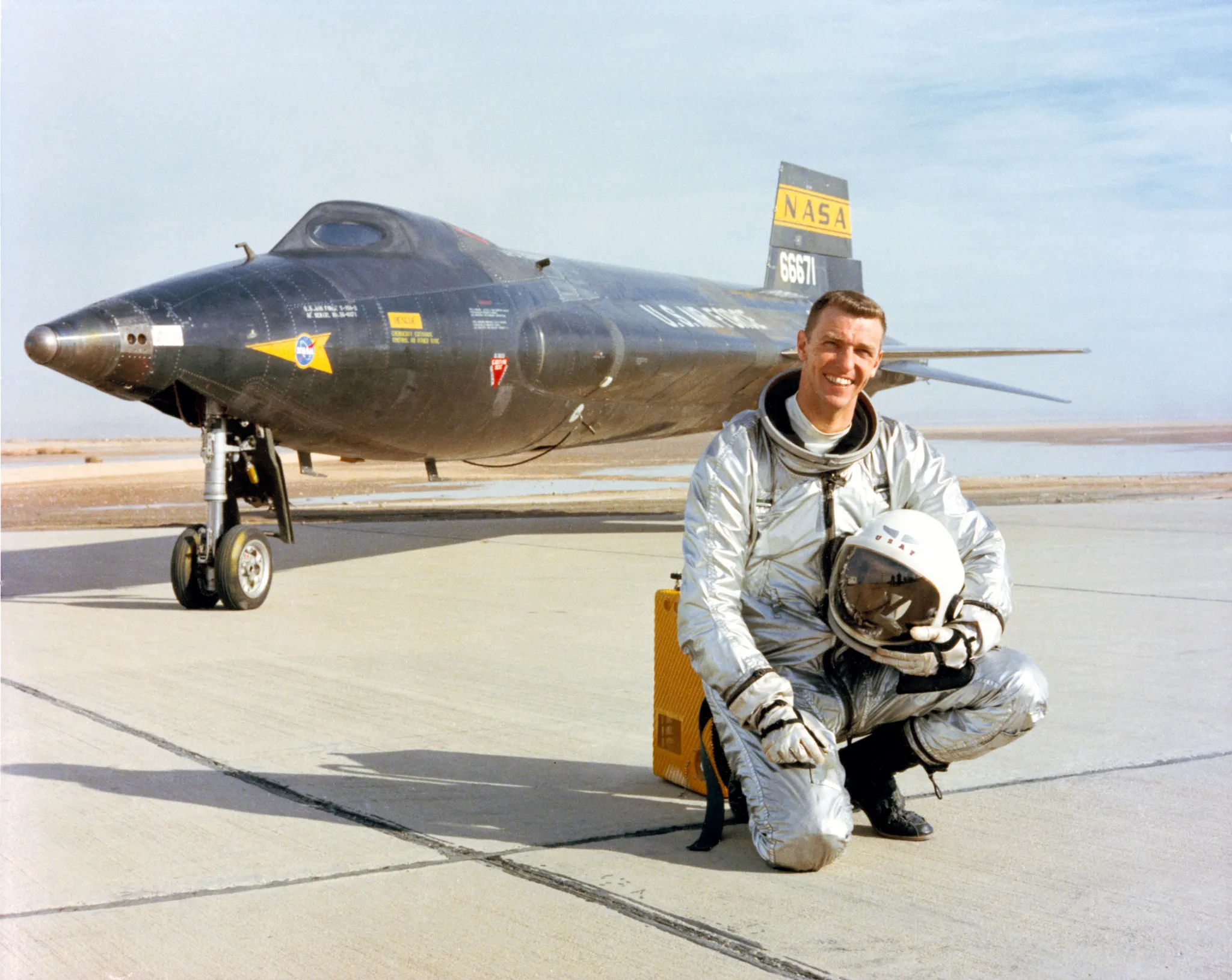
Exactly 61 years ago today, Joe Engle became the youngest person to earn astronaut wings by flying an X-15 plane 280,600 feet into the air. Soaring three miles over the qualifying threshold, he would go on to exceed the 50-mile requirement three more times during his X-15 career. This is a story beyond mere qualification metrics. It sits at the epicenter of the birth of astronautics from aviation.
Bridging the Aviation and Astronautics Gap
In 1955, the USSR detonated its first hydrogen bomb. Two years later, they launched humanity’s first satellite, Sputnik 1. The Space Race was in motion, and America was rushing to catch up. As they were setting their sights on conquering the frontier of space, a problem reared its head for the US: its gaps in knowledge. Questions spanning many fields of science made space research frustrating and slow. Can humans operate complex machinery at hypersonic speed? How do we make atmospheric reentry survivable? Can the human body even hold up in the extreme altitudes of space?
America dedicated the 1950s to answering these questions. This decade was marked as the transition period from pure aviation research to astronautics. NASA was established in 1958 by President Eisenhower, and promptly started up space programs to get American spacecraft and people to space.
The story of the American Space Age is usually introduced with Project Mercury, which was the first US human spaceflight program. In its lifespan from 1958 to 1963, it was in the spotlight for pioneering space research. This project, although important, would not be possible without the fundamental atmospheric, aviation, and aircraft research conducted beforehand. This is where the X-15 Program comes in.
Filling the Knowledge Gaps
The X-15 Program filled the knowledge gaps of scientists working on sending people to space. It was an exploration of hypersonic flight, aerodynamic heating, pilot physiology, and flight controls, all crucial ingredients to spaceflight. This information would go on to inform the Mercury, Gemini, and Apollo missions. The program was a heavily militarized effort, being a joint effort of the US Air Force, US Navy, Reaction Motors, and North American Aviation. It was spearheaded by the freshly created NASA, which had just emerged from the National Advisory Committee for Aeronautics.
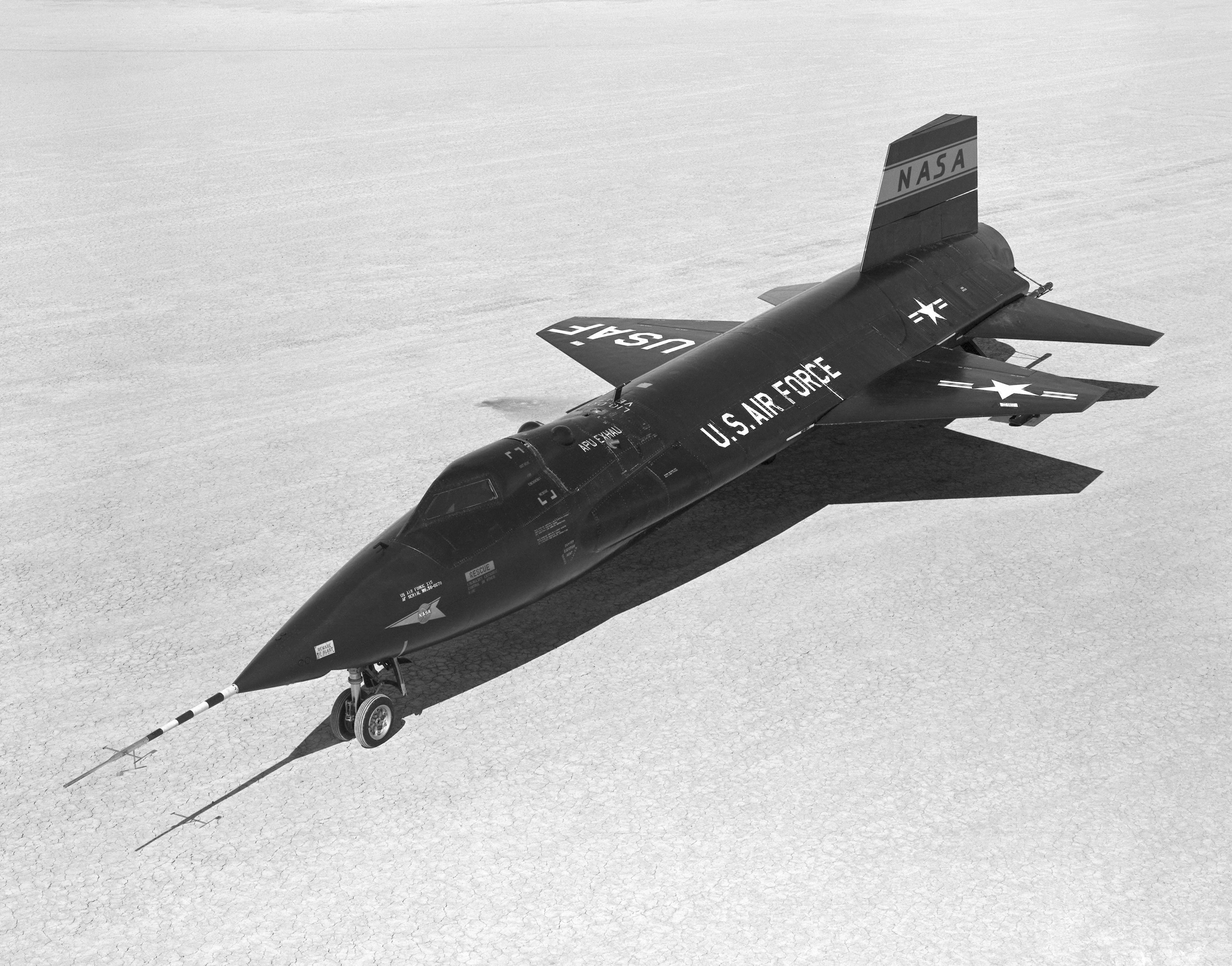
The focus of the program was the X-15, a first-of-its-kind rocket-powered, air-launched, reusable hypersonic aircraft. Hypersonic aircraft travel at Mach 5 or greater, which means five times the speed of sound. What made the X-15 special was the fact that it could reach such speeds while being directly piloted throughout the entire flight. Previous attempts at crewed spacecraft were ballistic Mercury capsules, which did not rely on constant piloting.
With the X-15, scientists got to observe for the first time how pilots can control hypersonic vehicles in the upper atmosphere. The program included a study of heat behavior at Mach 5 and Mach 6. Hypersonic flight generates extreme surface heat, up to 3,000 degrees Celsius, and a major achievement of the X-15 program was maintaining room temperature in the pilot’s cabin. Inertial navigation, reentry dynamics, and reaction control were all studied as well. The aircraft produced over 765 research reports.
This groundbreaking research was completed through the bravery of a surprisingly unlabeled group. Astronaut and pilot bore no real distinction at this time, and the men piloting X-15s simply deemed themselves aviators. They were elite test pilots who worked at Edwards Air Force Base. Stationed in the dry lakebeds of California, the base was a hub for innovative aircraft technologies. Every few years, a barrier was broken, a record was set, and the scientific world was rocked. The X-15 was just another tally under the base’s belt, following the first supersonic flight (X-1) and the first flight to reach Mach 3 (X-2), both completed there.
The rigorous aviation culture ingrained into the base and the X-15 project dictated that each new plane had to fly higher, faster, and farther. For this reason, many pilots weren’t satisfied with spacecraft, because they couldn’t pilot the whole flight. They felt like a passenger in a vehicle whose behavior wasn’t completely at their mercy.
They called it being “spam in a can.” Twelve Americans of this mindset joined the X-15 program: five from NASA, five from the Air Force, one from the Navy, and one from the manufacturer, North American Aviation.
A Brief Anatomy Lesson of an X-15
The X-15 was a 50-foot-long beast made of Inconel X, a nickel-chromium alloy that could survive temperatures that deformed typical aluminum aircraft. It was an oddball of engineering, not quite an airplane but not quite a spacecraft. It exceeded the speeds any airplane was capable of at the time, yet landed like a glider.
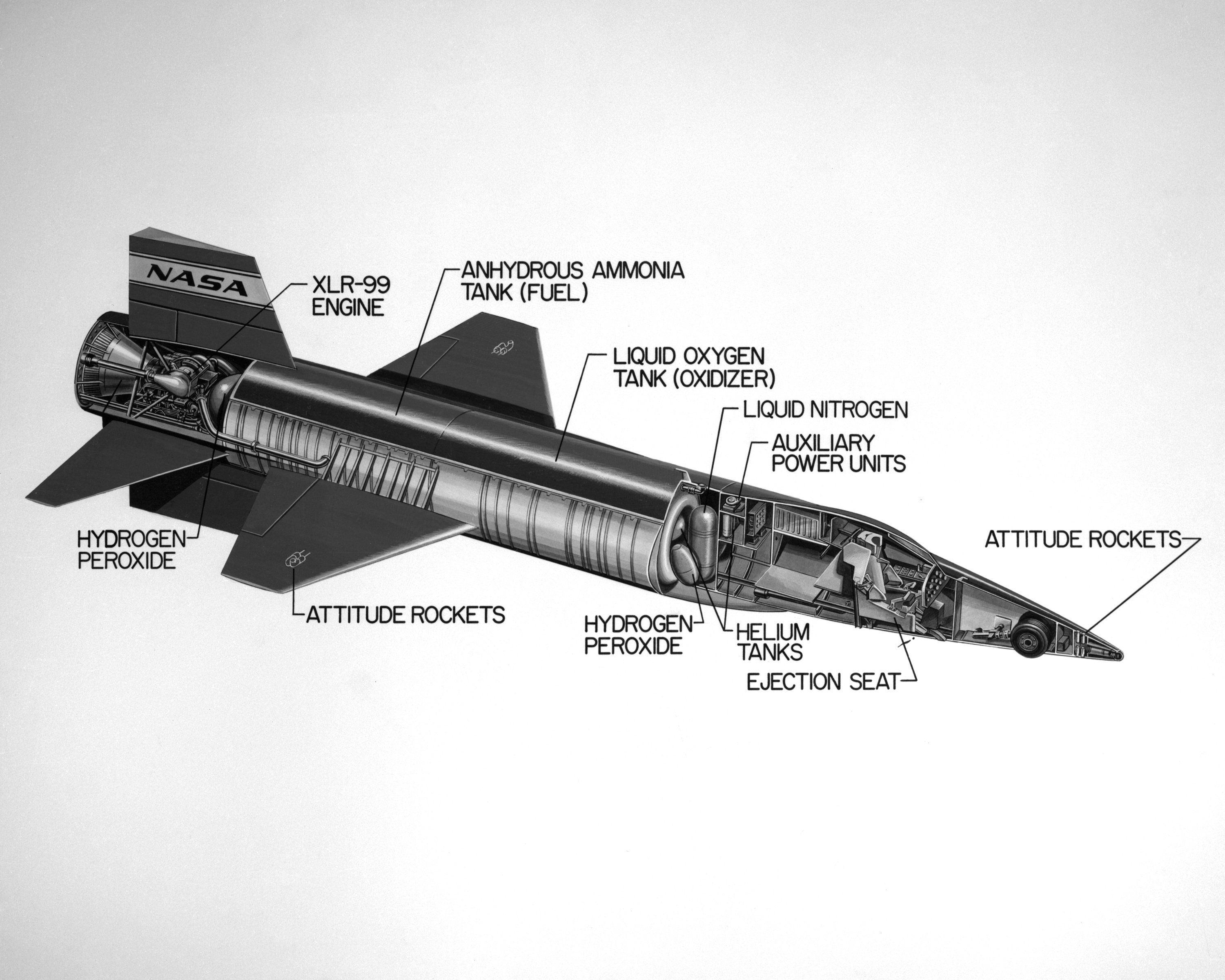
It also had a unique launch method that didn’t fit either category. To take off, a B-52 bomber carried the vehicle under its wing until it reached 45,000 feet. The X-15 was then dropped, and its engine ignited to accelerate it almost vertically toward space. Each flight took about 10 minutes, with acceleration lasting only about 85 seconds. Such methods conserved valuable fuel, which could instead be used to exceed supersonic speeds.
That acceleration came from 57,000 pounds of thrust at maximum output, about equal to two or three modern fighter jets at full afterburner. This thrust was made possible by the XLR-99 rocket engine, which was far more powerful than the initial two XLR-11 engines that together produced only a fifth of that thrust. On its highest flights, the X-15 could exceed the US astronaut threshold of 50 miles and even crossed the Karman line into space on two missions completed by Joseph Walker.
The X-15 relied on two different flight control systems. When it was in the lower atmosphere, rudders and tail surfaces were used to control the vehicle like a normal airplane. But as the vehicle neared space and the air thinned, the pilot switched to a reaction control system that used small rocket thrusters. This system is more similar to a spacecraft, using hydrogen peroxide rockets to control the yaw, pitch, and roll of the vehicle. The X-15 program was the first to demonstrate a successful transition between aerodynamic flight and spaceflight.
Momentum Gathered
Before the flight of Joe Engle, the X-15 program was quickly gaining momentum and racking up achievements. In 1961, Robert White became the first pilot in the program to exceed 50 miles in altitude and gain astronaut wings. He reached Mach 4, 5, and eventually 6.04. At the time, that was the highest altitude ever achieved on a piloted winged aircraft.
Neil Armstrong also flew the X-15s, just prior to being selected for astronaut training. He himself set many records in the program. On April 20, 1962, he completed the longest X-15 flight at 12 minutes and 28 seconds. As he was finishing up the flight, he pulled too high an angle during pullout, and ended up bouncing on the atmosphere like a skipping stone. He overshot the airbase and floated nearly 45 miles before managing to recover.
Robert White earns the first wings
White becomes the first X-15 pilot to exceed 50 miles, eventually reaching Mach 6.04, the highest altitude ever flown by a piloted winged aircraft at the time.
Armstrong skips off the atmosphere
Neil Armstrong flies the longest X-15 mission at 12 min 28 sec, ballooning above the airbase and overshooting by some 45 miles before recovering.
Walker crosses the Karman line
Joseph Walker reaches 354,200 feet, passes 100 km, sets the program's unbroken altitude record, and becomes the first civilian to cross into space.
Engle earns his wings
On Flight 138, Joe Engle reaches 280,600 feet and becomes the youngest person to earn astronaut wings.
Perhaps the biggest leap before Engle was that of Joseph Walker. The pilot achieved his second suborbital flight by reaching a staggering 354,200 feet in altitude. Walker crossed the Karman line at 100 kilometers and set an unbroken speed record for X-15 flights. He was also the first civilian to cross the Karman line. Engle would be the third pilot to earn his wings.
A Breathtaking Record
Engle’s historic mission was set for June 29, 1965. He had already accumulated 11 X-15 flights and proven himself capable in the most demanding environments. With an extensive background in military piloting, having tamed the F-100 Super Sabre, he was the perfect fit for the mission.
The flight, numbered 138, was not meant to break an altitude record. Joe Engle would fly on X-15-3 (56-6672), a modified X-15 that had been repaired after an accident in 1962. This was one of NASA’s principal research vehicles for pushing the boundaries of the X-15, yet no one was prepared for what Engle would do with it.
The X-15 he would fly was nestled under the right wing of a modified Boeing NB-52A Stratofortress. The carrier, nicknamed “The High and Mighty One,” was a powerhouse in the X-15 program, participating in 93 of the 199 test flights. The aircraft climbed to 13.7 kilometers above ground, and at 10:21 am, Joe Engle was air dropped into the sky.
In a seamless switch to its own hydraulic and electrical power, the X-15’s XLR-99 engine blazed to life. It fired for 81 seconds, accelerating to Mach 4.94 (about 3,432 miles per hour), following a deliberately planned trajectory that prioritized altitude over speed. The aircraft ascended to 280,600 feet.
Instead of leveling off like a normal aircraft, the X-15 was pitched steeply upward as it tore through the atmosphere, pushing Engle backwards into his seat. The air thinned as he entered the mesosphere, the same layer where meteors burn up as they plummet towards Earth. The sky darkened to nearly black, and the curve of the Earth was unmistakable beneath him.
Engle was able to reach 85.5 kilometers (280,600 feet) above ground, just 15 kilometers shy of crossing the Karman line and 5 kilometers above the required criterion for spaceflight. As he descended, the skin of the vessel endured temperatures well over 540 degrees Celsius. Bleeding off speed in a decisive glide over the desert, he touched down on Edwards Air Force Base 10 minutes and 34.2 seconds after takeoff, greeted by the cheerful faces of his parents, who had come to witness the flight.
Bright Future Ahead
Following Flight 138, Joe Engle became the youngest pilot ever to earn U.S. Air Force astronaut wings after flying the X-15 above the military’s 50-mile boundary of space. Although he did not surpass Joe Walker’s world altitude record, his successful mission marked another milestone in the X-15 program and paved the way for his future selection as a Space Shuttle astronaut.
Despite narrowly missing the Karman line, Engle’s achievement is an inspiring metaphor for the entire X-15 program. He earned his astronaut wings, transitioning from a pilot to a pioneer of space, much like how the program itself bridged the aviation and astronautics divide. It is in these intense flights that engineers and pilots proved humans can survive, navigate, and control machines even as they surpass the speed of sound fourfold in the sky.
References(9)
- June 29, 1965: Astronaut Engle Breaks X-15 Record - Air Force Test Center
- Astronaut Joe Engle Flies X-15 - NASA
- General Joe: Remembering Pilot and Astronaut Joe Engle - National Air and Space Museum
- X-15 Hypersonic Research Program - NASA
- NASA Armstrong Fact Sheet: X-15 Hypersonic Research Program - NASA
- The X-15 Hypersonic Flight Research Program, Chapter 6 - NASA History, SP-4219
- The Story of Neil Armstrong's X-15 Test Flight That Bounced Off the Atmosphere - The Aviation Geek Club
- 20 April 1962 - This Day in Aviation
- NASA Remembers Retired Astronaut, US Air Force Pilot Joe Engle - NASA

Theodore Kruczek