· today in space history · 9 min read
The Morning a Supply Ship Tore Open Mir
On 25 June 1997, a seven-ton cargo ship under hand control drifted into Mir's Spektr module, breached the hull, and left three crew members listening to their air hiss into space. It remains the worst collision in the history of human spaceflight.
At 09:18 Moscow time on 25 June 1997, Commander Vasily Tsibliyev was staring at a fuzzy black-and-white video monitor inside the Mir space station, trying to fly a spacecraft he could not see out the window. On the screen was the view from a camera mounted on an uncrewed Progress cargo ship, slowly drifting back toward the station for a docking test. The image was growing. Tsibliyev could tell the freighter was getting closer. What he could not tell, with any confidence, was how fast.
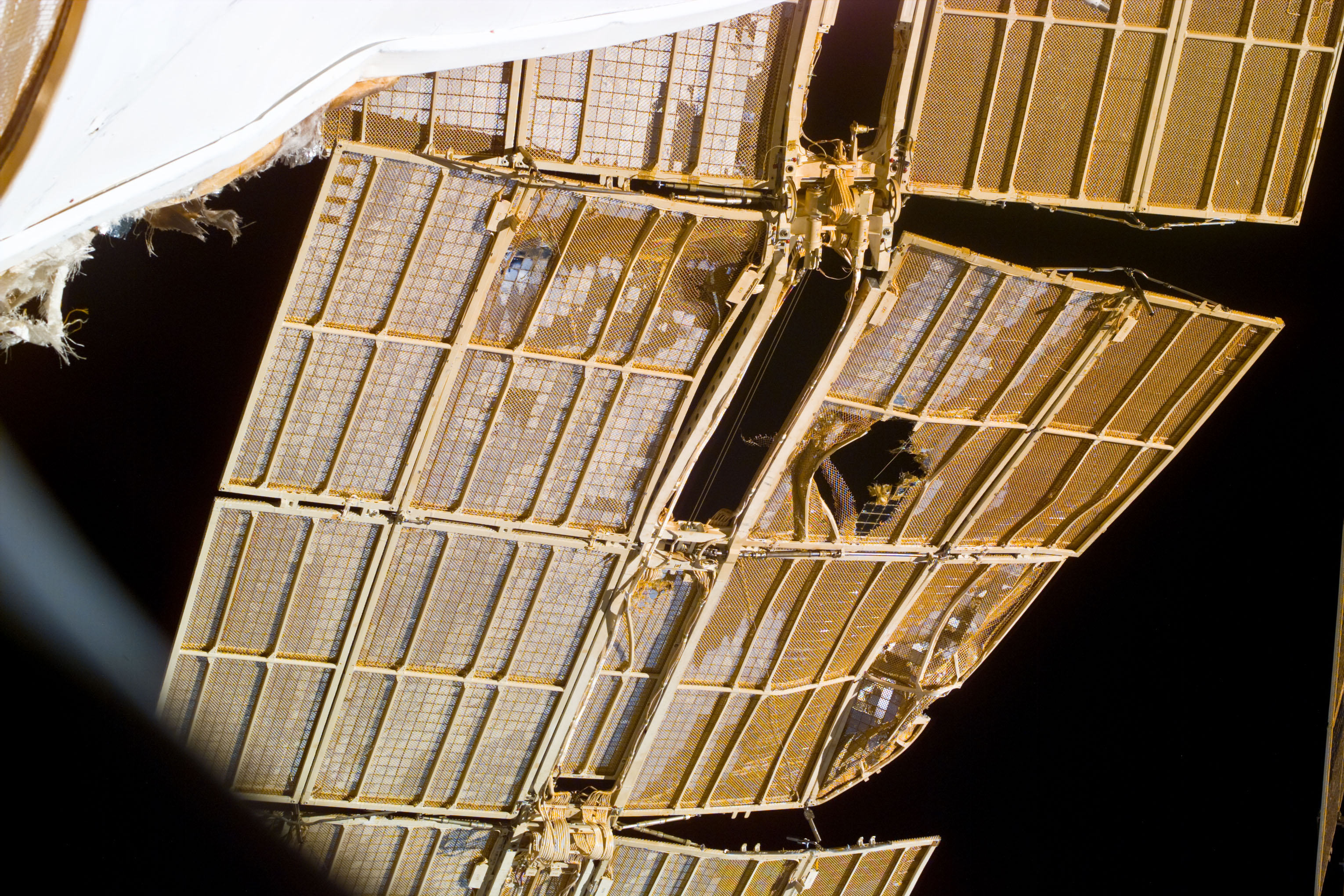
By the time he understood that the answer was “too fast,” there was very little he could do about it. He fired the braking thrusters. The seven-ton ship kept coming. It clipped one of the solar arrays on Mir’s Spektr science module, then struck Spektr itself, and the crew heard a sound no one aboard a space station ever wants to hear: the long, rising hiss of their atmosphere leaving the building.
What followed was a controlled panic that probably saved the station and certainly saved three lives. It was also, by any reasonable measure, the most dangerous moment of the entire fifteen-year Mir program, and it remains the worst collision in the history of crewed spaceflight. Nearly three decades later, it is still the case study that engineers reach for when they explain why knowing exactly where two objects are, and how fast they are closing, is not a luxury in orbit. It is the whole game.
The strange part is that none of it had to happen. The crew was running a test that existed mostly to save money.
7,150 kg
Mass of Progress M-34 at the moment of impact
A fully loaded cargo freighter, hand-flown toward a crewed station with no radar and no reliable way to judge its closing speed.
Why a cosmonaut was flying blind
To understand the collision, you have to understand the experiment that produced it. Progress freighters normally docked with Mir automatically, guided by a radar-based rendezvous system called Kurs. Kurs worked, but it was built in Ukraine, and after the breakup of the Soviet Union the price of each unit climbed steeply. The Russian space program, broke and improvising through the 1990s, wanted to know whether it could stop buying Kurs hardware and instead let cosmonauts manually fly each Progress in for the final approach using a backup system called TORU.
TORU let a cosmonaut on the station remotely pilot an approaching Progress, watching through a camera on the freighter and commanding its thrusters by hand. The catch is brutal in hindsight. With the Kurs radar disabled for the test, there was no instrument feeding Tsibliyev a precise range or closing rate. He was judging distance and speed by eye, from how big the station appeared in a low-quality video feed, with the freighter itself hard to spot against Earth and the structure of Mir.
Several things made an already difficult task nearly impossible. The Progress had been deliberately loaded with the station’s accumulated trash before being sent away, which shifted its center of mass and changed how it responded to thruster commands. The approach geometry left the freighter difficult to acquire visually until it was close. And the crew was exhausted. The EO-23 expedition had already survived a serious onboard fire in February 1997, when an oxygen-generating canister ignited and filled Mir with smoke. Morale and sleep were both in short supply.
The Progress collided with a solar array on the Spektr module. Then, the spacecraft hit Spektr itself, punched a hole in a solar panel, buckled a radiator, and breached the integrity of Spektr’s hull.
The hiss
The breach meant air. Mir’s atmosphere began bleeding out through the wound in Spektr, and the crew felt it before any gauge confirmed it. Ears popped. The pressure was dropping, and on a space station a falling pressure reading is the start of a countdown that ends with everyone unconscious.
Spektr was connected to the rest of Mir through an open hatch, and threaded through that hatchway were cables and ventilation ducts carrying power and data between the module and the core of the station. To seal Spektr, the crew had to first clear that hatch. Flight Engineer Aleksandr Lazutkin began frantically pulling and cutting the cables running through the opening, some by yanking the connectors apart by hand, racing the pressure drop. Once the passage was clear, the crew forced a hatch cover into place and sealed the leaking module off from the rest of the station.
That decision worked, and it cost them dearly. Sealing Spektr stopped the leak, but it permanently amputated the module from Mir. Spektr carried a large fraction of the station’s solar arrays, so isolating it knocked out roughly half of Mir’s electrical power. It also entombed most of Michael Foale’s personal belongings and science experiments, which were now inside a vacuum-filled compartment no one could safely enter.
Progress M-34 launches
The freighter lifts off from Baikonur and delivers cargo to Mir.
Undocking for the test
Progress backs away from Mir, loaded with station trash, to set up a manual re-approach.
Collision
Hand-flown on the TORU system, Progress strikes a Spektr solar array, then the module, breaching the hull.
Spektr sealed
The crew cuts cables and forces a hatch cover into place, stopping the leak but losing the module and half the station's power.
Spin arrested
Foale estimates the station's tumble; Moscow uses Soyuz thrusters to stop the rotation.
Internal spacewalk
Relief crew Solovyov and Vinogradov enter the depressurized Spektr to reconnect power cables.
A space station, tumbling in the dark
Losing half the power had a second-order consequence that was nearly as dangerous as the leak. Mir held its orientation using gyrodynes, spinning flywheels that needed electricity. With power collapsing, the gyrodynes spun down, and the station began drifting into a slow, uncommanded tumble. A tumbling station cannot point its remaining solar arrays at the Sun, which meant the power problem was feeding on itself. Mir was sliding toward a full blackout.
To stop the tumble, the crew needed to fire the thrusters on the docked Soyuz lifeboat in exactly the right direction, which required knowing how fast and which way the station was actually rotating. The instruments that would normally tell them that were dead. So Michael Foale improvised one of the more elegant pieces of seat-of-the-pants navigation in spaceflight history. He floated to a window, held his thumb out against the field of stars drifting past, and timed how long the starfield took to wheel around. Combining a sailor’s trick with a physicist’s arithmetic, he worked out that Mir was completing roughly one full rotation every six minutes.
Foale and Lazutkin relayed the spin estimate to the control center outside Moscow, and ground controllers commanded the Soyuz thrusters to fire against the rotation. It was not perfect and it was not permanent, but it worked. The tumble slowed, the arrays caught the Sun, and the slow climb back from the brink began.
Blame, and a brutal recovery
The cleanup stretched for months. Because the EO-23 crew was worn down and Tsibliyev had developed a heart arrhythmia in the aftermath, the most dangerous repair fell to the next expedition. On 22 August 1997, relief cosmonauts Anatoly Solovyov and Pavel Vinogradov suited up and performed an internal spacewalk, climbing into the still-depressurized Spektr to reconnect eleven power cables through a custom-built sealed hatch. Foale, by then the veteran aboard, manned the docked Soyuz in case the whole operation went wrong and the crew had to flee. A second internal spacewalk followed in October. Together they clawed back most of the lost power, restoring the station to something close to working order.
Then came the question of fault. In September 1997, a Russian commission formally blamed the crew, faulting the cosmonauts for the failed manual docking, and Tsibliyev’s mission bonus was reportedly docked. Many observers found that conclusion hard to swallow. The crew had been ordered to run a risky, under-instrumented test, with a freighter whose handling had been altered by its trash load, while exhausted from months of crises. The system, not just the pilot, had set up the conditions for failure.
What is not in dispute is the place the event holds. No crewed spacecraft has ever suffered a worse collision, before or since. The closest orbital parallel is the uncrewed 2009 Iridium-Cosmos smashup, which destroyed two satellites and scattered thousands of debris fragments. The difference is that Mir had people inside it.
Why it still matters
The Mir collision arrived at an awkward moment for NASA. American astronauts were living aboard Mir under the Shuttle-Mir program, the proving ground for what would become the International Space Station, and the fire in February followed by the collision in June fueled a real debate in Congress about whether the agency should keep putting people on an aging Russian station. NASA stayed, and the lessons traveled directly into ISS design and operations. Docking procedures grew more conservative, sensing was made redundant, and the program developed a deep institutional aversion to hand-flown approaches toward a crewed vehicle without instrumented range data.
The broader lesson is the one that defines space situational awareness as a discipline. Objects in orbit move at speeds where human intuition is worthless and where “close enough” is not a measurement. Everything that protects spacecraft today, from the radar networks that catalog tens of thousands of objects to the conjunction warnings that prompt satellites to maneuver, exists to replace eyeballing-it with knowing-it. Mir’s Spektr module, sealed and silent for the rest of the station’s life until Mir’s deorbit in 2001, is a permanent reminder of what happens when you have to guess. For more on the debris environment that makes precise tracking non-negotiable, see The Kessler Syndrome and our overview of space stations past and present.
Tsibliyev, Lazutkin, and Foale all came home. The hole in Spektr never did get patched. It simply orbited, sealed off and exposed to vacuum, a one-module monument to the day a routine cost-saving test nearly took down a space station.
References(6)
- Progress Collision with Mir - NASA Shuttle-Mir History (SP-4225)
- June 25, 1997: Progress Collides with Mir - SpaceNews
- Lessons Learned: Mir Collision - Space Safety Magazine
- First Internal Spacewalk - Guinness World Records
- Mir Spacewalk Complete, Power May Be Restored On Monday, Says NASA - ScienceDaily, August 1997
- Russia Blames Crew of Mir for June Collision - Deseret News, September 1997

Theodore Kruczek