· today in space history · 10 min read
The Afternoon a Blurry Smudge Turned Pluto Into a Double Planet
On 22 June 1978, an astronomer at the U.S. Naval Observatory looked at photographic plates that had been stamped 'image defective' and noticed a small bump on the side of Pluto. The bump was a moon, and finding it finally let astronomers weigh a planet that had fooled them for half a century.
After lunch on 22 June 1978, James Christy sat down at a measuring machine in the basement of the U.S. Naval Observatory in Washington and went back to a job he had been putting off. He was trying to pin down the orbit of Pluto, the faint and stubborn ninth planet, and to do that he needed precise positions measured off photographic plates. The plates in front of him had been shot months and years earlier with a telescope two thousand miles away in Arizona. Several of them carried a note from the technicians who had handled them first. They were marked “image defective.”
The defect was simple enough. On those plates, Pluto looked stretched. Instead of a clean round dot, the planet showed a slight bump or elongation on one side, the kind of smear you get when a telescope tracks poorly or the air will not settle. Background stars on the same plates looked fine. By the usual logic, a blur that touched the target and nothing else around it meant the exposure was bad, and a bad exposure was no good for careful astrometry. That is why the plates had been set aside.
Christy almost set them aside again. Then he stopped. If the atmosphere or the telescope had blurred Pluto, it should have blurred the nearby stars too. The stars were sharp. The only thing distorted was Pluto itself.
A flaw that shows up on one object and nowhere else on the plate is not a flaw in the plate. It is a fact about the object.
The planet that would not behave
To understand why a smudge mattered so much, you have to understand how little anyone actually knew about Pluto in 1978. It had been found in 1930 by Clyde Tombaugh at Lowell Observatory, six miles up the road in Flagstaff from the Naval Observatory station that would later take these very plates. For nearly half a century after that, Pluto had been almost pure rumor. It was a point of light so faint and so distant that no telescope on Earth could resolve it into a disk. Astronomers could not agree on how big it was, what it was made of, or how much it weighed, and every estimate of its mass kept shrinking as the years went on.
That last problem was not academic. A planet’s mass is the single number that drives almost everything else: its density, its composition, the way it tugs on its neighbors. Pluto had been blamed for decades for small wobbles in the orbits of Uranus and Neptune, the same wobbles that had motivated the search that found it. But to make Pluto responsible for those wobbles, you had to give it a respectable mass, and nothing about its dim, sluggish dot suggested it had one. The planet refused to behave.
Christy’s measuring work that June was a small piece of that long argument. The Naval Observatory specialized in astrometry, the unglamorous discipline of measuring exactly where things are in the sky, and a better orbit for Pluto was a worthwhile target. The plates came from the 61-inch Kaj Strand Astrometric Reflector at the observatory’s dark-sky station outside Flagstaff. They were good plates, mostly. The “defective” ones just happened to be the most important ones anyone would measure that century.
A bulge that would not hold still
Christy pulled more plates. The bulge was there on several of them, and it was not always in the same place. On some images it sat on one side of Pluto, on others it had swung around to the opposite side. His first instinct was dramatic and short-lived.
So, at first, I thought there was an explosion on Pluto, but you wouldn’t expect that to last for a month.
An explosion does not return night after night, month after month, marching around the planet on a schedule. A companion does. When Christy laid the dated plates out in order, the bump cycled from one side of Pluto to the other and back again with a period of about 6.4 days, which happened to be the same figure astronomers had measured for Pluto’s own rotation. Something was circling Pluto once every time Pluto turned once, locked to it like the two ends of a slowly spinning barbell.
He went looking in the observatory’s archive and found the same elongation on plates going back years, including images shot in 1965. Nobody had questioned them because nobody had a reason to. A faint moon hugging close to an already-blurry planet looks exactly like a bad night at the telescope, right up until you notice it keeps appointments.
Pluto found
Clyde Tombaugh discovers Pluto at Lowell Observatory in Flagstaff, Arizona.
Clues on file
Plates from the Naval Observatory's Flagstaff station already show Pluto's elongation, unrecognized at the time.
The bulge
James Christy notices a moving bump on plates stamped 'image defective.'
Announced
The discovery goes out to the world as IAU Circular 3241, with the provisional name S/1978 P 1.
Eclipse season
Pluto and Charon pass in front of each other as Robert Harrington predicted, confirming the moon.
Close up
NASA's New Horizons flies through the Pluto system and photographs Charon's surface in detail.
Christy took the plates to his colleague Robert Harrington, an orbital dynamicist down the hall. Harrington worked through the geometry and agreed. The simplest explanation that fit every plate was a satellite, orbiting close in and roughly over Pluto’s pole. Within days the two had a discovery on their hands, and a faint companion to a planet that had spent forty-eight years as a single point of light suddenly had a partner.
Naming a moon for Charlene
The discovery was announced to the astronomical community on 7 July 1978 through the International Astronomical Union’s Central Bureau for Astronomical Telegrams, as IAU Circular 3241. The new object carried the bureaucratic provisional label S/1978 P 1, but Christy already had a name in mind, and it was personal before it was mythological.
He wanted to name it after his wife, Charlene, whose nickname was “Char.” To make it sound like a proper astronomical body, he tacked on the “-on” ending common in physics, which gave him “Charon.” It was a private joke that he was not sure would survive review, since the convention is to name moons from classical mythology. Then he discovered, to his delight, that the name already worked. In Greek myth, Charon is the ferryman who carries the dead across the river to the underworld ruled by Hades, the god the Romans called Pluto. A moon named Charon escorting the planet Pluto was almost too neat.
Weighing Pluto at last
The romance of the name aside, Charon’s real gift to science was arithmetic. Once you have a moon orbiting a planet, you can measure how far out it sits and how long it takes to go around, and Kepler’s laws hand you the combined mass of the system. Charon orbits Pluto at an average distance of about 19,600 kilometers and completes one lap every 6.39 days. Plug those numbers in, and for the first time astronomers could actually weigh Pluto.
The answer was humbling. Pluto turned out to be far smaller and far less massive than generations of textbooks had implied, with only about two-tenths of one percent of Earth’s mass. It could not possibly have been shoving Uranus and Neptune around. The wobbles that had launched the search for a ninth planet were, in the end, mostly measurement error in the giants’ own orbits. Pluto had been found by accident, in roughly the right place, for the wrong reason.
12 %
Charon's mass relative to Pluto
No other moon in the solar system is so large compared to the world it orbits. The balance point the two share sits in empty space above Pluto's surface, so neither body truly circles the other. They swing around a common center, which is why Pluto and Charon are often called a double planet.
That mass ratio is the detail that still makes Charon special. At roughly 1,212 kilometers across, it is just over half Pluto’s diameter, and it carries about an eighth of Pluto’s mass. Our own Moon, by comparison, is about one-eightieth the mass of Earth. Because Charon is so hefty relative to Pluto, the gravitational balance point of the pair, the barycenter, lies outside Pluto entirely, hanging in space between the two worlds. Pluto does not simply hold a moon. Pluto and Charon orbit each other.
The eclipses Harrington predicted
A bump on a photographic plate is suggestive, not proof. The confirmation came from a coincidence of geometry that Harrington had the foresight to flag. Charon’s orbit is tilted such that, twice during Pluto’s 248-year trip around the Sun, we look at the system edge-on. When that happens, Pluto and Charon repeatedly pass in front of and behind each other from our viewpoint, a season of mutual eclipses and transits.
Harrington calculated that one of those rare windows was about to open, and it did, running from roughly 1985 through 1990. Astronomers watched the combined light of Pluto and Charon dip and recover exactly when the orbital math said it should. The events did more than confirm Charon was real. By timing how the brightness changed as one body slid across the other, observers extracted the sizes of both worlds, refined their orbit, and even began crudely mapping bright and dark patches on their surfaces, all from a single unresolved point of light. It was one of the most productive observing campaigns ever wrung out of a target nobody could actually see as a disk.
What New Horizons found
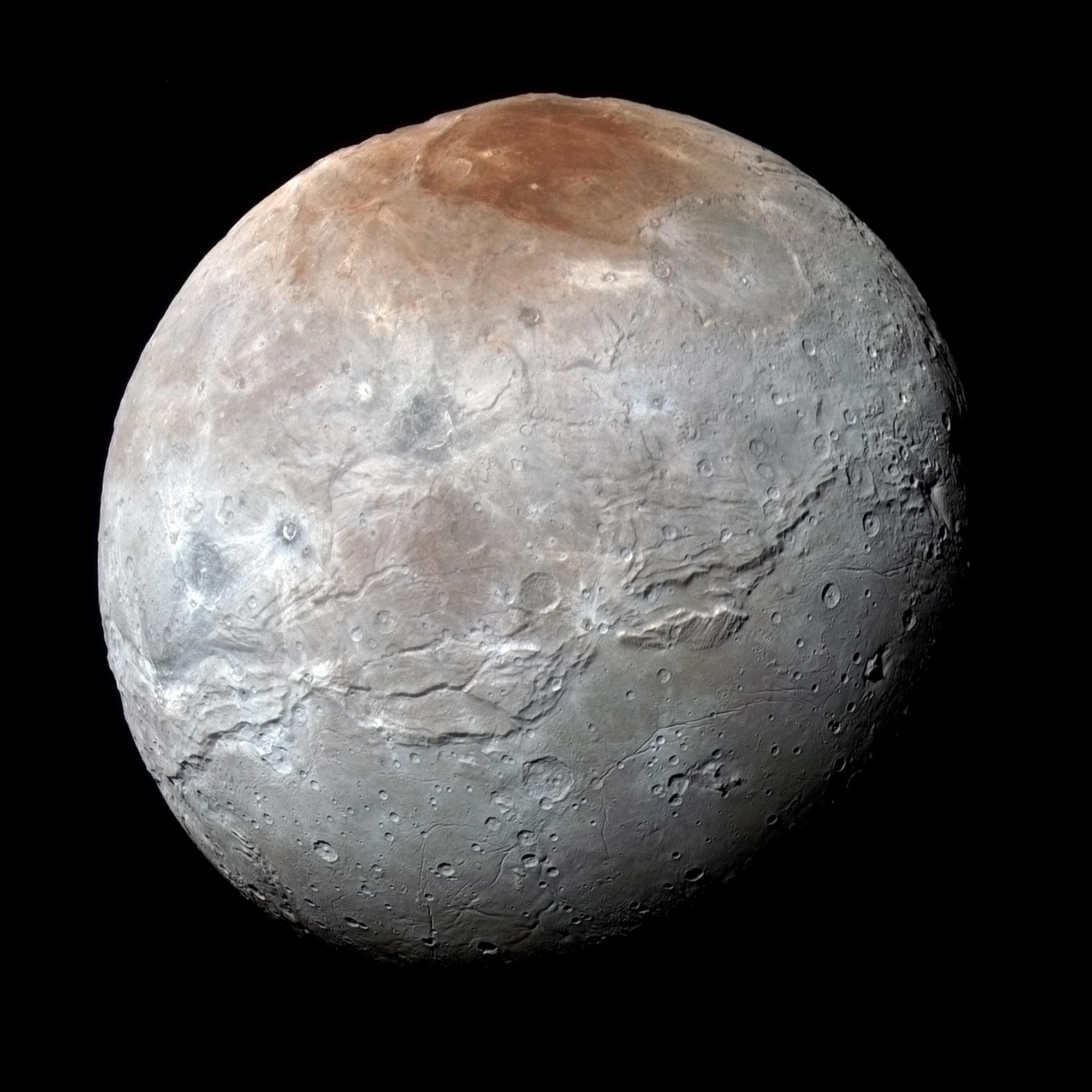
For 37 years after Christy’s afternoon, Charon stayed a smudge that had been promoted to a dot. That changed on 14 July 2015, when NASA’s New Horizons spacecraft tore through the Pluto system at roughly 14 kilometers per second and turned its cameras on a world that had only ever been inferred. The grainy bulge resolved into a place, a battered gray-white ball gashed by a canyon system several times longer and deeper than the Grand Canyon, and capped at its north pole by a strange dark red stain that the mission team nicknamed Mordor Macula. The reddish material appears to be tholins, organic gunk built from methane that escaped Pluto’s atmosphere, drifted to Charon, and was cooked by sunlight onto its frozen pole.
By then, Charon had quietly helped rewrite the rules. The accurate, embarrassingly small mass that Charon revealed was part of a slow reassessment of what Pluto even was. When astronomers began finding other icy bodies of comparable size in the same distant region of the solar system in the 1990s and 2000s, the case for calling Pluto a full planet collapsed, and in 2006 the International Astronomical Union reclassified it as a dwarf planet. Some of Pluto’s defenders still resent that decision. None of it would have been possible without first knowing how little Pluto weighed, and that number traces straight back to a man deciding not to throw away a defective plate.
Christy went on to a long career and lived to see New Horizons photograph the moon he named for his wife. The lesson of 22 June 1978 has not aged. The most important thing on the plate was the thing everyone else had been trained to ignore.
References(10)
- 45 Years Ago, Astronomers Discover Pluto's Moon Charon - NASA History
- Charon at 40: Four Decades of Discovery on Pluto's Largest Moon - NASA
- James Christy, Co-Discoverer of Charon, Pluto's Largest Moon - NASA Science
- An Interview With Jim Christy: How 'Defective' Images Revealed Pluto as a Double Planet - Astronomy.com
- Charon Discovery Image - NASA Science
- 40 Years Since the Discovery of Charon - BBC Sky at Night Magazine
- 25th Anniversary of the Discovery of Pluto's Moon Charon - SpaceNews
- Charon in Enhanced Color - NASA New Horizons
- Pluto and Charon - NASA Solar System Exploration
- New Horizons: The First Mission to the Pluto System and the Kuiper Belt - NASA

Theodore Kruczek