· today in space history · 10 min read
Mike Melvill, 124 Meters, and the Morning Space Went Private
On 21 June 2004, a 63-year-old test pilot rode a homebuilt rocket plane to 100,124 meters above the Mojave Desert, clearing the edge of space by about the length of a city block. He came down the first private astronaut in history, holding a sign that read 'SpaceShipOne, GovernmentZero.'
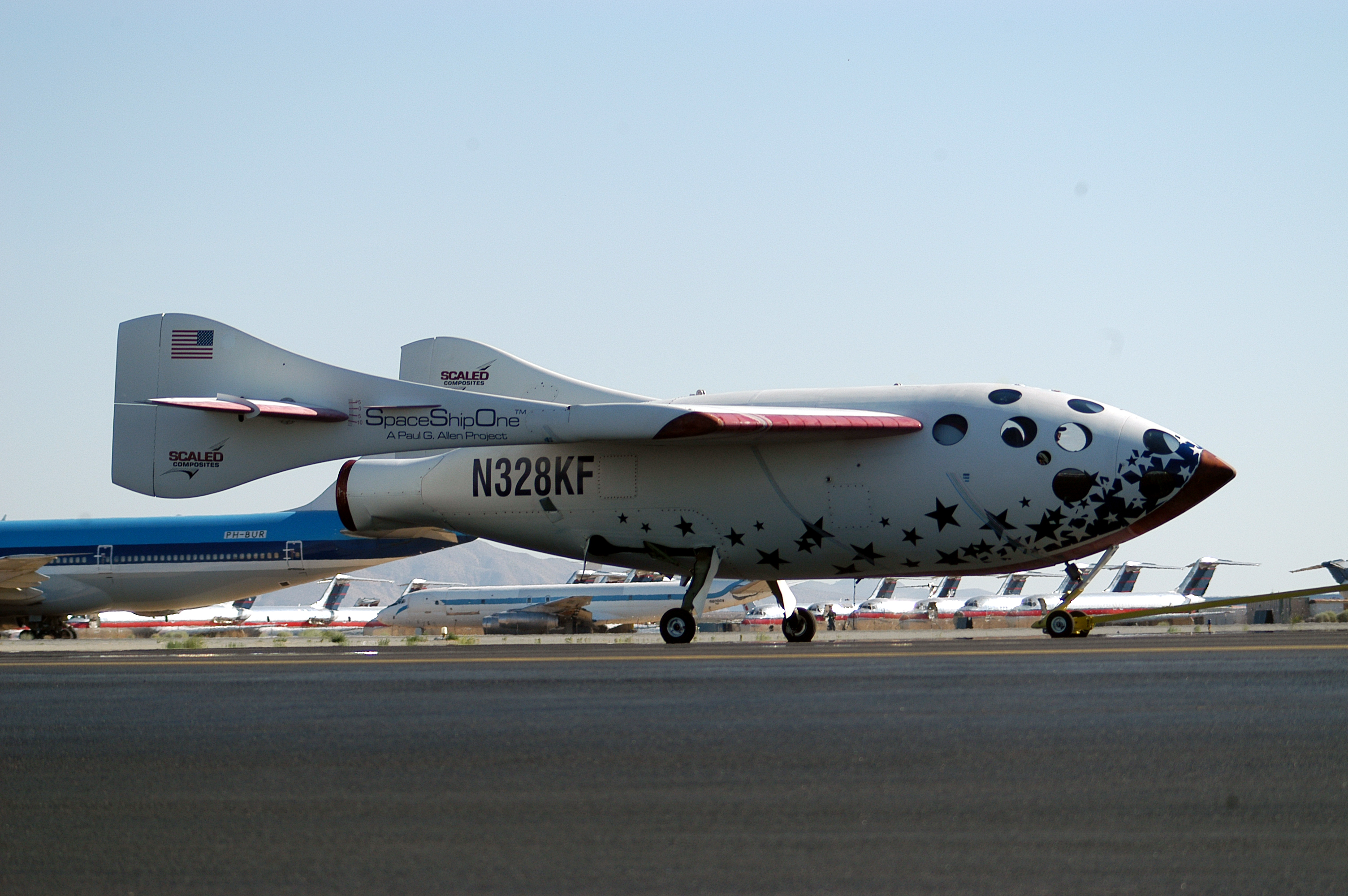
At 6:47 in the morning on 21 June 2004, an odd-looking white aircraft with two long tail booms lifted off the runway at the Mojave Air and Space Port in the California desert. The plane was called White Knight, and slung under its belly was a stubby rocket ship the size of a small bus, painted white and speckled with blue stars. Some eleven thousand people had driven out into the desert before dawn to watch. Bolted to the rocket ship was a 63-year-old test pilot named Mike Melvill, who was about to fly higher than any privately built craft had ever flown.
For about an hour White Knight spiraled upward, hauling its passenger toward the thin air at the top of the troposphere. At 47,000 feet, a little over fourteen kilometers up, the carrier plane released its load. SpaceShipOne dropped free, fell for a beat, and then Melvill lit the motor.
What happened over the next twenty-four minutes was messier than the press releases later suggested, and far more impressive for it. SpaceShipOne clawed its way past the 100-kilometer Kármán line, the internationally recognized boundary of space, by a margin so thin it could be measured in the length of a city block. When Melvill climbed out at Mojave a half hour later, he was the first human being to reach space in a vehicle that no government had built, funded, or flown. Spaceflight, for the first time in its history, had a private sector.
The flight itself was almost an afterthought to what it proved. A small company in the desert, bankrolled by one man’s checkbook, had done in three years what most people assumed required a national space agency and a decade of appropriations.
The Designer and the Billionaire
The story really starts with two men who could not have been more different. Burt Rutan was an aircraft designer with a reputation for ignoring the way things were supposed to be done. From a hangar in Mojave, his company Scaled Composites had spent decades building strange, beautiful airplanes out of molded composite, including the Voyager that flew around the world without refueling in 1986. Rutan thought human spaceflight had been captured by bureaucracy and that a small team could do it cheaply if it threw out the rulebook.
The money came from Paul Allen, who had co-founded Microsoft with Bill Gates and walked away wealthy enough to fund his own ideas. Allen had grown up on the promise of Apollo and watched it curdle into a program that, by the early 2000s, flew a handful of expensive Shuttle missions a year and had stopped feeling like the future. He agreed to back Rutan’s spaceship through a joint venture called Mojave Aerospace Ventures. The total bill came to more than 20 million dollars of Allen’s own money, an amount that would not cover a rounding error on a government launch program.
What they built broke from convention at every turn. Rather than launch from the ground, SpaceShipOne would be carried to altitude under White Knight and dropped, saving the enormous energy cost of climbing through the dense lower atmosphere. Its motor was a hybrid, burning solid rubber fuel with liquid nitrous oxide, a design chosen because it was simple, cheap, and could be shut down. And for the trip back down it used an idea Rutan called “feathering,” hinging the entire rear half of the wing upward so the craft fell belly-first like a shuttlecock, stable and slow, before folding back into a glider for the runway.
Rutan’s bet was that the hardest part of spaceflight, the part NASA spent billions on, was the reentry, and the feather solved it with a hinge. SpaceShipOne came back down in a self-stabilizing high-drag shape that needed almost no input from the pilot and shed heat without a heavy thermal shield. By December 2003 the spaceship had flown its first powered test, going supersonic on the way up. Through the spring of 2004 the team pushed the envelope higher with each flight. The June attempt was the real thing, the first try at crossing into space, and Melvill drew the assignment.
A Rough Ride to the Top
Melvill was an unlikely astronaut. Born in Johannesburg in 1940, he had no military test-pilot pedigree and no college degree. He had taught himself to fly, fallen in with Rutan in the 1970s, and become Scaled Composites’ chief test pilot, flying nearly every experimental design that came out of the Mojave hangar. He was 63 years old on the morning of the flight, an age when most pilots have long since retired.
The ascent did not go to plan. Seconds after the motor lit, near 60,000 feet, a wind shear rolled the ship 90 degrees to the left. Melvill corrected, and it rolled 90 degrees the other way. Fighting the oscillation, he ran the pitch trim hard against its stop, which triggered a designed three-second timeout in the trim actuator. Neither Melvill nor the ground understood what had happened in the moment. They read it as a failure, and he switched to the backup trim system while the rocket was still thundering. During the few seconds the craft flew uncommanded, it drifted badly off its planned path.
Then there was the bang. A new aerodynamic fairing wrapped around the rocket nozzle had overheated, gone soft, and crumpled inward with a loud crack that Melvill heard clearly over the roar of the motor. It did no real damage, but in the cockpit, mid-boost, it was one more thing to absorb.
You’re just sitting there, and the view is absolutely staggering. You can see the curvature of the Earth.
The motor burned for 76 seconds and pushed the ship to Mach 2.9, roughly 2,150 miles per hour, before Melvill shut it down and coasted the rest of the way up on momentum. He hung weightless for about three and a half minutes at the top of the arc. Reaching into his flight suit, he pulled out a handful of M&M’s, picked up on a whim that morning because they shared his initials, and let them tumble and float around the cabin while he raised the feather for the trip home.
One Hundred Twenty-Four Meters
The planned apogee had been around 360,000 feet, about 110 kilometers. The control trouble during the burn cost altitude, and SpaceShipOne topped out at 328,491 feet, which works out to 100,124 meters. The Kármán line, the boundary the world uses to define the start of space, sits at exactly 100,000 meters.
Melvill cleared it by 124 meters. The ship was above the line for roughly ten seconds before it began falling back. Had the flight lost much more energy during those uncommanded seconds, the most famous private spaceflight in history would have been a near miss instead of a record.
It held. The feather worked exactly as designed, stabilizing the fall through the upper atmosphere, and Melvill folded it back down and glided SpaceShipOne onto the Mojave runway at 8:14 a.m., 22 miles from where the flight plan said it should have come down but safely home. The whole flight, from drop to landing, had lasted about 24 minutes.
Launching from 47,000 feet let SpaceShipOne skip the densest, most fuel-hungry part of the climb. The same logic, an aircraft as a flying launch pad, runs straight through to Virgin Galactic’s air-launched system today and to the broader idea that you do not always need a giant ground-launched rocket to reach space. Rutan’s desert experiment was a proof of concept for an entire branch of the industry.
About two hours after wheels-down, an official from the Federal Aviation Administration pinned a set of commercial astronaut wings on Melvill, the first the agency had ever awarded. Melvill, grinning, held up a hand-lettered sign someone in the crowd had passed him. It read “SpaceShipOne, GovernmentZero.” For four decades, every human who had crossed into space had done so on a government’s vehicle. That morning, the scoreboard changed.
The Prize That Followed
The June flight was a demonstration, not a competition. The real target was the Ansari X Prize, a 10-million-dollar purse put up to reward the first private team that could fly a crewed craft to 100 kilometers twice within two weeks, carrying the weight of three people each time. Twenty-six teams around the world were chasing it. The June 21 flight carried no ballast and was never meant to count. It was the dress rehearsal.
The real attempt came that autumn. Melvill flew again on 29 September 2004, clearing the line a second time. Five days later, on 4 October, pilot Brian Binnie took SpaceShipOne up one more time, this time to 367,442 feet, about 112 kilometers, a higher mark than any of the program’s earlier flights. The two flights inside two weeks won the Ansari X Prize outright. Allen had spent more than twice the prize money to win it, which was never the point.
First powered flight
SpaceShipOne goes supersonic on its first rocket-powered test, on the 100th anniversary of the Wright brothers.
First private spaceflight
Mike Melvill reaches 100,124 m and becomes the first commercial astronaut.
First X Prize flight
Melvill crosses the Kármán line again, the first of the two qualifying flights.
Ansari X Prize won
Brian Binnie flies to 112 km, clinching the $10 million prize within the two-week window.
SpaceShipOne never flew again. Rutan retired it at the top of its game, and it now hangs in the Smithsonian’s National Air and Space Museum in Washington, between Charles Lindbergh’s Spirit of St. Louis and the Bell X-1 that first broke the sound barrier. The company placement was deliberate. The museum was making an argument about which flights mattered.
What It Started, and Who Carried It
The line from that Mojave morning to the present runs straight and clear. The technology became SpaceShipTwo, licensed to Richard Branson’s Virgin Galactic, which two decades later flies paying passengers to the edge of space from a spaceport in New Mexico. Where that whole suborbital tourism business actually stands today, more than twenty years after Melvill’s flight, is its own complicated scorecard. The proof that a small private team could reach space, cheaply and fast, helped clear the political and psychological ground for the commercial space industry that NASA now depends on. The agency that once held a monopoly on human spaceflight today buys rides to orbit from a private company. That world was not inevitable. It needed a first.
There is a quieter coda. The two men who flew SpaceShipOne across the line are both gone now. Brian Binnie died in 2024. Mike Melvill died on 19 March 2026, in California, at the age of 85, after a long illness. When the news reached Burt Rutan, he wrote a short, stunned tribute that captured how fast the era he built has already receded into history.
It seems impossible that there are still Apollo astronauts alive, while my two SpaceShipOne astronauts are now gone.
The men who reached space on government rockets in the 1960s are outliving the men who reached it on a homebuilt one in 2004. History does not always arrive in order. But the thing Melvill did that June morning, clearing the line by 124 meters in a craft no government had touched, holds its place no matter who outlives whom. He opened a door, climbed out, held up a sign, and went home. The industry walked through behind him.
References(11)
- Twenty Years Since Breaking a Boundary: SpaceShipOne - Scaled Composites, 2024
- First Privately Owned Spacecraft Travels Beyond Earth's Atmosphere, June 21 2004 - HISTORY
- SpaceShipOne Makes History: First Private Manned Mission To Space - ScienceDaily, June 2004
- Private Rocket Ship Breaks Space Barrier - NBC News, June 2004
- SpaceShipOne: The First Private Spacecraft - Space.com
- SpaceShipOne - Smithsonian National Air and Space Museum
- The Unlikeliest Astronaut - AOPA, 2013
- SpaceShipOne Wins $10 Million Ansari X Prize in Historic 2nd Trip to Space - Space.com
- October 4, 2004: SpaceShipOne Wins $10 Million X Prize - Smithsonian Magazine
- Mike Melvill, First Commercial Astronaut Who Piloted SpaceShipOne, Dies at 85 - collectSPACE, 2026
- Stratolaunch Founder Paul Allen Dies - SpaceNews, 2018

Theodore Kruczek