· today in space history · 9 min read
Sally Ride and the Twenty Years It Took America to Catch Up
At 7:33 on the morning of 18 June 1983, a 32-year-old astrophysicist named Sally Ride rode Challenger off Pad 39A and became the first American woman in space. She got there two decades after the Soviets, and only after months of being asked whether spaceflight would damage her reproductive organs and whether she planned to cry.
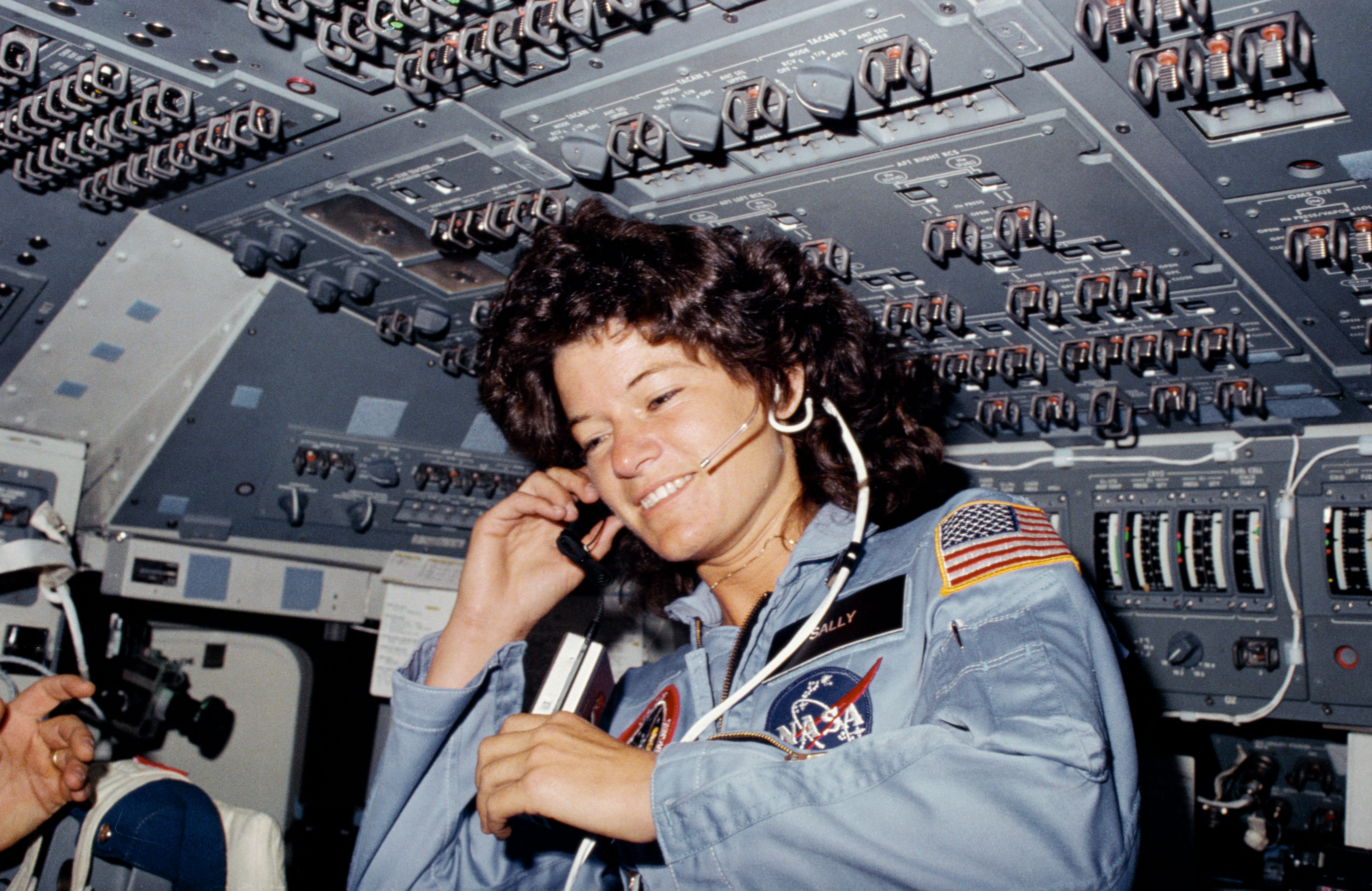
At 7:33 in the morning, Eastern time, on 18 June 1983, the Space Shuttle Challenger lit its engines on Pad 39A at the Kennedy Space Center and climbed into a clear Florida sky. An estimated half a million people had come to watch, many of them wearing T-shirts that read “Ride, Sally Ride.” Strapped into the middeck for ascent was a 32-year-old physicist from California named Sally Kristen Ride, and by the time Challenger reached orbit eight and a half minutes later she had become the first American woman in space.
She was also, at 32, the youngest American to have flown to that point. The mission, STS-7, carried the largest crew yet launched aboard a single spacecraft, five people, and it was only the seventh flight of the Space Shuttle program. Any one of those facts would have made the flight notable. What made it news on every front page in the country was the one that needed no explaining.
The strange part of the achievement was how late it came. The Soviet Union had put a woman into orbit twenty years and two days earlier, when Valentina Tereshkova flew Vostok 6 on 16 June 1963. For two decades after that, the United States, the country that had landed men on the Moon and prided itself on opportunity, had flown nothing but men. The gap was not a matter of capability. It was a matter of who NASA had been willing to ask.
That is the real story of STS-7. The flight itself went nearly flawlessly. The road that led to it ran through twenty years of assumptions about who belonged in a spacecraft.
20 years
Between the first woman in space and the first American woman
Tereshkova flew in June 1963. No American woman followed until Sally Ride in June 1983, and only after NASA finally opened astronaut selection to women in 1978.
An Ad in the Stanford Daily
Sally Ride did not grow up planning to be an astronaut. There was no point in planning for a job that, for women, did not exist. She was a nationally ranked junior tennis player good enough that Billie Jean King once told her she should turn professional. She chose physics instead, earning her bachelor’s and master’s degrees at Stanford and staying on for a doctorate in astrophysics, studying the behavior of X-rays in the interstellar medium.
In 1977, near the end of that PhD work, she saw an announcement in the Stanford student newspaper. NASA was recruiting a new class of astronauts for the Space Shuttle, and for the first time it was inviting women to apply. Roughly 8,000 people sent in applications. NASA selected 35. Six were women, and Ride was one of them. The class that reported for training in 1978, formally Astronaut Group 8, nicknamed itself the “Thirty-Five New Guys,” a joke that captured exactly how new the idea of mixed-gender crews still was.
Selection was not the same as flying. Ride spent five years training and working support roles, including a stint as a capsule communicator, the voice in Mission Control that talks to the crew, for the second and third Shuttle flights. She also helped develop the Shuttle’s robotic arm, the Canadian-built remote manipulator system. That expertise is part of why commander Robert Crippen, who got to help pick his own crew, chose her for STS-7. He wanted someone who knew the arm, and Ride knew it as well as anyone.
When NASA announced in April 1982 that she would fly, the assignment turned a working scientist into a symbol overnight, whether she wanted the role or not.
The Questions They Asked Her
What followed was a months-long demonstration of why it had taken so long to get here. The press did not quite know what to do with a woman astronaut, and the questions reflected it. Reporters asked Ride whether spaceflight would affect her reproductive organs. They asked whether she planned to have children. They asked whether she cried when things went wrong on the job, and how she would handle the emotional pressure of a mission.
At one pre-flight press conference, a correspondent reportedly opened with “Dr. Ride, a couple of fast questions, sir, ma’am,” genuinely unsure how to address her. When an interviewer pressed her on whether she wept under stress during training, Ride had a standing answer that cut straight to the absurdity of being singled out.
Why doesn’t anybody ask Rick those questions?
Rick was Frederick Hauck, the mission’s pilot, who was not being asked whether he would cry. The engineering side of NASA was not always better. In one widely retold exchange, technicians preparing her personal kit asked whether 100 tampons would be the right number for a one-week flight, a question that revealed how little institutional thought had gone into flying a woman even at the level of basic supplies.
Ride mostly absorbed it with dry patience and kept the focus on the work. She was a mission specialist with a doctorate in physics and a specific, technical job to do, and she made clear that was how she wanted to be seen. The flight, she understood, would speak louder than any press conference.
Six Days Aboard Challenger
STS-7 was a working mission, not a publicity flight, and its manifest was full. Over six days Challenger’s crew deployed two commercial communications satellites, Anik C2 for Telesat Canada and Palapa B1 for Indonesia, spinning them out of the payload bay to begin their climb toward geostationary orbit. Ride, sharing mission-specialist duties with John Fabian, was central to those deployments.
The flight’s signature maneuver was a first for the program. The crew released a German-built science platform called SPAS-01, let it fly free alongside the orbiter taking photographs of Challenger against the Earth, and then reached out with the robotic arm and pulled it back aboard. It was the first time a satellite had been deployed and then retrieved with the Shuttle’s arm, and Ride was the first woman to operate that arm in space. Crippen summed up the operation with a line that became the unofficial motto of the flight.
We pick up and deliver.
The numbers behind those six days were straightforward by Shuttle standards and remarkable for what they represented.
The plan had been to bring Challenger home on the runway at Kennedy, which would have been a program first. Poor weather in Florida forced a diversion, and on 24 June the orbiter touched down instead at Edwards Air Force Base in California, on the dry lakebed where the early Shuttle flights had been landing all along. Ride later said the part of the flight she would remember most had nothing to do with history.
The thing I’ll remember most about the flight is that it was fun. In fact, I’m sure it was the most fun that I’ll ever have in my life.
The Woman, Not the Symbol
Ride flew once more, on STS-41-G in October 1984, a mission that included Kathryn Sullivan, who became the first American woman to walk in space. Ride was assigned to a third flight, but it was still in training when Challenger broke apart 73 seconds after launch in January 1986, killing all seven aboard. Her remaining mission was cancelled along with the rest of the schedule, and she never flew again.
What she did next mattered as much as her flights. President Reagan appointed her to the Rogers Commission investigating the Challenger disaster, where she worked alongside physicist Richard Feynman and helped expose how NASA’s management had ignored engineering warnings about the booster seals. Seventeen years later, after the loss of Columbia in 2003, she was named to that investigation too. She is the only person who served on both Space Shuttle accident investigation boards, a distinction that says something about how seriously her judgment was taken once the cameras moved on.
Sees the NASA ad
While finishing her physics PhD at Stanford, Ride answers a newspaper notice recruiting astronauts, now open to women.
Selected for Astronaut Group 8
One of six women among 35 candidates in NASA's first class to include women.
STS-7 launches
Ride becomes the first American woman in space aboard Challenger.
Rogers Commission
Serves on the panel investigating the Challenger disaster.
Columbia board
Becomes the only person to sit on both Shuttle accident investigations.
Dies at 61
Sally Ride dies of pancreatic cancer after a 17-month illness.
After leaving NASA, Ride became a physics professor at the University of California, San Diego, and in 2001 co-founded Sally Ride Science, a company built to keep middle-school girls interested in science and engineering before the cultural pressure to drop out kicks in. It was the same problem she had quietly beaten herself, told through a company instead of a press conference.
She kept the most personal part of her life private. When she died of pancreatic cancer on 23 July 2012, at 61, her obituary revealed that she had shared the previous 27 years with Tam O’Shaughnessy, a childhood tennis friend who became her partner and the co-founder of her company. That single line made her, in retrospect, the first known LGBT astronaut, a fact she had chosen not to make public during her lifetime. The following year she was awarded the Presidential Medal of Freedom.
Twenty Years, Closed
The thing worth sitting with is the distance between Tereshkova and Ride. Two competent women, two near-identical firsts, separated by twenty years that had nothing to do with whether a woman could fly a spacecraft. Tereshkova had answered that question in 1963, on her first day in orbit, when she caught an error in her descent program that ground controllers had missed. The world spent two decades acting as if the question were still open.
Sally Ride closed it the way she did most things, by being obviously good at the job and refusing to treat the fuss as the point. She flew the arm, deployed the satellites, came home, and went back to work, first investigating why NASA’s own overconfidence had killed seven people, then spending the rest of her life making sure the girls coming up behind her would never have to read an ad to discover the door was finally open.
The half a million people on the Florida coast that June morning understood the symbolism. Ride understood the work. Both were true, and the flight needed both. But the cleanest measure of what she accomplished is that within a few years a woman on a Shuttle crew was no longer a headline. That, more than the half-million spectators, is what winning looks like.
References(11)
- Sally Ride - First American Woman in Space - NASA History
- 40 Years Ago: STS-7 and the Flight of Sally Ride - NASA History
- Sally Ride (1951-2012) - NASA Science
- STS-7 - NASA Mission Information
- Sally Ride and Valentina Tereshkova: Changing the Course of Human Space Exploration - NASA History
- How Sally Ride Faced Sexism as an Astronaut - HISTORY
- Sally Ride becomes the first American woman in space, June 18, 1983 - HISTORY
- Sally Ride - Challenger, American Astronaut, NASA, & Death - Britannica
- Biography: Sally Ride - National Women's History Museum
- Badge, Columbia Accident Investigation Board (CAIB), Sally Ride - Smithsonian National Air and Space Museum
- STS-7 Fact Sheet - Spaceline

Theodore Kruczek