· today in space history · 9 min read
How a Parachutist Named Seagull Became the First Woman in Space
On 16 June 1963, a 26-year-old former textile worker named Valentina Tereshkova launched aboard Vostok 6 and spent nearly three days alone in orbit. She flew 48 times around the Earth, longer than every American astronaut combined, and spotted a dangerous flaw in her descent program that ground controllers had missed.
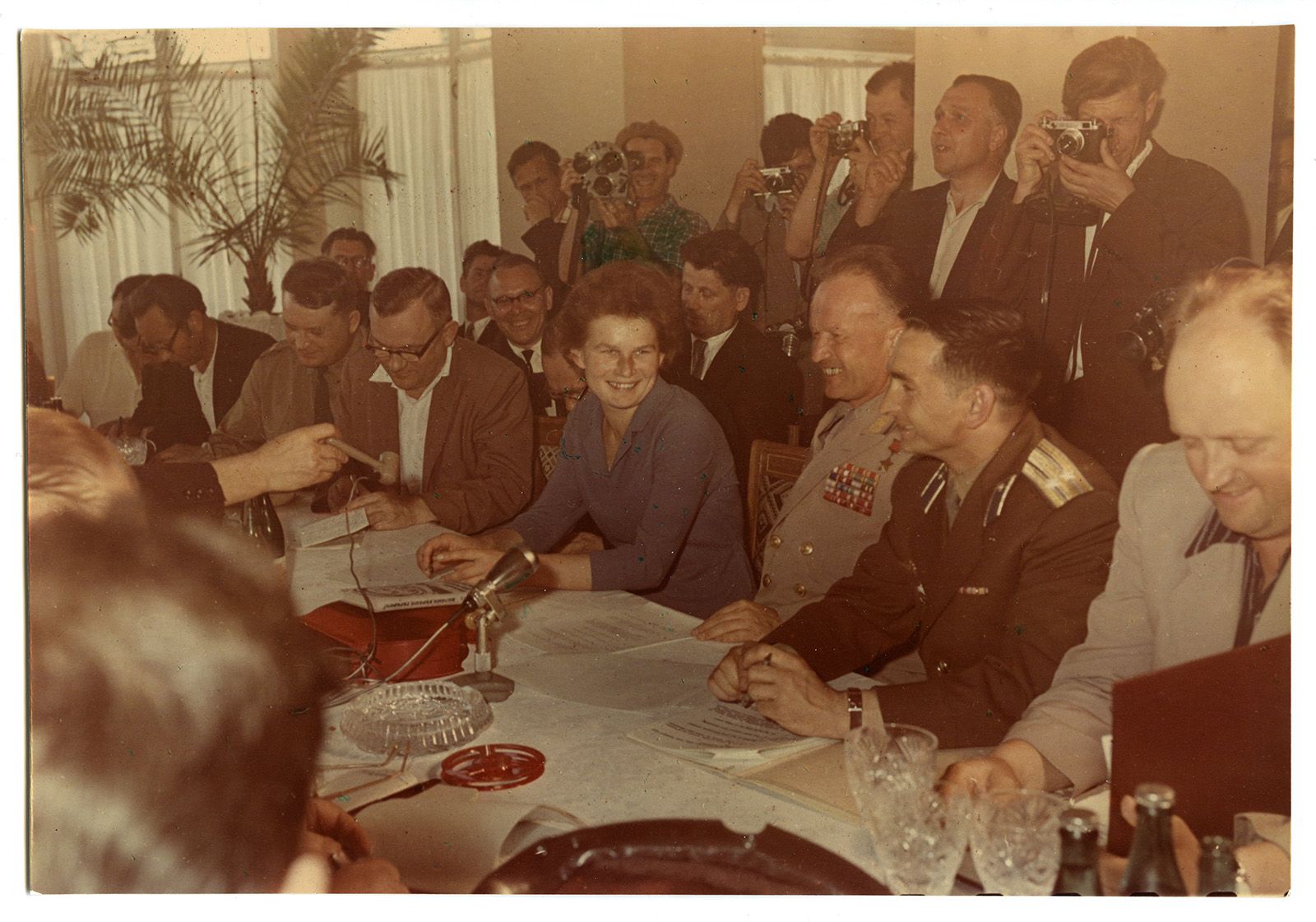
At 12:30 in the afternoon, Moscow time, on 16 June 1963, a Vostok rocket climbed off a pad at the Baikonur Cosmodrome carrying a 26-year-old woman who, three years earlier, had been operating looms at a textile mill on the Volga. Her name was Valentina Vladimirovna Tereshkova. By the time the upper stage shut down and her capsule slipped into orbit, she had become the first woman ever to leave the planet.
She was not a pilot. She had never flown an aircraft. What she had done, hundreds of times, was jump out of one. That single qualification, amateur parachuting, was the thread that pulled her from a provincial factory floor into the most exclusive corps on Earth and then off the Earth entirely.
Her radio callsign was Chaika, the Russian word for seagull. Minutes into the flight, controllers on the ground heard her voice come down through the static.
I am Seagull. I see the horizon, a light blue, a beautiful band. This is the Earth. How beautiful it is.
The flight that followed would last almost three days and circle the globe 48 times. It would also turn Tereshkova into one of the most recognizable people alive, a propaganda triumph for Nikita Khrushchev, and the answer to a trivia question that would not get a sequel for nearly two decades.
From the Krasny Perekop Mill to the Cosmonaut Corps
Tereshkova was born on 6 March 1937 in the village of Maslennikovo, in Yaroslavl Oblast, north of Moscow. Her father, a tractor driver, was killed during the Soviet war with Finland when she was two. Her mother raised the family and went to work at the Krasny Perekop cotton mill, where Valentina eventually followed her onto the factory floor.
What set her apart was a hobby. In May 1959, at the age of 22, she made her first parachute jump at a local aviation club. She kept jumping, building up the kind of logbook that, by chance, was exactly what the Soviet space program was quietly looking for.
The Vostok capsule did not land with its occupant inside. On the way down, the cosmonaut ejected at roughly six kilometers and came home under a personal parachute, separate from the spacecraft. That detail made experienced parachutists ideal candidates, and in 1961 the program decided to recruit a group of women. The motive was openly political. Sending the first woman into space before the Americans did would be a propaganda coup, and the leadership wanted it.
In February 1962, out of more than four hundred applicants, five women were selected. They were Tereshkova, Tatyana Kuznetsova, Irina Solovyova, Zhanna Yorkina, and Valentina Ponomaryova. They trained alongside the men in weightless flights, isolation tests, and centrifuge runs, and they were given commissions in the Soviet Air Force. Of the five, only one would ever fly.
The choice came down to more than flight scores. Major General Nikolai Kamanin, who ran cosmonaut training, valued Tereshkova’s working-class background and her ease in front of crowds. She was the daughter of a war hero, a mill worker, a committed member of the Komsomol. For a state that wanted to present spaceflight as a triumph of ordinary Soviet citizens, she was, in the most literal sense, the right profile.
Two Ships in the Same Sky
Vostok 6 did not fly alone. It was the second half of a dual mission. Two days earlier, on 14 June 1963, cosmonaut Valery Bykovsky had launched aboard Vostok 5 on what would become a record-setting solo endurance flight of nearly five days. Tereshkova’s launch was timed so that the two capsules would share the sky.
Vostok 5 launches
Valery Bykovsky reaches orbit, beginning a solo endurance flight of just under five days.
Vostok 6 launches
Tereshkova lifts off from Baikonur just after 12:30 p.m. Moscow time, checking in as Chaika.
Closest approach
The two capsules pass within roughly five kilometers, and the cosmonauts speak to each other by radio.
Both come home
Tereshkova ejects and parachutes onto the Altai steppe after 48 orbits. Bykovsky lands hours later.
The two spacecraft were never designed to dock or to maneuver toward one another, and they could not. Vostok had no engine for orbital rendezvous. The flight plan instead put them on orbits that brought them, at one point early in Tereshkova’s mission, within about five kilometers of each other. That was close enough for the two cosmonauts to exchange radio greetings before their paths drifted apart again, a propaganda image of Soviet ships flying in formation that was, in engineering terms, a carefully arranged near-miss rather than a controlled approach.
For the rest of the flight, Tereshkova worked alone. She kept a flight log, photographed the horizon for later atmospheric studies, and ran the basic biomedical observations the program needed to understand how a woman’s body handled extended weightlessness. She also reported feeling unwell, with nausea and fatigue that she later attributed in part to the spacecraft’s food and the discomfort of the suit. Soviet officials, sensitive to anything that might tarnish the achievement, kept those details muted for years.
The Error in the Descent Program
The most serious moment of the mission was not the launch or the landing. It was a problem with the numbers loaded into the spacecraft’s orientation system, and Tereshkova was the one who caught it.
As she checked the spacecraft’s behavior, she realized that the automatic control settings were wrong in a way that mattered enormously. Configured as they were, firing the retrorocket would not have lowered her orbit for reentry. It would have pushed the spacecraft higher, into an orbit she had no way to come back from. She reported the discrepancy to the ground, where it reached Sergei Korolev, the chief designer of the Soviet space program. Controllers worked out corrected figures and relayed new data for her to enter before the descent.
A flaw in the descent program had the retrofire pointed the wrong way. Left uncorrected, the burn that was supposed to bring Tereshkova home would have raised her orbit instead. She flagged it from space, Korolev’s team sent up new numbers, and the reentry went as planned. The episode stayed out of public accounts for more than forty years.
Korolev reportedly asked her to keep the incident quiet, and she did. The story of the bad descent data did not surface in detail until decades later, long after the Soviet Union itself was gone. For most of the twentieth century, the official version of Vostok 6 was a flawless flight, with no hint that its pilot had headed off a catastrophe in the first day of the mission.
Three Days, Forty-Eight Orbits
Stripped of the politics, the raw numbers of the flight were genuinely staggering for 1963.
Tereshkova spent 2 days, 22 hours, and 50 minutes in orbit. In that time she logged more hours in space than the six American Mercury astronauts had accumulated, combined, across all of their flights. Her capsule rode an orbit inclined about 65 degrees to the equator, steeper than any crewed flight before it, which carried her over higher latitudes than earlier missions had reached.
On 19 June, the corrected descent worked exactly as intended. The capsule separated, the heat of reentry built and faded, and Tereshkova ejected as planned. She came down by parachute onto the steppe of the Altai region, several hundred kilometers from the Kazakh border, with a bruise on her face from the hard landing. Villagers reached her before the recovery team did. By some accounts she traded her sealed space rations for local bread and kvass, a small human moment that earned her a reprimand from a medical staff who had wanted those samples and her strict diet preserved.
Propaganda, and the Long Silence After
For Khrushchev, the flight was exactly the victory he had ordered up. He spoke to Tereshkova by radio during the mission and put her at the center of the celebrations afterward. The message was deliberate. A Soviet woman had flown in space while the United States, for all its wealth, was still an all-male astronaut club and would remain one for twenty more years.
Then the program that produced her was quietly shelved. The other four women in the corps never flew. The leadership had what it wanted, a first, and saw little further political return in sending more women up. The next Soviet woman, Svetlana Savitskaya, would not reach orbit until 1982, nineteen years after Tereshkova, and Savitskaya’s flight was itself prompted in part by news that NASA was finally about to fly women of its own.
That gap is the uncomfortable core of the Tereshkova story. Her flight was real, difficult, and competently flown, including the descent she helped save. It was also, from the state’s point of view, a one-time demonstration rather than the opening of a door. The first woman in space was followed by no second woman for almost two decades, on either side of the Iron Curtain.
The Seagull’s Legacy
Tereshkova never flew again. She became a prominent public figure in the Soviet Union and then in Russia, serving for decades in political roles and remaining, into her late eighties, a national symbol. In 2013, around the fiftieth anniversary of her flight, she said publicly that she would happily take a one-way trip to Mars if the chance came.
The clearest measure of what she started is the flight that mirrored hers almost exactly twenty years later. On 18 June 1983, Sally Ride launched aboard the Space Shuttle Challenger and became the first American woman in space, closing a gap that Tereshkova’s 1963 flight had opened and then, for political reasons, left hanging. The two missions are often told together, and they belong together. One woman was sent up to win a propaganda race. The other flew as a working member of a crew, in an era when that had finally become unremarkable.
The distance between those two flights is the real story. Tereshkova proved on her first day in orbit, catching an error that could have killed her, that the question of whether a woman could fly and operate a spacecraft had a simple answer. The world then spent twenty years acting as if it hadn’t heard her. The Seagull had said it plainly enough from orbit. The Earth, she reported, was beautiful, and she was there to see it.
References(8)
- Vostok 6 - NASA NSSDCA Spacecraft Details
- Sally Ride and Valentina Tereshkova: Changing the Course of Human Space Exploration - NASA History
- First woman in space: Valentina - European Space Agency
- Valentina Tereshkova - Britannica
- Soviet cosmonaut Valentina Tereshkova becomes the first woman in space, June 16, 1963 - HISTORY
- Valentina Tereshkova: First woman in space - Space.com
- The First Group of Female Cosmonauts Were Trained to Conquer the Final Frontier - Smithsonian Magazine
- Sally Ride - First American Woman in Space - NASA History

Theodore Kruczek