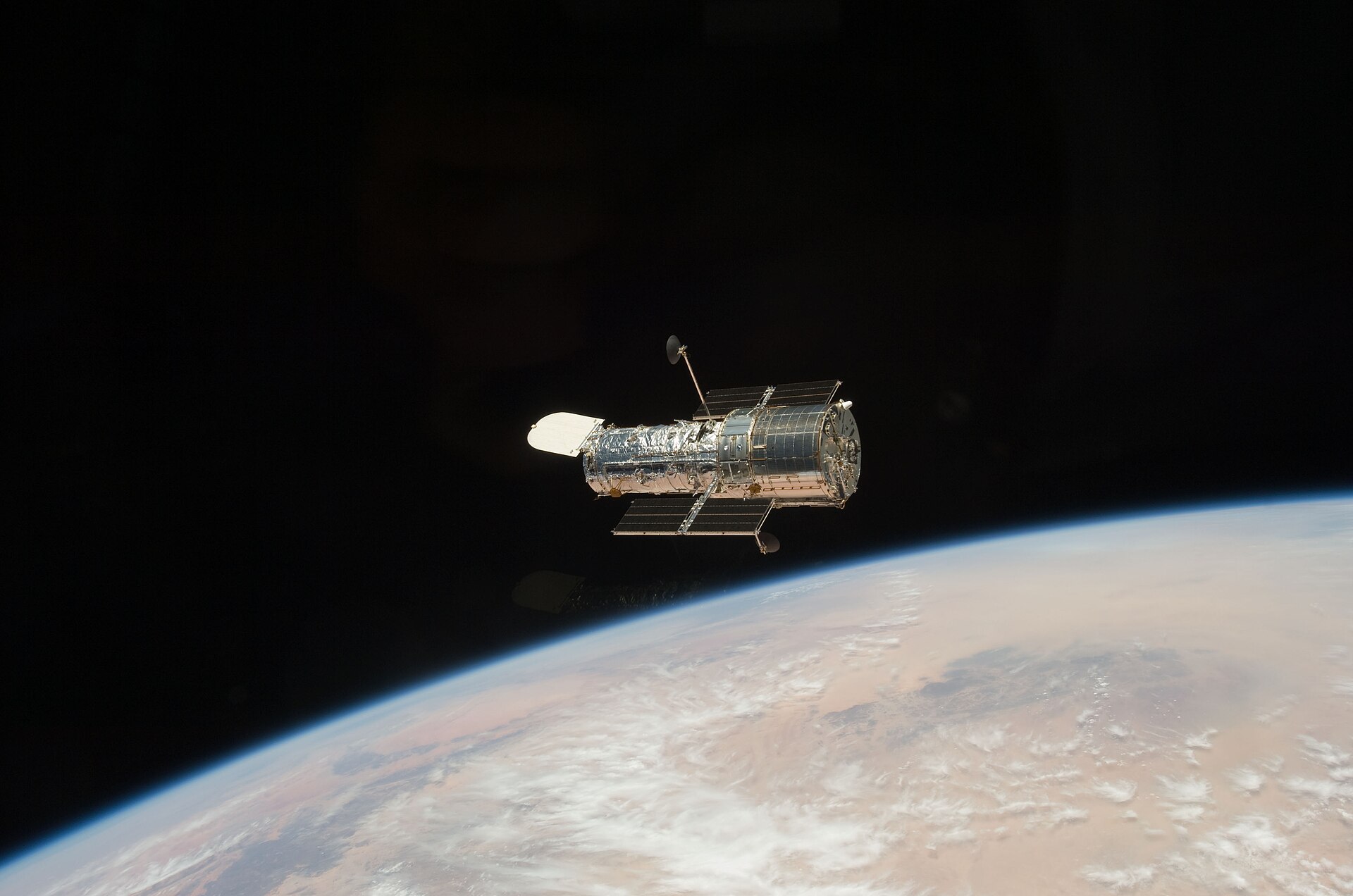
At 3:38 p.m. Eastern on April 25, 1990, mission specialist Steven Hawley reached the robotic arm of Space Shuttle Discovery out over the payload bay, grappled a satellite the size of a school bus, and lifted it into the sunlight streaming over the Pacific. The satellite’s two solar arrays unfurled. Its aperture door rotated open to the stars. A gentle push from the robotic arm released it into its 612-kilometer orbit at an inclination of 28.5 degrees. And with that, the Hubble Space Telescope began what NASA had promised would be a fifteen-year mission to change astronomy forever.
It was the smoothest deployment of anything we’d ever done. We figured, right up to the minute we released it, that some small thing would refuse to work. Nothing did. We were handing off a piece of equipment in perfect health.
Shriver was right about the deployment. He was spectacularly wrong about the health. Within weeks of arrival in orbit, the first test images came back to the Space Telescope Science Institute in Baltimore showing something profoundly broken. Point sources - individual stars - did not form the crisp diffraction-limited dots that Hubble had been designed to produce. They formed blurred halos with faint wings, a classic signature of one of the oldest optical defects known to astronomy. Someone had ground the primary mirror to the wrong curve.
The Mirror That Was Too Good and Too Wrong
Hubble’s primary mirror is a 2.4-meter-diameter disk of ultra-low-expansion glass, polished to what was, at the time of fabrication in 1981-1982, the most precise optical figure ever produced by human hands. Perkin-Elmer Corporation in Danbury, Connecticut, spent two years grinding the mirror to a specification of one-twentieth of a wavelength of green light - meaning no deviation greater than 28 nanometers across the entire surface. By that metric, the mirror was polished to the tolerance the specification required.
The specification was wrong.
Perkin-Elmer had designed and built a device called a reflective null corrector to verify the mirror’s curvature during polishing. The corrector used a small secondary mirror whose position relative to a measurement lens defined the zero point of the optical test. That measurement lens was mounted to a metering rod whose spacing was set by a metering cap. And the metering cap, installed by a technician during assembly of the null corrector, was positioned against the wrong surface of a bracket. The error was 1.3 millimeters.
A 1.3-millimeter error in the null corrector translated, through the rigorous mathematics of optical testing, into a 2.2-micrometer error in the mirror’s conic constant. The primary mirror had been ground to produce a focal surface with a specific shape - hyperbolic, as designed - but the shape was off by that 2.2 micrometers at the edge. The consequence was spherical aberration, in which light reflecting off different zones of the mirror arrived at slightly different focal distances.
The error was detected during ground testing by a separate Perkin-Elmer measurement using a refractive null corrector - a completely independent instrument that gave different results from the reflective null. Rather than investigate the discrepancy, Perkin-Elmer engineers and NASA project managers dismissed the refractive null as less accurate and trusted the reflective null. The decision to ignore the conflicting measurement would become the central finding of the 1990 Allen Commission report.
$2.5 billion
Hubble's pre-launch cost
Adjusted for inflation, roughly $6 billion in 2026 dollars. The spherical aberration made this look like the most expensive unusable telescope in history. For six weeks, it was.
Six Weeks From Champagne to Disaster
The STS-31 crew returned to Earth on April 29, 1990, and was treated as heroes. NASA held a press conference. Congressmen appeared in photos with the empty payload bay. The Space Telescope Science Institute in Baltimore had roughly 6,000 astronomers worldwide queued up for observation time.
The first images came back the week of June 25. They were awful. Point sources were blurred halos with 15-20% of the light smeared into the halo rather than the core. Resolution was degraded by a factor of three to ten, depending on what measurement you used. Extended sources like galaxies and nebulae were almost unusable for scientific purposes. The Wide Field/Planetary Camera had to revise its scientific program downward by an order of magnitude.
NASA confirmed the spherical aberration on June 27, 1990. The public reaction was merciless. Senator Barbara Mikulski, chair of the Senate Appropriations subcommittee that funded NASA, convened hearings within weeks. Editorial cartoons showed blurred Hubble images with captions mocking American engineering. Johnny Carson joked about it on the Tonight Show for a week. The agency that had delivered the Moon, the Shuttle, and Voyager now had its most publicly visible scientific project crippled in full view of the world.
The Fix Nobody Thought Was Possible
The spherical aberration in Hubble’s primary mirror could have been fixed in one way: replace the mirror. That would have required either returning Hubble to Earth (impossible - the Shuttle could not land with a telescope in the bay) or sending up a replacement mirror and astronauts to install it (enormously expensive and technically challenging).
What NASA chose instead was subtler. The spherical aberration of Hubble’s mirror, though damaging, was deterministic. Its exact mathematical form was known. If the mirror over-focused light by a specific amount in a specific pattern, then a corrective optic that under-focused light by exactly the same amount in exactly the opposite pattern would cancel the error out. The corrector, in other words, could be fitted not to the primary mirror, but to Hubble’s downstream instruments - replacing the affected cameras and spectrographs with new versions that carried their own correcting optics.
This is how the Corrective Optics Space Telescope Axial Replacement (COSTAR) was born. Engineers at Ball Aerospace, Jet Propulsion Laboratory, and Goddard worked through 1991 and 1992 on an instrument-sized module that would replace the High Speed Photometer in one of the telescope’s instrument bays. COSTAR contained a set of tiny corrective mirrors that would be deployed on mechanical arms in front of the Faint Object Camera, Faint Object Spectrograph, and Goddard High Resolution Spectrograph. Each mirror was ground to an optical figure that exactly compensated for the error in the primary.
The Wide Field/Planetary Camera 2, already in development as a follow-on to the original WFPC, was redesigned to carry its own internal corrective optics. The new WFPC 2 was the crown jewel of the fix: a single camera module, self-correcting, that would replace the crippled original.
Servicing Mission 1
Everything depended on Servicing Mission 1, the first scheduled Hubble repair mission, launched as STS-61 on December 2, 1993. The crew, commanded by Dick Covey, included astronauts Story Musgrave, Jeff Hoffman, Tom Akers, and Kathy Thornton, plus mission specialists Ken Bowersox and Claude Nicollier. The mission was a tour de force. Seven EVAs. Five instrument replacements. A new solar array to fix a vibration problem that had been jittering the pointing system. The COSTAR deployment. The WFPC 2 swap.
STS-31 deployment
Discovery releases Hubble Space Telescope into 612-km orbit. Champagne flows at NASA.
Spherical aberration confirmed
NASA announces Hubble's primary mirror is defective. Point source imaging degraded by a factor of 3-10.
Allen Commission report
Investigation blames Perkin-Elmer's reliance on a single test instrument and NASA's insufficient oversight.
STS-61 Servicing Mission 1
COSTAR and WFPC 2 installed over seven EVAs. First corrected images astonish the world in January 1994.
STS-82 Servicing Mission 2
NICMOS near-infrared camera and STIS spectrograph installed.
STS-103 Servicing Mission 3A
Emergency replacement of failing gyroscopes. Hubble had been in protective mode for weeks.
STS-109 Servicing Mission 3B
New solar arrays, power control unit, and the Advanced Camera for Surveys replacing the Faint Object Camera.
STS-125 Servicing Mission 4
Final servicing mission. Wide Field Camera 3, Cosmic Origins Spectrograph installed. Original mirror still uncorrected but all downstream instruments now have internal correctors.
The first corrected images came back on January 13, 1994. A picture of the core of globular cluster M100 circulated widely, showing resolution ten times better than the pre-servicing images of the same target. The spherical aberration was gone. The $2.5 billion satellite that had been a national embarrassment was, in a span of weeks, a national treasure. Mikulski declared at a press conference that “the trouble with Hubble is over.”
Thirty-Six Years of Science
Hubble has operated continuously since 1990. The Servicing Mission 4 in May 2009 installed the Wide Field Camera 3 and Cosmic Origins Spectrograph, the last two instruments ever to fly to the telescope (the Shuttle program retired in 2011, ending the possibility of future servicing). WFC3 has operated for seventeen years. Hubble’s original mission plan was fifteen years. Every year it has operated past 2005 has been a bonus.
The scientific output is difficult to summarize, but some benchmarks matter. Hubble has produced the definitive Hubble Deep Field images of 1995, revealing thousands of galaxies in a tiny patch of sky that had appeared empty to ground-based telescopes. It has measured the Hubble constant to within a few percent, reshaping cosmology. It has discovered the accelerating expansion of the universe (the 2011 Nobel Prize in Physics, awarded to Perlmutter, Schmidt, and Riess, was based on Type Ia supernova data obtained in part by Hubble). It has observed the atmospheres of exoplanets. It has imaged the birth and death of stars across the galaxy.
The telescope’s catalog has grown to over 1.6 million scientific exposures. The Space Telescope Science Institute has received observation proposals at oversubscription ratios of 5:1 to 7:1 for every annual cycle since 1993. More than 20,000 peer-reviewed scientific papers have been published using Hubble data.
The Flaw That Became a Case Study
The spherical aberration was not just an engineering failure. It was an organizational failure, and NASA has treated it as one ever since. Aerospace programs study the Allen Commission report the way medical students study famous misdiagnoses. The practice of “independent verification through redundant measurement,” now standard in large space telescope programs, was born from Hubble’s mistake. The James Webb Space Telescope’s mirrors, manufactured twenty years later by Ball Aerospace, were verified using multiple independent optical tests specifically to prevent a repeat. The Nancy Grace Roman Space Telescope, scheduled to launch in 2027, follows the same protocol.
The fix also taught the space telescope community something it had not previously known: that corrective optics inserted downstream of a primary mirror can, for all practical purposes, cancel the primary’s systematic errors. This insight influenced the design of every major space telescope that followed. JWST’s coarse phasing and fine phasing procedures assume that small residual wavefront errors can always be corrected in software or with active optics. Roman Space Telescope’s coronagraph uses wavefront control to achieve contrast ratios that would be impossible on passive optics alone.
Why the Anniversary Still Matters
Hubble turns 36 years old on April 25, 2026. It is still in orbit. It is still operating. Its gyroscopes are aging and its instruments are beyond their design life, but the telescope continues to produce science, and the team that runs it at the Space Telescope Science Institute shows no sign of calling it done.
The April 25 anniversary is, in one sense, the anniversary of a near-disaster. It is also the anniversary of what was, until recently, the most ambitious space-based science mission in human history. The combination of those two facts - deployment of a crippled instrument, followed by one of the most improbable engineering recoveries in the history of spaceflight - is what makes Hubble a case study rather than just a telescope. Every future large space telescope is a descendant of the institutional learning that took place between 1990 and 1994, when NASA had to figure out how to fix a telescope that could not be brought home.
References(8)
- The Hubble Space Telescope Optical Systems Failure Report - NASA (Allen Commission), November 1990
- Hubble Space Telescope Overview - Space Telescope Science Institute
- Servicing Mission 1 Press Kit - NASA STS-61, December 1993
- Hubble: The First Deep Field - Williams et al., Astronomical Journal, 1996
- Saving Hubble - Chris Gainor, University of Nebraska Press, 2020
- The Universe in a Mirror - Robert Zimmerman, Princeton University Press, 2008
- COSTAR Corrective Optics Technical Overview - NASA Goddard, 1993
- Hubble Science Results - NASA Astrophysics Division Annual Reports 1994-2024