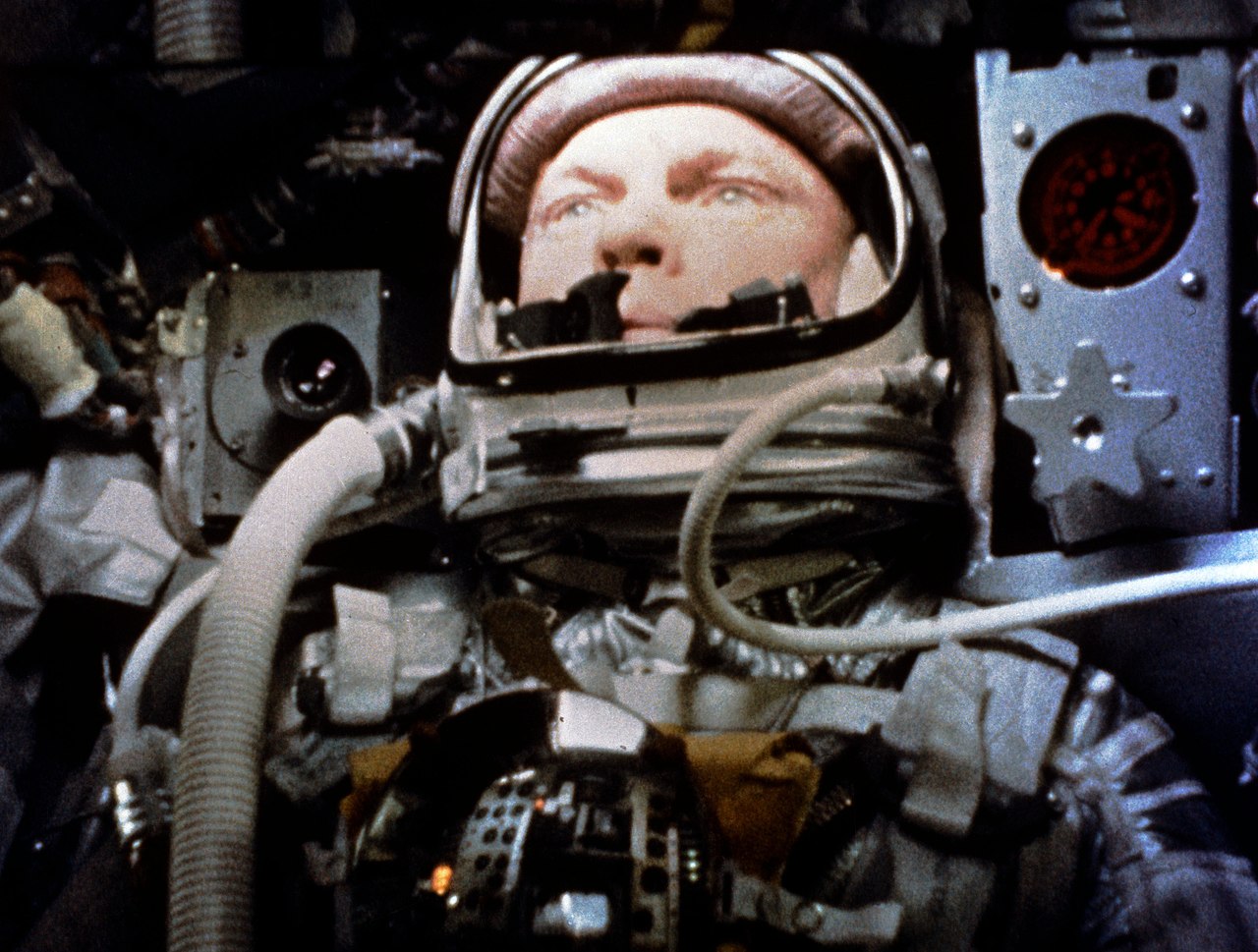
At 9:47 AM on February 20, 1962, the rockets of an Atlas launch vehicle thundered to life at Cape Canaveral’s Launch Complex 14. Seated atop the converted missile was John Glenn, sealed inside his Friendship 7 capsule and about to make history as the first American to orbit Earth. As launch control engineer T.J. O’Malley pressed the button that would send Glenn skyward, fellow astronaut Scott Carpenter spoke the now-famous words: “Godspeed, John Glenn.”
A Mission Born of Necessity
The launch came at a crucial moment in the Space Race. The Soviet Union had already sent two cosmonauts into orbit, and America needed a breakthrough to demonstrate its technological capabilities. Glenn, a decorated Marine Corps pilot, had been selected to pilot Mercury-Atlas 6, a mission that would either put America back in the game or risk falling further behind in space exploration.
Engineering for the Unknown
Friendship 7 represented a triumph of rapid engineering development. The Mercury capsule, weighing just 2,981 pounds, had been carefully designed to protect its occupant from the hostile environment of space. The spacecraft carried sophisticated systems for life support, navigation, and communication, all packed into a space roughly the size of a small car. Most critically, its heat shield would need to protect Glenn from temperatures reaching 3,000 degrees Fahrenheit during reentry.
Three Orbits That Changed History
As Friendship 7 separated from its Atlas booster, Glenn became only the fifth human to venture into space. “Zero G and I feel fine,” he reported as he began the first of three orbits. Over the next 4 hours and 55 minutes, Glenn would experience phenomena never before seen by an American, including the “fireflies” – mysterious luminous particles that he observed streaming past his window, later determined to be ice crystals from the spacecraft’s exterior.
Crisis and Calm
The mission was not without its dramatic moments. A sensor indicated Glenn’s heat shield might be loose, a potentially catastrophic situation. Mission Control made the crucial decision to keep the retrorocket pack attached during reentry, hoping it would help hold the heat shield in place. Glenn, displaying remarkable composure, manually flew much of the reentry when his automatic control systems began acting erratically.
A New Era Begins
Friendship 7 splashed down in the Atlantic Ocean at 2:43 PM EST, 800 kilometers southeast of Cape Canaveral. USS Noa reached Glenn just seventeen minutes later, finding him in excellent spirits. His first words upon stepping onto the destroyer’s deck were characteristically understated: “It was hot in there.”
Legacy and Impact
Glenn’s flight transformed America’s space program. Beyond proving that Americans could orbit Earth, it demonstrated that humans could meaningfully contribute to spacecraft operation rather than being mere passengers. The mission’s success provided crucial momentum for President Kennedy’s goal of reaching the Moon by decade’s end.
The flight yielded vital scientific data about human performance in space. Glenn showed that astronauts could eat, drink, and work effectively in zero gravity. His observations of the “fireflies” led to better understanding of how spacecraft interact with the space environment. Perhaps most importantly, his success proved that NASA’s approach to human spaceflight was fundamentally sound.
Looking Forward
Today, as new generations of spacecraft carry humans into orbit, they build upon the foundation laid by Friendship 7. The mission’s emphasis on pilot control and backup systems remains a cornerstone of spacecraft design. Modern astronauts still train to manually fly their vehicles, carrying forward Glenn’s legacy of the astronaut as both explorer and operator.
The Mercury-Atlas 6 mission marked more than just America’s entry into orbital spaceflight – it represented a fundamental shift in how humans viewed their relationship with space. Glenn’s three orbits proved that space was not just a place we could visit, but an environment where we could work, explore, and eventually thrive. As we look toward returning to the Moon and venturing to Mars, the lessons of Friendship 7 continue to light the way forward.s