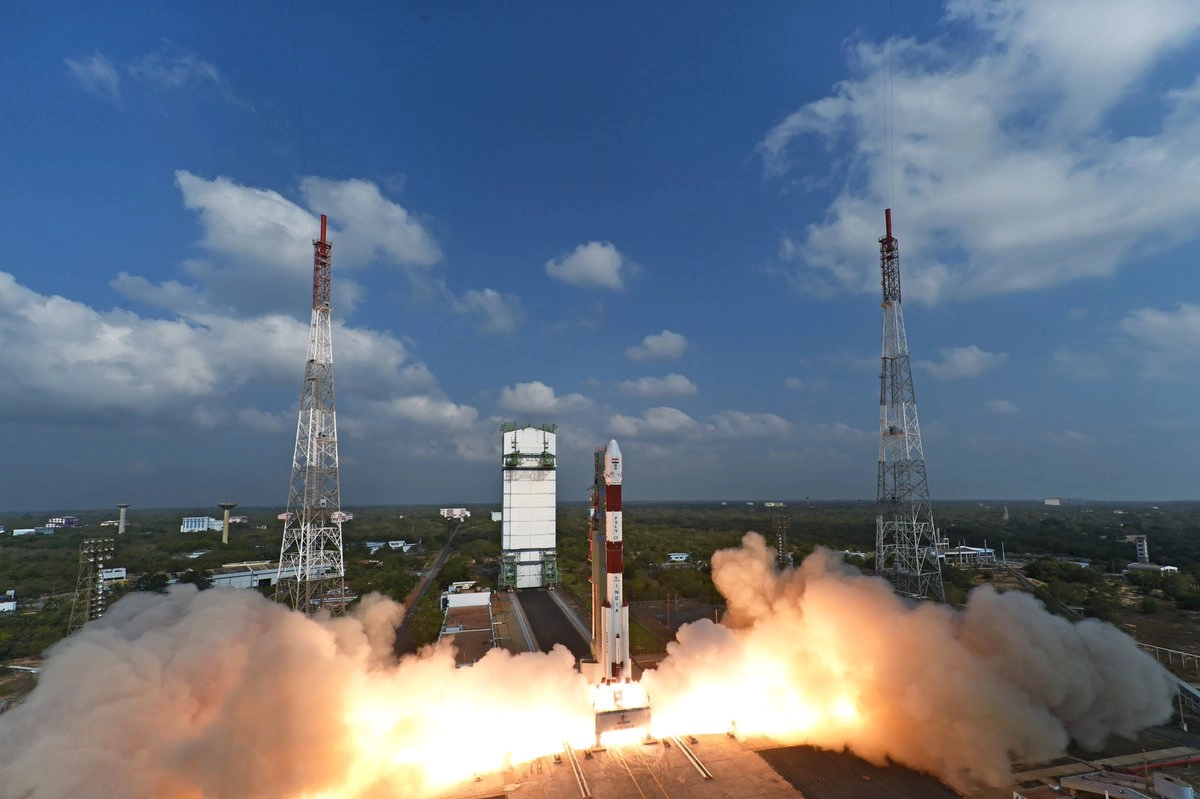
At precisely 9:28 AM IST on February 15, 2017, India’s Polar Satellite Launch Vehicle thundered into the sky from the First Launch Pad at Satish Dhawan Space Centre. This thirty-ninth PSLV flight, designated PSLV-C37, would make history not just for India but for the entire space industry, carrying an unprecedented payload of 104 satellites with a total mass of 1,378 kilograms.
A Lieutenant’s Perspective
As a lieutenant on radar duty during this launch, I witnessed firsthand the operational impact of deploying so many satellites at once. Our tracking workload increased more than fivefold in a single instant. This launch marked a clear transition from space being a relatively benign environment to becoming a congested, complex domain requiring significantly more attention and resources to monitor effectively.
Breaking Records with Precision
The mission’s complexity was matched only by its precision. After a flight of 16 minutes and 48 seconds, the PSLV achieved a polar Sun Synchronous Orbit of 506 kilometers, inclined at 97.46 degrees to the equator. What followed was an intricate orbital ballet, as all 104 satellites separated from the PSLV’s fourth stage in a predetermined sequence over the next 12 minutes, beginning with the primary payload - the Cartosat-2 series satellite.
Primary Mission and Payload
The main payload, a 714-kilogram Cartosat-2 series satellite, represented India’s continued commitment to Earth observation. Following deployment, its twin solar arrays automatically unfurled, and ISRO’s Telemetry, Tracking and Command Network (ISTRAC) in Bangalore assumed control. The satellite’s panchromatic (black and white) and multispectral (color) cameras would soon begin providing vital remote sensing services.
International Collaboration
The mission exemplified international cooperation in space, carrying satellites from six nations:
- India: Cartosat-2 series satellite and two technology demonstration satellites (INS-1 weighing 8.4 kg and INS-2 weighing 9.7 kg)
- United States: 96 satellites
- The Netherlands: 1 satellite
- Switzerland: 1 satellite
- Israel: 1 satellite
- Kazakhstan: 1 satellite
- UAE: 1 satellite
This launch brought the total number of foreign customer satellites launched by PSLV to 180, cementing India’s position as a reliable commercial launch provider.
Engineering Achievement
The PSLV-C37 mission marked the PSLV’s thirty-eighth consecutive successful flight, demonstrating the reliability that had made it ISRO’s workhorse launch vehicle. The mission required precise engineering to:
- Manage the deployment of multiple satellites without collision
- Achieve exact orbital parameters
- Coordinate with international partners
- Track and verify the status of each deployed satellite
Impact on Space Traffic Management
The successful deployment of 104 satellites in a single launch demonstrated both the possibilities and challenges of the new space age. Space tracking facilities worldwide had to adapt to:
- Monitoring unprecedented numbers of objects from a single launch
- Developing new protocols for tracking multiple similar objects
- Implementing enhanced space traffic management systems
- Creating new procedures for collision avoidance
Legacy and Current Impact
This mission set new standards for:
- Multi-satellite launch capabilities
- Commercial space access
- International cooperation in space
- Space traffic management procedures
Today, as mega-constellations become commonplace, the lessons learned from this pioneering mission continue to influence how we manage increasingly crowded orbits.
Looking Forward
As we approach the decade mark since this historic launch, its impact continues to resonate through the space industry. The mission demonstrated both the possibilities and challenges of the new space age, where single launches can dramatically alter the orbital environment. As more countries and companies plan large constellation deployments, the lessons learned from this pioneering mission remain more relevant than ever.
The PSLV-C37 mission didn’t just break a record – it marked the moment when space professionals worldwide realized that the final frontier had become a crowded neighborhood, requiring new approaches to space traffic management and international cooperation. As we continue to launch more satellites, the insights gained from this mission help guide our path forward in managing an increasingly complex orbital environment.