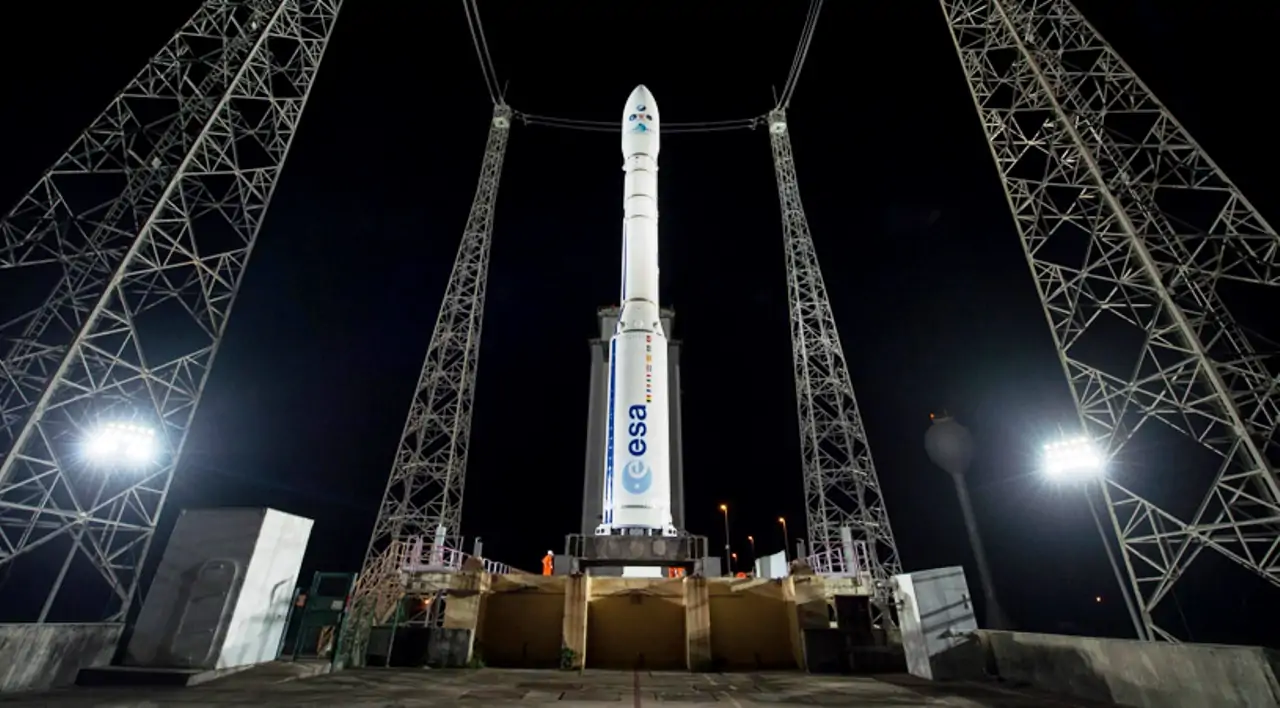
In the humid air of French Guiana, at precisely 10:00 UTC on February 13, 2012, a gleaming white rocket stood poised on its launch pad at the edge of the Amazon rainforest. This was Vega, Europe’s newest launch vehicle, about to make its maiden flight. Within its payload fairing, it carried not just satellites but the culmination of decades of European rocket development and the scientific dreams of university students across the continent.
A New Star in Europe’s Launch Fleet
The development of Vega represented a strategic shift in European space capabilities. While the larger Ariane 5 excelled at launching heavy satellites to geostationary orbit, a gap existed in Europe’s ability to launch smaller payloads efficiently. As Bernard Bigot, then-chairman of the French space agency CNES, noted at the time, “Vega completes Europe’s family of launchers, allowing us to serve all satellite operators, from institutional customers to commercial clients, across the full spectrum of mission requirements.”
Engineering for Efficiency
Standing 30 meters tall, Vega embodied clever engineering choices that made it particularly suited for its role. The rocket combined the best of both worlds: the raw power of solid rocket motors for its first three stages, providing high thrust at lower cost, with a liquid-fueled fourth stage that offered precise orbital insertion capabilities. This hybrid approach allowed Vega to place payloads of up to 1,500 kilograms into low Earth orbit with remarkable accuracy.
A Mission of Many Firsts
The inaugural flight, designated VV01, carried an unusually diverse payload. The primary passenger was LARES (Laser Relativity Satellite), a 390-kilogram sphere of tungsten designed to test Einstein’s General Theory of Relativity. But the mission’s broader significance lay in its secondary payloads: seven CubeSats built by university students across Europe, including the first satellites ever launched by Hungary (MaSat-1) and Romania (Goliat).
The Educational Revolution
The inclusion of student-built satellites marked a revolutionary moment in space education. Dr. Elena Vladescu, lead supervisor for Romania’s Goliat project, remarked, “This mission showed our students that space isn’t just something they read about in textbooks. They can actually build something that flies in orbit.” Each CubeSat, measuring just 10 centimeters on each side, represented hundreds of hours of work by student teams and opened new possibilities for hands-on space engineering education.
Technical Achievement
The launch itself proceeded flawlessly. Each of Vega’s four stages performed exactly as designed, demonstrating the maturity of European rocket technology. The AVUM upper stage executed a complex series of burns, precisely deploying each payload into its intended orbit. LARES entered a nearly circular orbit at approximately 1,450 kilometers altitude, while the CubeSats were released into slightly lower orbits around 300 x 1,400 kilometers.
Legacy and Impact
Vega’s successful debut transformed Europe’s position in the global launch market. Over the following decade, the rocket would launch dozens of missions, establishing itself as a reliable workhorse for small satellites. More importantly, it democratized access to space for European universities and small companies, creating new opportunities for innovation and education in space technology.
Looking Forward
Today, as the space industry continues to evolve with new players and technologies, Vega’s inaugural flight stands as a testament to European technological capability and cooperation. The rocket’s success helped establish the foundation for Europe’s current position in the commercial space launch market, while the student satellites it carried inspired a new generation of space engineers. As we look toward future developments in small satellite launch vehicles, that February morning in 2012 remains a pivotal moment when Europe changed the game for small satellite launches and opened space to a new generation of explorers.