On a clear Florida morning, February 11, 2010, an Atlas V rocket pierced the blue sky above Cape Canaveral, carrying NASA’s most sophisticated solar observatory into space. At precisely 10:23 a.m. EST, the Solar Dynamics Observatory (SDO) began its journey to a unique vantage point high above Earth, where it would revolutionize our understanding of the Sun and transform our ability to predict potentially devastating space weather events.
A New Era in Solar Science
The launch of SDO marked the beginning of NASA’s ambitious “Living With a Star” program, designed to study how solar activity affects life and technology on Earth. Unlike previous solar missions, SDO was designed to provide continuous, high-resolution observations of our star, generating more scientific data per day than any NASA mission before it. The spacecraft’s capabilities represented a quantum leap forward in solar observation, promising to unlock mysteries that had puzzled scientists for generations.
Engineering for Excellence
At 3,200 kilograms (7,000 pounds), SDO carried three groundbreaking instruments designed to work in concert: the Atmospheric Imaging Assembly (AIA) for capturing detailed solar images, the Helioseismic and Magnetic Imager (HMI) for studying the Sun’s magnetic field, and the Extreme Ultraviolet Variability Experiment (EVE) for measuring solar output. The spacecraft’s unique geosynchronous orbit, carefully chosen to maintain constant communication with its dedicated ground station in New Mexico, would enable it to transmit this unprecedented volume of data back to Earth.
A Perfect Launch
The Atlas V 401 rocket performed flawlessly, first placing SDO into a parking orbit 175 kilometers above Earth, then using its Centaur upper stage to boost the spacecraft into a transfer orbit reaching more than 35,000 kilometers high. From there, SDO used its own propulsion system to reach its final orbital position, perfectly positioned to keep its unblinking eye on the Sun.
Transforming Our Understanding
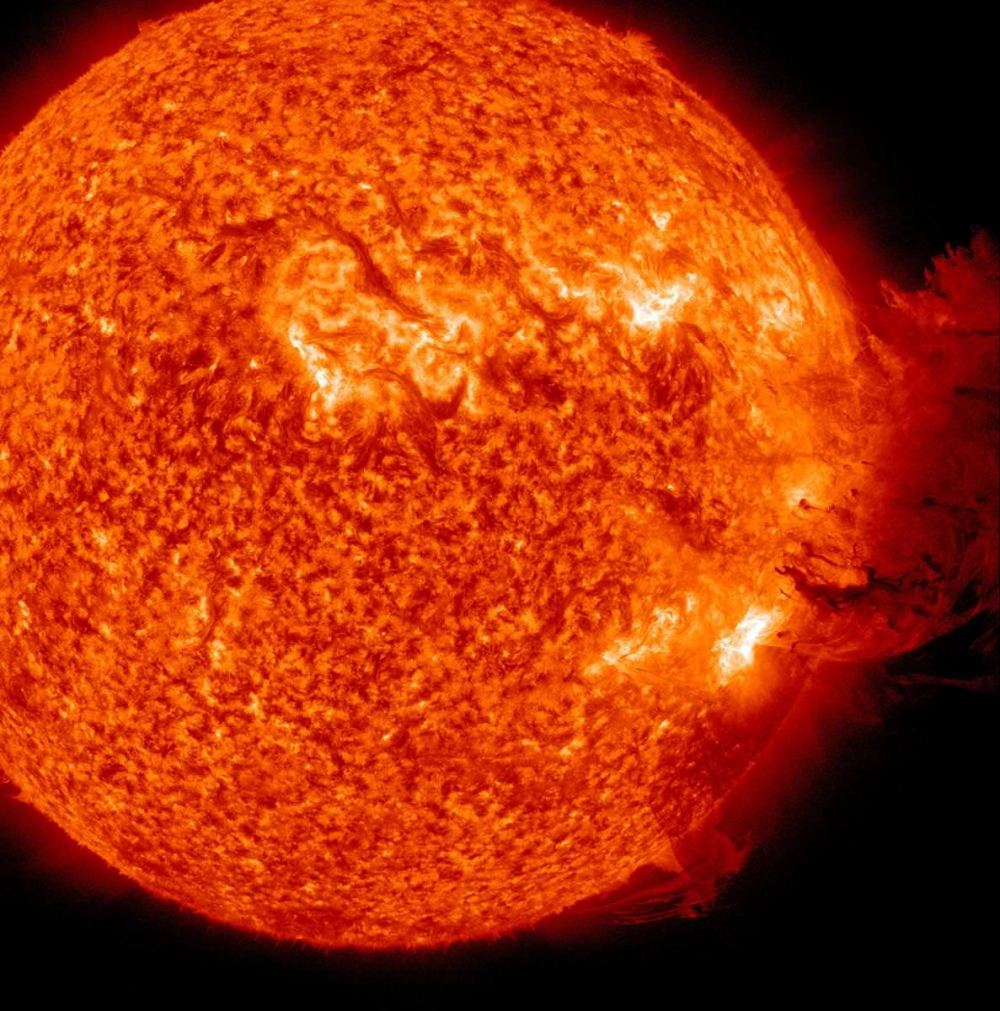
Within hours of reaching its operational orbit, SDO began returning images of the Sun with clarity that astonished even veteran solar physicists. “The level of detail we’re seeing is simply remarkable,” said Dean Pesnell, SDO Project Scientist at NASA’s Goddard Space Flight Center. “It’s like we’ve put on glasses after decades of seeing the Sun in a blur.”
Scientific Impact and Discovery
Over the past fifteen years, SDO has fundamentally changed our understanding of solar physics. The observatory has:
- Captured over 200 million images of the Sun
- Observed thousands of solar flares and coronal mass ejections
- Enabled scientists to predict solar events hours or days before they affect Earth
- Provided crucial data for over 4,000 peer-reviewed scientific papers
Protecting Earth’s Technology
Perhaps SDO’s most practical impact has been its contribution to space weather prediction. By providing early warning of solar events that could disrupt satellite communications, damage power grids, or endanger astronauts, SDO has become an essential part of our planetary defense system against solar threats.
“Before SDO, we were essentially working blind,” explains W. Dean Pesnell, SDO Project Scientist. “Now we can see potentially dangerous solar activity developing and give satellite operators and power companies time to prepare.”
Looking Forward
As SDO enters its second decade of operation, its role becomes even more crucial. With increasing reliance on satellite technology and plans for lunar and Mars missions that will expose astronauts to space radiation, understanding and predicting solar activity has never been more important.
The success of SDO has inspired the development of next-generation solar observatories, while its continuous stream of data continues to reveal new insights about our star. As humanity ventures further into space, the legacy of that February morning launch grows increasingly significant, reminding us that understanding our Sun is key to our future among the stars.