


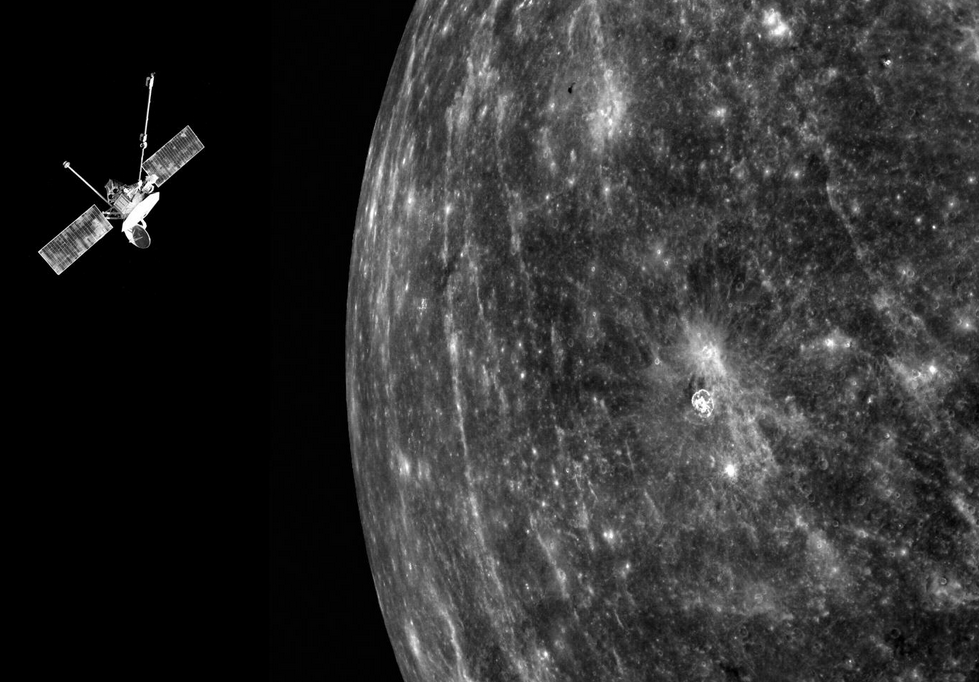
On February 5, 1974, in a bold maneuver that would forever change space exploration, NASA’s Mariner 10 spacecraft swept past Venus at a carefully calculated distance of 5,768 kilometers, using the planet’s gravitational field to alter its trajectory. This precisely choreographed cosmic ballet marked humanity’s first successful use of a gravity assist maneuver, transforming not just Mariner 10’s path through space, but our entire approach to solar system exploration.
A Revolutionary Mission Design
The journey to this breakthrough began with a challenging problem: how to reach Mercury with the limited rocket power available in the early 1970s. Giuseppe “Bepi” Colombo, an Italian mathematician and engineer, proposed a revolutionary solution. By sending the spacecraft past Venus first, they could use the planet’s gravitational field to adjust the probe’s velocity and orbital period, allowing it to make multiple passes by Mercury while using far less fuel than a direct route would require.
Breaking New Ground
Mariner 10 didn’t just pass by Venus; it conducted groundbreaking science during its visit. The spacecraft’s ultraviolet cameras captured over 4,000 images of Venus’s cloud structures, revealing previously unknown details about the planet’s atmospheric circulation patterns. These observations provided the first comprehensive look at Venus’s cloud-level weather systems, showing they complete a full circulation around the planet every four Earth days.
The Technical Achievement
The gravity assist maneuver required unprecedented precision in spacecraft navigation. Mission controllers had to guide Mariner 10 through a specific point in space at a specific time, with minimal margin for error. The spacecraft’s trajectory was so precisely calculated that it passed through its target point near Venus within just 100 kilometers of the planned location – a remarkable feat of navigation for the era.
Dual-Planet Legacy
After its Venus encounter, Mariner 10 became the first spacecraft to visit two planets, going on to make three flybys of Mercury. The success of this complex orbital choreography opened new possibilities for solar system exploration. Mission planner Gary Flandro noted, “Once we demonstrated that gravity assists worked, it completely changed how we thought about designing interplanetary missions. Suddenly, the entire solar system seemed more accessible.”
Scientific Breakthroughs
The Venus flyby yielded several significant discoveries:
- First detailed ultraviolet imagery of Venus’s cloud patterns
- Confirmation of the planet’s retrograde rotation
- Detection of a weak magnetic field
- Evidence of a bow shock in Venus’s interaction with the solar wind
Engineering Innovation
The mission pioneered several technical innovations that would become standard in future spacecraft design. Mariner 10 was the first spacecraft to use a dual-frequency communications link that allowed precise tracking through the solar corona. It also demonstrated the effectiveness of using a planet’s gravity as a propulsion tool, leading mission designer John Dunne to observe, “We essentially turned Venus into a natural rocket engine.”
Looking Forward
Today, gravity assists have become a cornerstone of solar system exploration. Missions like Cassini-Huygens, Messenger, and BepiColombo have built upon Mariner 10’s legacy, using complex sequences of planetary flybys to reach their destinations. As humanity prepares for increasingly ambitious deep space missions, the fundamental principle demonstrated on February 5, 1974 – that we can use natural celestial mechanics to our advantage – continues to expand our reach into the cosmos.
The success of Mariner 10’s Venus flyby marked the moment when human spaceflight truly began to work in harmony with the natural dynamics of the solar system. As future missions plan ever more complex trajectories using gravity assists, they all trace their lineage back to that pioneering moment when a small spacecraft first used a planet’s gravity to forge a new path through space.


