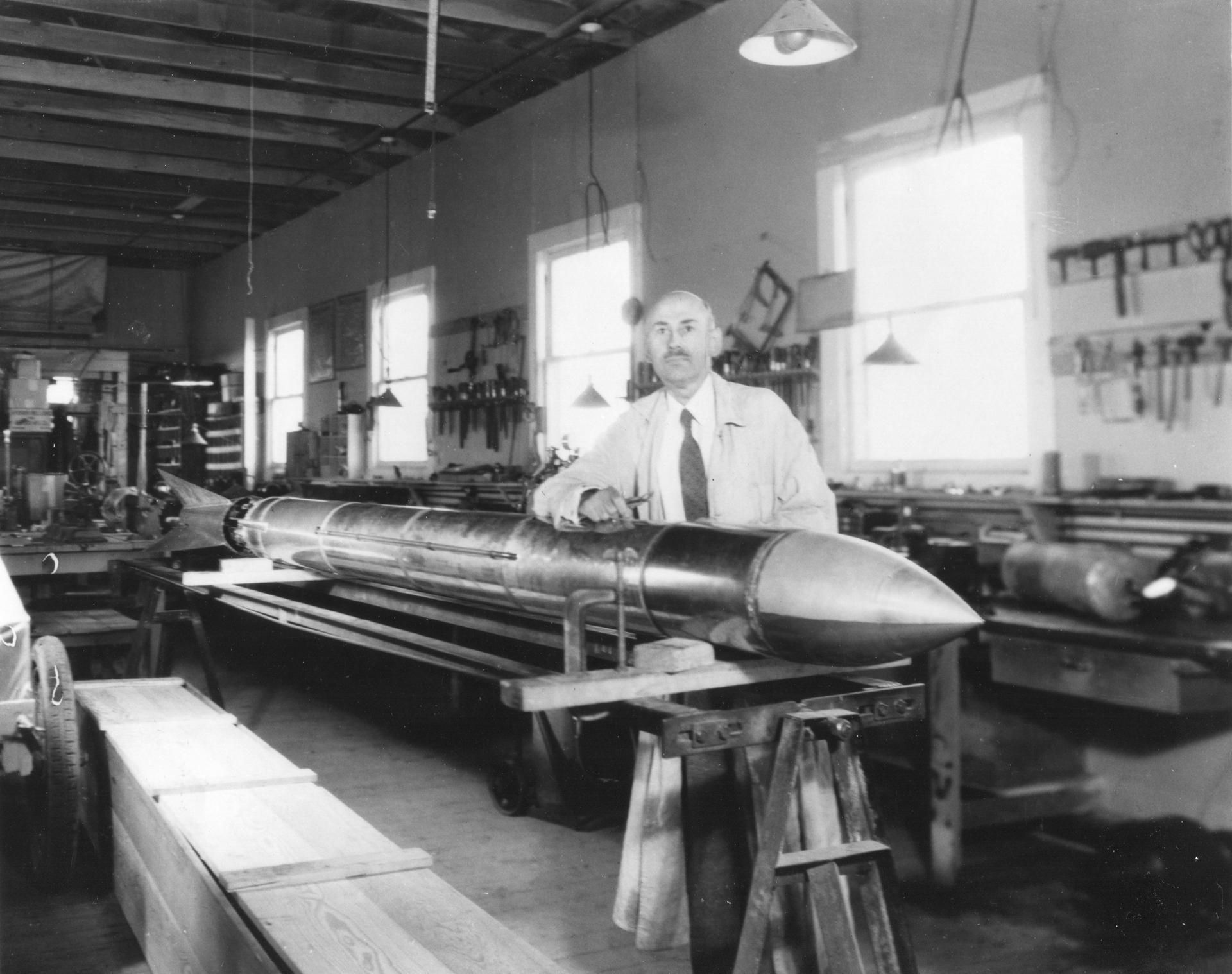
In a notebook entry dated February 2, 1909, a 26-year-old physics instructor named Robert Goddard documented a breakthrough that would transform the future of spaceflight. His calculations revealed that liquid hydrogen as fuel and liquid oxygen as an oxidizer could achieve 50% efficiency in converting heat energy to kinetic energy – an insight that would eventually revolutionize rocket propulsion.
The Problem That Sparked a Revolution
In the early 1900s, the dream of spaceflight faced a fundamental challenge: the limitations of solid-fuel rockets. Goddard’s early experiments with solid fuels had convinced him that a more efficient propulsion method was necessary. His calculations showed that even his innovative “nested gun” concept would require an impractical amount of explosive to achieve meaningful altitudes, leading him to explore alternative approaches.
The Breakthrough Moment
What made Goddard’s February 2nd notebook entry so significant was his identification of liquid propellants as a viable alternative to solid fuels. While the concept of using liquid hydrogen and liquid oxygen was theoretically promising, practical constraints of the era would shape his early experiments differently. Due to the limited availability of liquid hydrogen at the time, Goddard would later turn to a more practical combination: gasoline and liquid oxygen.
From Theory to Revolutionary Practice
Goddard’s journey from theoretical insight to practical application reached a historic milestone on March 16, 1926, when he launched the world’s first liquid-fueled rocket. Using gasoline as fuel and liquid oxygen as the oxidizer, this achievement marked the birth of modern rocketry and laid the groundwork for all space exploration that followed.
Why LOX/LH2 Changed Everything
Goddard’s initial insight about liquid oxygen (LOX) and liquid hydrogen (LH2) proved prescient. This combination offers several key advantages that make it ideal for rocket propulsion:
- Highest Specific Impulse: Among chemical rocket propellants, the LOX/LH2 combination provides one of the most efficient energy outputs
- Clean Combustion: The reaction produces only water vapor as a byproduct
- Precise Control: Unlike solid fuels, liquid propellants allow for throttling and engine shutdown as needed
Legacy in Modern Spaceflight
The LOX/LH2 combination that Goddard first proposed in his 1909 notebook remains a cornerstone of space exploration:
- It powered the Space Shuttle’s main engines throughout the program’s 30-year history
- Modern rockets like NASA’s Space Launch System and ESA’s Ariane 5 rely on LOX/LH2 for their upper stages
- New launch vehicles continue to build upon this fundamental propulsion technology
The Visionary’s Impact
Goddard’s contributions to rocketry extended far beyond his initial insights about liquid propellants. Throughout his career, he was awarded 214 patents for his innovations in rocketry. His work established many of the fundamental principles that would later enable humanity’s greatest adventures in space exploration.
Looking Forward
As we enter an era of renewed space exploration, with ambitious plans for lunar bases and Mars missions, Goddard’s breakthrough continues to influence rocket design. While new propellant combinations have emerged, his fundamental insights about liquid propulsion remain relevant to modern spaceflight.
Modern rocket scientists continue building upon Goddard’s foundation, exploring variations and enhancements to liquid propulsion systems. From methane-based engines to hybrid propulsion systems, each new development can trace its lineage back to that moment in 1909 when a young physicist documented his thoughts about liquid propellants in his notebook.
As we look to the future of spaceflight, with increasingly ambitious goals of establishing permanent presence beyond Earth, we continue to build upon the foundation laid by Goddard’s breakthrough. His February 2nd insight wasn’t just a moment in history; it was the beginning of humanity’s journey to the stars.