Top Stories
Space Force Adds Relativity Space and Impulse Space to NSSL Phase 3 Lane 1
The U.S. Space Force has added Relativity Space and Impulse Space to its National Security Space Launch Phase 3 Lane 1 program. Lane 1 is the competitive tier designed for newer entrants, distinct from the Lane 2 contracts held by SpaceX and ULA for higher-priority missions.
Both companies now have a pathway to compete for military payloads. Relativity has been developing its Terran R reusable rocket, while Impulse Space focuses on orbital transfer vehicles — making them an unusual pairing in a launch program that typically centers on launch vehicles alone. Tracking what these providers eventually put on orbit will be relevant for anyone monitoring national security constellation buildout.
Read the full story: SpaceNews
SpaceX Defense Contract Portfolio Has Grown Substantially Over the Past Decade
SpaceX has moved well beyond commercial launch to become a major U.S. defense contractor. Its portfolio now spans launch services, the Starshield national security satellite network, and crewed access to the ISS under NASA contracts with defense implications.
For satellite trackers, the scale matters: SpaceX-operated assets under military contracts are proliferating in orbits that overlap with commercial Starlink. Distinguishing Starshield from standard Starlink in the catalog is an ongoing challenge, as many of those satellites are not publicly cataloged with full details.
Read the full story: Space Explored
NATO Summit in Ankara Addresses Iran Nuclear Status Amid Active U.S. Military Operations
NATO Secretary General Mark Rutte is pressing allies at the Ankara summit to formally reaffirm that Iran must not acquire nuclear weapons. The meeting comes while the U.S. is actively engaged in military operations against Iran.
The conflict has direct space domain implications. ISR satellites, missile warning systems, and communications constellations are under heightened operational demand during active combat. Any disruption or repositioning of assets in the region is worth watching in the catalog.
Read the full story: Breaking Defense
UK Buying $254M in PrSM Long-Range Missiles from U.S. Army Program
The United Kingdom has agreed to join the U.S. Army’s Precision Strike Missile program with a $254 million purchase. PrSM has a range exceeding 500 km, replacing the older ATACMS in U.S. and now allied inventories.
The UK stated the buy does not replace its separate work with Germany on a Deep Precision Strike weapon. That parallel development track suggests the UK is hedging across multiple long-range strike options simultaneously.
Read the full story: Breaking Defense
Spirit Electronics Opens Managed Access to U.S. Semiconductor Fabs for Aerospace and Defense
Spirit Electronics announced a managed-access program giving aerospace and defense customers a secure route to advanced U.S.-based semiconductor manufacturing. The offering is aimed at programs that require domestic sourcing for supply chain security reasons.
Radiation-hardened and mil-spec chips remain a bottleneck for satellite programs. Domestic fab access is a known constraint for smallsat and military spacecraft developers who can’t use commercial off-the-shelf components in high-radiation orbital environments.
Read the full story: SpaceNews
Senate Democrats Allege Stonewalling on Qatar-Gifted Air Force One Conversion
Senate Democrats say they have been blocked from getting detailed answers about the conversion of a Qatari-gifted 747 for use as a “bridge” Air Force One aircraft. They are pressing the Air Force and the contracted modification company for cost, timeline, and security vetting details.
The conversion raises questions about TEMPEST shielding, communications security, and the classified systems integration required for presidential transport — all areas where contractors and the Air Force typically do not comment publicly.
Read the full story: Breaking Defense
Fast Radio Bursts Used to Probe Milky Way’s Outer Boundary — Galaxy May Be Larger Than Estimated
Astronomers used fast radio bursts — brief, intense pulses of radio energy from cosmological distances — as probes of the dispersion measure through the Milky Way’s halo. The data suggest the galaxy’s gas halo extends farther than current models estimate, implying a larger total mass and physical extent.
The finding doesn’t affect satellite tracking directly, but it revises the baseline model of our galaxy’s structure that underpins long-range astrometry and deep-space navigation references.
Read the full story: Space.com
Satellite of the Day
SPACEBEE-163
SPACEBEE-163 is a tiny but mighty CubeSat operated by Swarm Technologies (SWARMX), a US-based company pioneering machine-to-machine (M2M) and Internet of Things (IoT) communication from space. This 0.25U satellite—roughly the size of a deck of cards at just 284 grams—launched aboard a SpaceX Falcon 9 rocket on January 3, 2023, from Cape Canaveral Air Force Station. Despite its diminutive size, SPACEBEE-163 was designed to relay data from remote sensors, devices, and systems that lack traditional terrestrial connectivity, making it part of a growing constellation of smallsats democratizing space-based communications.
The Spacebee constellation represents an interesting inflection point in the NewSpace era: ultra-low-cost satellites capable of providing global coverage for IoT applications without the infrastructure demands of larger systems. Operating from a sun-synchronous orbit at 97.4° inclination, SPACEBEE-163 used solar cells and batteries to power its communications payload and two-antenna configuration. However, this particular satellite has since decayed from orbit, completing its mission and returning to Earth—a natural conclusion for many CubeSats with limited operational lifespans.
| Detail | Value |
|---|---|
| NORAD ID | 55089 |
| Operator | SWARMX (US) |
| Launch Date | January 3, 2023 |
| Orbit | Sun-synchronous, 97.373° inclination |
| Purpose | Communication M2M/IoT |
| Status | Decayed |
Learn more about this satellite: View SPACEBEE-163
Upcoming Space Launches
July 9
- SpaceX Falcon 9 Block 5: Starlink Group 10-42
- 29 Starlink V2 Mini Optimized satellites launching to low Earth orbit from Space Launch Complex 40, Cape Canaveral Space Force Station, FL, USA (09:05 UTC) Watch Live Launch Preview
July 10
- China Aerospace Science and Technology Corporation Long March 10B: Demo Flight
- Debut test flight of the Long March 10B, a reusable two-stage launch vehicle capable of delivering up to 16,000 kg to low Earth orbit. The first stage, powered by seven YF-100 series kerosene/liquid oxygen engines, is designed for downrange recovery via an arrestor net on a barge. The second stage uses a single YF-219 methane/liquid oxygen engine. This demonstration flight marks a significant milestone for Chinese reusable launch vehicle development, launching from Commercial LC-2 at Wenchang Space Launch Site, China (05:12 UTC) Launch Preview
July 11
- SpaceX Falcon 9 Block 5: Starlink Group 17-48
- 29 Starlink V2 Mini Optimized satellites launching to low Earth orbit from Space Launch Complex 4E, Vandenberg Space Force Base, CA, USA (02:00 UTC) Watch Live Launch Preview
July 12
-
Orienspace Technology Gravity-1: Unknown Payload
- Launch of an unspecified payload aboard Gravity-1, a four-stage all-solid Chinese private launch vehicle capable of 6,500 kg to low Earth orbit, lifting off from the Haiyang offshore launch location at Haiyang Oriental Spaceport, China (02:00 UTC). (Status: To Be Confirmed) Launch Preview
-
Skyroot Aerospace Vikram-I: Demo Flight
- Debut flight of Skyroot Aerospace’s Vikram-I, a four-stage orbital launch vehicle developed by an Indian private company. The first three stages are solid-fueled, topped by a hypergolic upper stage, with a payload capacity of up to 350 kg to low Earth orbit. This mission will carry several cubesats from Satish Dhawan Space Centre First Launch Pad, Satish Dhawan Space Centre, India (05:00 UTC). (Status: To Be Confirmed) Launch Preview
July 14
-
SpaceX Falcon 9 Block 5: Starlink Group 15-14
- 29 Starlink V2 Mini Optimized satellites launching to low Earth orbit from Space Launch Complex 4E, Vandenberg Space Force Base, CA, USA (01:16 UTC) Watch Live
-
SpaceX Falcon 9 Block 5: Starlink Group 10-45
- 29 Starlink V2 Mini Optimized satellites launching to low Earth orbit from Space Launch Complex 40, Cape Canaveral Space Force Station, FL, USA (07:15 UTC) Watch Live
-
Russian Federal Space Agency (ROSCOSMOS) Soyuz 2.1a: Soyuz MS-29
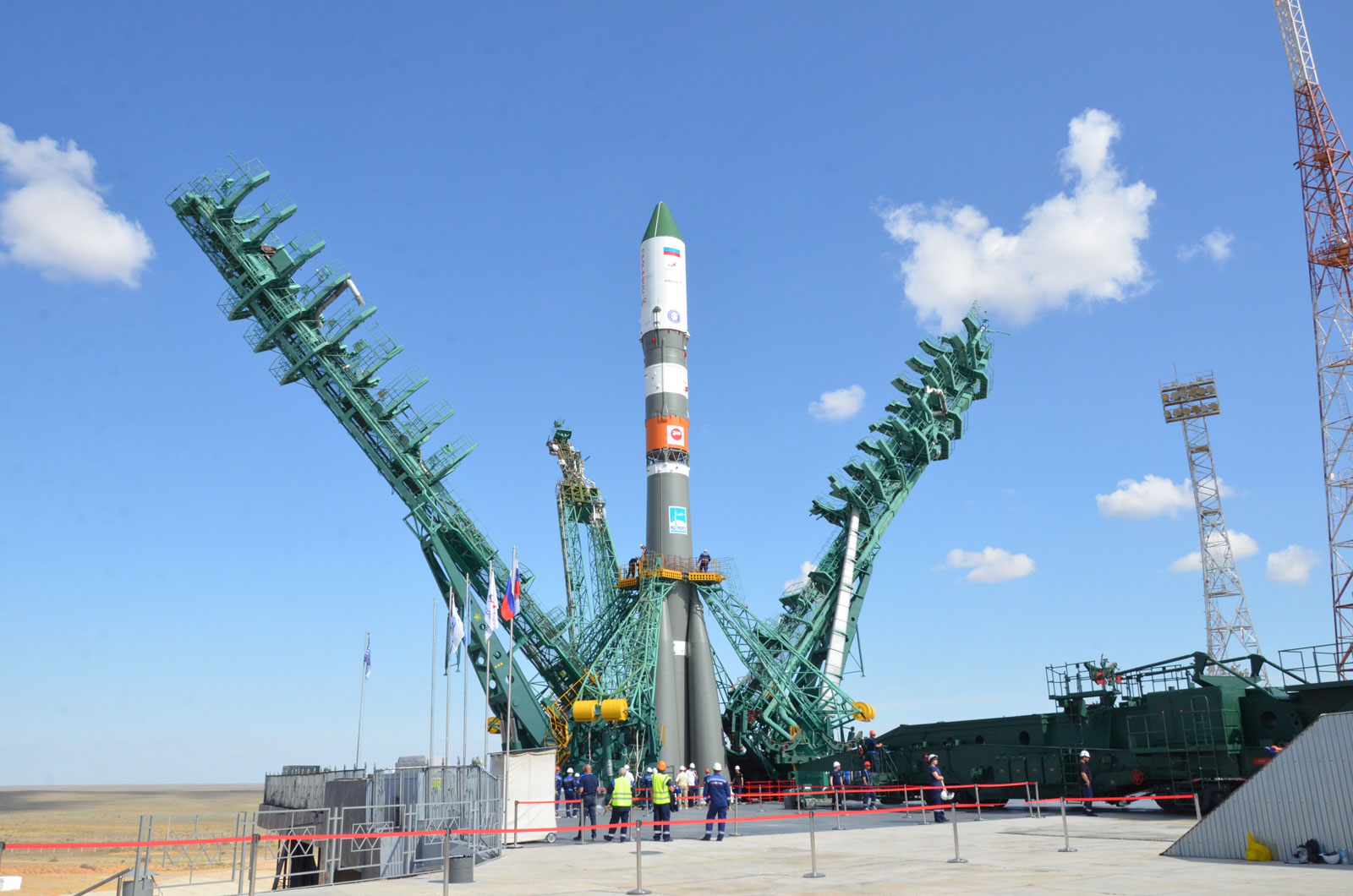
- Soyuz MS-29 will carry a crew of three to the International Space Station, including Roscosmos cosmonauts Pyotr Dubrov and Anna Kikina, and NASA astronaut Anil Menon. The Soyuz 2.1a features a fully digital flight control system and serves as the primary vehicle for crewed ISS rotations. Launching from Launch Pad 31/6, Baikonur Cosmodrome, Republic of Kazakhstan (14:47 UTC)
-
SpaceX Starship: Flight 13 (Status: To Be Confirmed)
- The 13th integrated test flight of the SpaceX Starship launch vehicle, and the second flight of the Starship V3 configuration. Starship is a fully reusable two-stage super heavy-lift vehicle with a leo capacity of 100,000 kg, representing the third major development version of the system. Launching from Orbital Launch Pad 2, SpaceX Starbase, TX, USA (22:45 UTC)
July 17
- Rocket Lab Electron: LOXSAT 1 (Status: To Be Determined)
- LOXSAT 1 is a demonstration satellite developed by Eta Space, sponsored by NASA’s Tipping Point program, designed to validate a complete cryogenic oxygen fluid management system in orbit. Flying on a Rocket Lab Photon-LEO satellite bus, the mission will collect cryogenic fluid management data over nine months, demonstrating in-space cryogenic storage and transfer capabilities to support future commercial propellant depot development. Launching from Rocket Lab Launch Complex 1, Mahia Peninsula, New Zealand (00:00 UTC)
Schedule Changes
- Starship | Flight 13 has been newly added to the launch manifest, currently listed as To Be Confirmed, with a window opening on July 14, 2026 at 22:45 UTC from Orbital Launch Pad 2 at SpaceX Starbase, Texas. This will be the second flight of the Starship V3 configuration.
Note: Launch dates and times are subject to change due to technical or weather considerations.