· space brief · 8 min read
Space Force Deploys Meadowlands Satellite-Jamming System | KeepTrack Space Brief
U.S. Space Force transitions Meadowlands mobile satellite-jamming platform to operational status. System provides ground forces with electronic warfare capability against adversary satellite links.
Top Stories
Space Force Fields Meadowlands Mobile Satellite-Jamming System
The U.S. Space Force has transitioned the Meadowlands system to operational use. Meadowlands is a mobile satellite-jamming platform, giving ground forces a deployable electronic warfare capability against adversary satellite links.
This is a direct counter-space capability entering the inventory. For KeepTrack users monitoring geostationary communication satellites, this represents an operational threat layer that now exists on the battlefield — not just in development.
Read the full story: SpaceNews
Blue Origin Rebuilding Launch Pad After New Glenn Explosion — New Layout Planned
Blue Origin has started reconstruction of Launch Complex 36 at Cape Canaveral, damaged in the May 28 New Glenn explosion. The rebuilt pad will use a substantially different design from the original.
The May 28 vehicle loss is still under investigation. Until that investigation concludes, return-to-flight timing remains open. The pad rebuild adds a separate infrastructure recovery timeline on top of the vehicle investigation.
Read the full story: Space.com
Blue Origin Shifts to Hybrid Integration Model for New Glenn Return to Flight
Alongside the pad rebuild, Blue Origin announced it is moving to a hybrid horizontal-vertical integration process for future New Glenn vehicles. The current vertical-only integration approach will be replaced.
The change suggests Blue Origin identified integration or vehicle processing as a factor — or at minimum, a risk area — in the May 28 failure sequence. No specific return-to-flight date has been announced.
Read the full story: Spaceflight Now
GAO Warns DoD Testing Office Cuts Are Hiding Weapons Defects
The Government Accountability Office warned that workforce reductions at the Pentagon’s operational testing office (DOT&E) are creating oversight gaps. Action officers are now covering more programs than before, including programs outside their technical expertise.
The concern is that weapons with undiscovered defects could reach fielding. For space systems specifically, under-tested ground or space hardware with undetected flaws has direct consequences for mission reliability.
Read the full story: Breaking Defense
Matthew Williams Joins Commercial Space Federation as National Security Advisor
The Commercial Space Federation hired Matthew Williams as Senior Advisor for National Security. Williams previously served as Principal Deputy Assistant Secretary of Defense and as Chief of Staff at the Pentagon.
The hire gives CSF a senior-level DoD policy voice at a time when national security space contracts and commercial integration into government missions are expanding.
Read the full story: SpaceNews
UK Defence Investment Plan Commits £5 Billion to Autonomous Systems
The UK’s Defence Investment Plan allocates £5 billion specifically to autonomous systems, including plans for a “hybrid navy” mixing crewed and uncrewed vessels. The plan also covers drone procurement and next-generation fighter development.
The autonomous systems push has direct implications for space-based ISR and satellite communications, which underpin most modern autonomous military operations at scale.
Read the full story: Breaking Defense
Turkey’s EFES 2026 Exercise Puts Multinational Force Integration on Display
Turkey hosted the EFES 2026 multinational military exercise, with Breaking Defense reporting from the event. The exercise tests interoperability across coalition partners in a large-force employment scenario.
Multinational exercises at this scale stress satellite communications, GPS-dependent navigation, and space-based ISR coordination — all trackable domains for KeepTrack users monitoring military satellite constellations.
Read the full story: Breaking Defense
Satellite of the Day
GEESAT-1 07
GEESAT-1 07, also known as Geely Xinguou 01 zu 07 xing, is part of China’s commercial satellite constellation operated by GEESP (Geely Geespace). Launched on June 2, 2022, from Xi Chang Launch Center aboard a Chang Zheng 2C rocket, this compact satellite is designed to provide navigation and communication services. At just 130 kilograms with a 1-meter body and 2-meter solar array span, GEESAT-1 07 demonstrates how modern satellite miniaturization allows operators to deliver dual-purpose functionality in a small package.
This satellite operates in a near-50° inclination orbit, making it accessible over much of the populated Northern Hemisphere. As part of a larger constellation, GEESAT-1 07 contributes to China’s growing commercial space capabilities in positioning and data relay services. The satellite’s box-shaped design with deployable solar panels is typical of modern small-satellite architecture, optimized for power efficiency and mission longevity in its operational orbit.
| Detail | Value |
|---|---|
| NORAD ID | 52791 |
| Operator | GEESP (China) |
| Launch Date | June 2, 2022 |
| Orbit | Near-circular, 49.99° inclination |
| Purpose | Navigation, communication |
| Status | Active |
Track this satellite in real-time: Track GEESAT-1 07
Upcoming Space Launches
July 1
-
Northrop Grumman Space Systems Pegasus XL: Swift Boost Mission
- Air launch to orbit (07:30 UTC) Northrop Grumman’s Stargazer aircraft will carry the Pegasus XL rocket to approximately 40,000 feet before releasing it over Kwajalein Atoll. The mission will deploy the Katalyst Space Systems-built Link spacecraft, which will rendezvous with NASA’s Neil Gehrels Swift Observatory and boost it to a safe operating orbit. The Pegasus XL, an air-launched small-lift vehicle capable of carrying up to 443 kg to low Earth orbit, uses three solid propellant stages with a wing and tail for atmospheric control after release. Launch Preview
-
Rocket Lab Electron: The Grain Goddess Provides (iQPS Launch 7)
- Rocket Lab Launch Complex 1, Mahia Peninsula, New Zealand (13:00 UTC) A Rocket Lab Electron rocket will deploy a synthetic aperture radar Earth observation satellite for iQPS, a Japanese Earth imaging company. The Electron is a small-lift, electric-pump-fed launch vehicle capable of carrying up to 300 kg to low Earth orbit.
July 2
-
China Aerospace Science and Technology Corporation Long March 4C: Unknown Payload
- Jiuquan Satellite Launch Center, People’s Republic of China (23:38 UTC) Details of the payload are not yet available. The Long March 4C is a three-stage Chinese orbital launch vehicle previously used to deploy Yaogan reconnaissance and Fengyun meteorological satellites.
-
SpaceX Falcon 9 Block 5: Starlink Group 17-46
- Vandenberg SFB, CA, USA — Space Launch Complex 4E (02:00 UTC) A batch of 24 Starlink V2 Mini Optimized satellites to low Earth orbit. Watch Live
-
United Launch Alliance Atlas V 551: Amazon Leo (LA-08)
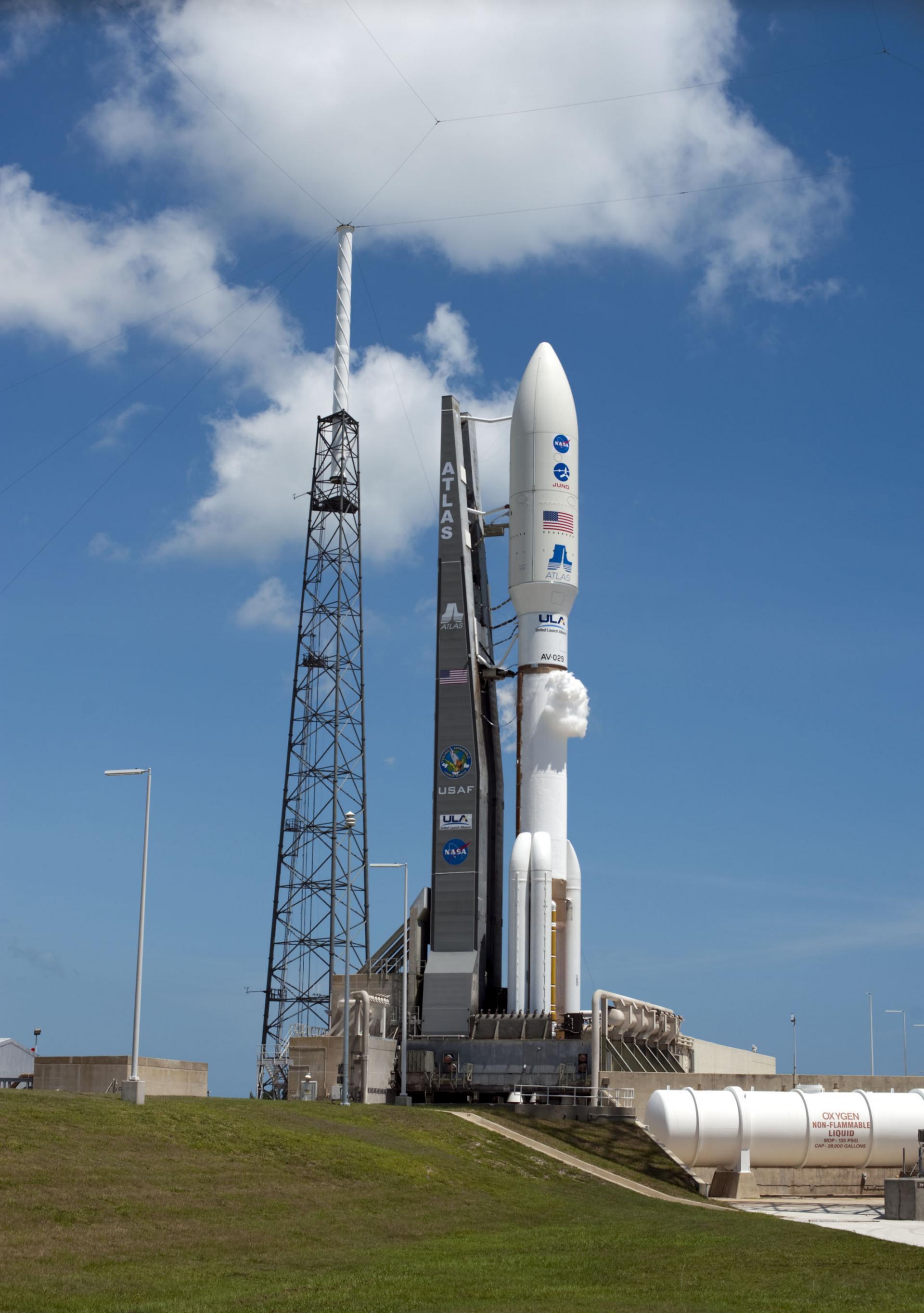
- Cape Canaveral SFS, FL, USA — Space Launch Complex 41 (04:24 UTC) A United Launch Alliance Atlas V 551 rocket will launch 29 Amazon Leo broadband internet satellites into low Earth orbit. This is the ninth and final Atlas V mission booked by Amazon for its Leo constellation, which aims to deliver high-speed, low-latency internet connectivity to underserved and remote regions globally. The Atlas V uses a Russian-built RD-180 engine on its first stage and an RL10 engine on its Centaur upper stage, with a lift capacity of up to 18,850 kg to low Earth orbit. Watch Live
-
China Aerospace Science and Technology Corporation Long March 8A: Unknown Payload
- Wenchang Space Launch Site, People’s Republic of China — Commercial LC-1 (13:46 UTC) Details of the payload are not yet available. The Long March 8A is an enhanced variant of the Long March 8, capable of lifting up to 9,800 kg to low Earth orbit, featuring a larger liquid hydrogen/liquid oxygen second stage powered by two upgraded YF-75H engines.
July 3
- SpaceX Falcon 9 Block 5: Starlink Group 10-50
- Cape Canaveral SFS, FL, USA — Space Launch Complex 40 (11:20 UTC) A batch of 24 Starlink V2 Mini Optimized satellites to low Earth orbit. Watch Live
July 4
- China Aerospace Science and Technology Corporation Long March 6A: Unknown Payload
- Taiyuan Satellite Launch Center, People’s Republic of China — Launch Complex 9A (09:21 UTC) Details of the payload are not yet available. The Long March 6A is China’s first rocket to use solid rocket boosters alongside a liquid-fueled core stage, capable of lifting up to 530 tonnes at liftoff.
July 6
- SpaceX Falcon 9 Block 5: Starlink Group 17-48
- Vandenberg SFB, CA, USA — Space Launch Complex 4E (14:00 UTC) A batch of 24 Starlink V2 Mini Optimized satellites to low Earth orbit. Watch Live
July 7
- SpaceX Falcon 9 Block 5: Transporter 17 (Dedicated SSO Rideshare)
- Vandenberg SFB, CA, USA — Space Launch Complex 4E (07:10 UTC) Dedicated rideshare flight to sun-synchronous orbit carrying dozens of small microsatellites and nanosatellites for commercial and government customers. Watch Live
July 9
- SpaceX Falcon 9 Block 5: Starlink Group 10-42
- Cape Canaveral SFS, FL, USA — Space Launch Complex 40 (09:05 UTC) A batch of 29 Starlink satellites to low Earth orbit. Watch Live
July 10
- China Aerospace Science and Technology Corporation Long March 10B: Demo Flight
- Wenchang Space Launch Site, People’s Republic of China — Commercial LC-2 (05:00 UTC) Demonstration flight of the Long March 10B, a reusable launch vehicle derived from the Long March 10A first stage core, capable of delivering up to 16,000 kg to low Earth orbit. The 10B features seven YF-100 series kerosene/liquid oxygen engines on its first stage, designed for downrange recovery via a barge-mounted arrestor net, and a methane/liquid oxygen second stage powered by a single YF-219 engine. Launch Preview
Schedule Changes
- New Launch Added: SpaceX Falcon 9 Block 5 | Starlink Group 10-42 has been added to the manifest, scheduled for July 9, 2026 at 09:05 UTC from Cape Canaveral SFS, Florida.
- Status Update: China Aerospace Science and Technology Corporation Long March 10B | Demo Flight has moved from To Be Determined to To Be Confirmed, indicating increased confidence in the July 10 launch window.
- Status Update: SpaceX Falcon 9 Block 5 | Transporter 17 (Dedicated SSO Rideshare) has advanced from To Be Confirmed to Go for Launch, confirming the July 7 launch date at Vandenberg SFB.
Note: Launch dates and times are subject to change due to technical or weather considerations.

Maurice Stellarski