Top Stories
China’s Shenlong Spaceplane Releases Unidentified Object in Orbit
China’s Shenlong reusable spaceplane has released an unidentified object while on orbit, according to a private space surveillance firm. The nature, size, and purpose of the object are not publicly confirmed. Shenlong has a history of releasing sub-payloads on previous missions, but each instance draws scrutiny given the platform’s military affiliation and lack of Chinese transparency.
For satellite trackers, any new object associated with Shenlong’s current mission is worth watching closely for maneuvering behavior — particularly given the U.S. Space Force’s parallel Victus Haze mission testing exactly this kind of rendezvous and proximity operation. Check KeepTrack’s glossary on RPO for background on what these maneuvers look like in tracking data.
Read the full story: Space.com
Rocket Lab Launches Victus Haze 2 with Under 17 Hours’ Notice
Rocket Lab launched the second spacecraft for the U.S. Space Force’s Victus Haze mission on less than 17 hours’ notice — a new record for the program. The two Victus Haze satellites are now in active pursuit of each other, tasked with performing what the Space Force describes as “dynamic engagements.”
Victus Haze is a direct demonstration of tactically responsive launch and on-orbit maneuvering capability. The 17-hour call-up window is the metric that matters here — it cuts the timeline from days to hours for getting a military asset on orbit. Both spacecraft are trackable; the mission directly exercises the same RPO tradecraft that makes Shenlong’s object release concerning.
Read the full story: Space.com
Boeing Beats Lockheed for $2 Billion Space Force Comms Satellite Contract
Boeing won a contract worth up to $2 billion to build two next-generation military communications satellites for the U.S. Space Force, beating out Lockheed Martin. No additional technical specifications on the satellites have been made public.
The win is notable given Boeing’s recent string of program difficulties across other defense lines. Two satellites at that contract value puts each platform in the $1 billion range — consistent with protected, high-capacity MILSATCOM architecture rather than proliferated LEO approaches.
Read the full story: SpaceNews
Army Launches Low-Cost Interceptor Program, Live Fire Demo Targeted for Fall
The U.S. Army has stood up a new Low-Cost Interceptor (LCI) program, with Army Secretary Dan Driscoll describing the weapons as supplements to — not replacements for — existing high-end air defense systems. A live fire demonstration is targeted for fall 2026.
The program reflects pressure to find affordable intercept options against drone and cruise missile threats, where expending a Patriot interceptor per target is economically unsustainable. The LCI concept has space relevance indirectly: proliferated LEO constellations are partly driven by the same logic — lower cost per unit, more expendable architecture.
Read the full story: Breaking Defense
L3Harris Converted a Qatari 747 into Air Force One Interim in 10 Months
L3Harris modified a former Qatari government 747 into an interim Air Force One aircraft in 10 months, deploying 400 employees on a 24/7 schedule to hit a July 4 deadline. The work was led by L3Harris’s ISR division.
The conversion timeline is operationally relevant — 10 months from foreign commercial airframe to mission-ready head-of-state transport is fast by any defense program standard. It also highlights L3Harris’s ISR and special mission aircraft integration depth, separate from its satellite and space sensor work.
Read the full story: Breaking Defense
T. Coronae Borealis Could Briefly Appear as a New Naked-Eye Star This Week
The recurrent nova T. Coronae Borealis — known as the “Blaze Star” — may undergo a nova outburst this week, potentially brightening to match Polaris in the night sky. The event would be visible to the naked eye for a short window before fading.
T CrB sits about 3,000 light-years away and recurs on roughly an 80-year cycle. For observers using KeepTrack, the nova will appear in Corona Borealis — worth orienting your sky view now so you can catch it if it fires. No satellite tracking implications, but it’s a rare naked-eye event worth stepping outside for.
Read the full story: Space.com
Satellite of the Day
PRSS 1 (PakTES-1a)
PRSS 1, also known as PakTES-1a, is Pakistan’s dedicated Earth observation satellite designed to monitor land resources, disaster management, and environmental changes across South Asia. Launched on July 9, 2018, aboard a Chinese Chang Zheng 2C rocket from the Jiuquan Satellite Launch Center, this 285 kg satellite represents a significant milestone in Pakistan’s space capabilities and indigenous remote sensing program. The satellite operates from a sun-synchronous near-polar orbit, allowing it to image the same areas at consistent local solar times—ideal for tracking agricultural cycles, urban development, and climate-related phenomena.
Built by SUPA (Space Upper Payload) using the CAST-2000 platform, PRSS 1 features a compact box configuration with a panoramic imaging panel and a 4-meter solar array span. With an expected operational lifetime of seven years, the satellite carries instruments optimized for visible and infrared Earth observation. Its high orbital inclination of 97.78° ensures excellent coverage of Pakistan and neighboring regions, making it a valuable asset for national resource management, disaster response, and scientific research in one of Asia’s most geographically diverse countries.
| Detail | Value |
|---|---|
| NORAD ID | 43530 |
| Operator | SUPA (Pakistan) |
| Launch Date | July 9, 2018 |
| Orbit | Sun-synchronous, 97.78° inclination |
| Purpose | Earth observation |
| Status | Active |
Track this satellite in real-time: Track PRSS 1
Upcoming Space Launches
June 25
- SpaceX Falcon 9 Block 5:
- Starlink Group 17-45 from Vandenberg Space Force Base, Space Launch Complex 4E (02:48 UTC) Batch of 24 Starlink V2 Mini Optimized satellites to low Earth orbit. Booster B1081 flying for its 25th time will land on drone ship Of Course I Still Love You in the Pacific Ocean. Watch Live
June 27
- Northrop Grumman Space Systems Pegasus XL:
- Swift Boost Mission from Air Launch to Orbit, Kwajalein Atoll (09:00 UTC) Contracted by NASA under the Small Business Innovation Research Phase 3 contract, Katalyst Space Technologies’ LINK servicing spacecraft will rendezvous and attach to NASA’s Neil Gehrels Swift Observatory to re-boost its orbit. This mission aims to demonstrate on-orbit servicing capabilities while extending the Swift Observatory’s science lifetime in gamma ray astronomy. The Pegasus XL is an air-launched solid-propellant rocket dropped from a carrier aircraft at approximately 40,000 feet altitude.
June 28
- SpaceX Falcon 9 Block 5:
- Starlink Group 17-40 from Vandenberg Space Force Base, Space Launch Complex 4E (14:00 UTC) Batch of 24 Starlink V2 Mini Optimized satellites to low Earth orbit. Booster B1081 will land on drone ship Of Course I Still Love You in the Pacific Ocean. Watch Live
June 29
-
SpaceX Falcon 9 Block 5:
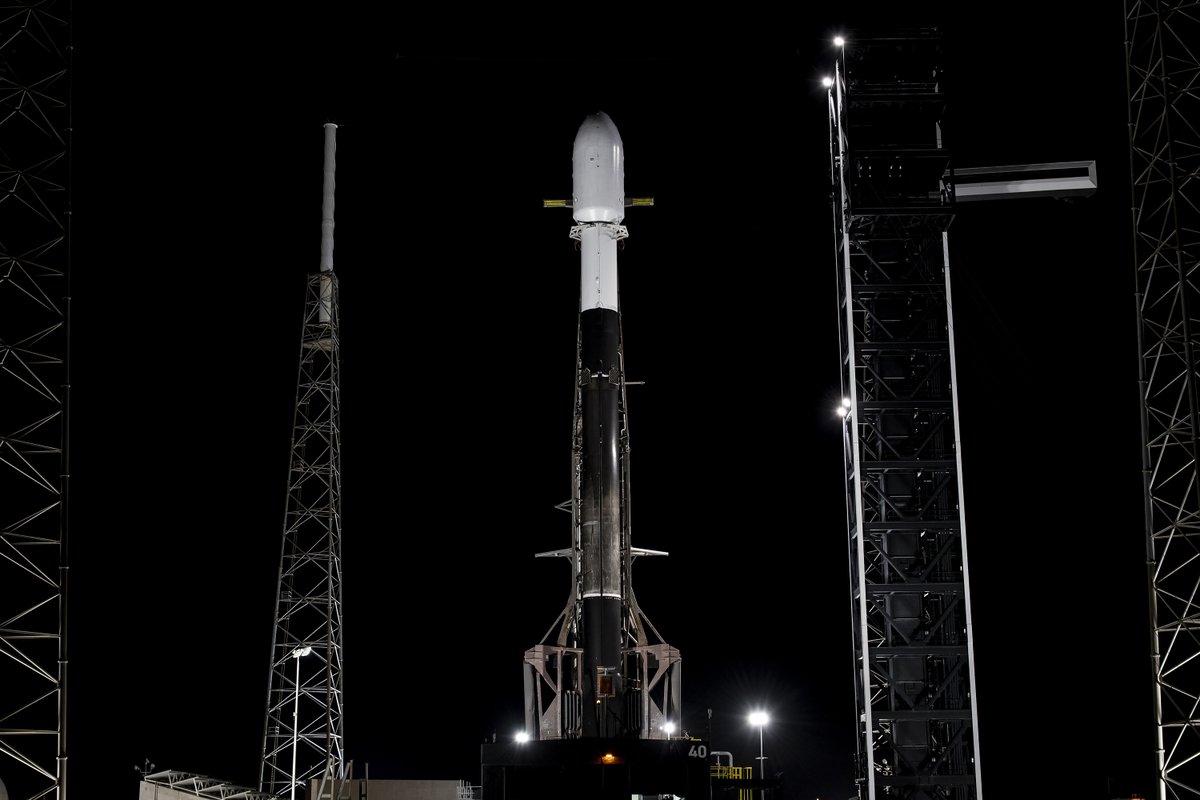
- Sirius SXM-11 from Cape Canaveral Space Force Station, Space Launch Complex 40 (02:25 UTC) SXM-11 is the 12th high-powered digital audio radio satellite built by Lanteris Space for SiriusXM. The spacecraft is based on the IM-1300-class platform and features a large mesh unfurlable reflector nearly 10 meters in diameter to deliver SiriusXM programming to receivers including those in moving vehicles. The Falcon 9 Block 5 is a reusable two-stage rocket capable of carrying up to 22,800 kg to low Earth orbit. Watch Live
-
Agency for Defense Development South Korean ADD Solid-Fuel SLV:
- Demo Flight from Sea Launch, ADD Offshore Launch Platform (05:00 UTC) Demonstration flight of South Korea’s Agency for Defense Development solid-fuel small launch vehicle, targeting low Earth orbit. Launch Preview
June 30
-
Rocket Lab Electron:
- Ten Owl Of Ten (StriX Launch 10) from Rocket Lab Launch Complex 1, Mahia Peninsula, New Zealand (TBD) Earth observation mission for Synspective, launching the tenth StriX-series synthetic aperture radar satellite. The Electron is a small-lift launch vehicle powered by nine Rutherford electric-pump-fed engines, capable of delivering up to 300 kg to low Earth orbit. Launch Preview
-
Rocket Lab Electron:
- The Grain Goddess Provides (iQPS Launch 7) from Rocket Lab Launch Complex 1, Mahia Peninsula, New Zealand (TBD) Synthetic aperture radar Earth observation satellite for Japanese Earth imaging company iQPS.
-
China Rocket Co. Ltd. Smart Dragon 3:
- Unknown Payload from Haiyang Oriental Spaceport, Haiyang Offshore Launch Location (TBD) Details to be determined. Smart Dragon-3 is a solid-fuel commercial orbital rocket developed by a subsidiary of the state-owned CASC group.
-
SpaceX Falcon 9 Block 5:
- Globalstar 2-R Mission 1 (x9) from Cape Canaveral Space Force Station, Space Launch Complex 40 (TBD) A Falcon 9 will launch nine Globalstar HIBLEO-4 replenishment satellites to low Earth orbit. This is the first of two launches constituting a full fleet replenishment. Booster B1090 flying for its 12th time will target a landing on drone ship A Shortfall of Gravitas in the Atlantic Ocean. Watch Live Launch Preview
-
European Space Agency Themis Demonstrator:
- T1H-1 from Esrange Space Center, Launch Complex 3B (TBD) First low-altitude hop test of the Themis reusable rocket demonstrator, targeting a peak altitude of up to 100 meters. Themis is a flagship European prototype powered by the methane-fuelled Prometheus engine, developed with ArianeGroup to advance European rocket recovery and reuse technologies.
Schedule Changes
- Newly Added: Themis Demonstrator T1H-1 has been added to the manifest, scheduled for a test hop at Esrange Space Center on or around June 30, 2026.
- Status Update: The SpaceX Falcon 9 Block 5 Project Starfall Demonstration Mission has been removed from the upcoming calendar following a successful launch.
- Status Update: The South Korean Agency for Defense Development Solid-Fuel SLV Demo Flight has been upgraded from To Be Determined to Go for Launch, confirming it is proceeding toward its June 29 launch window.
Note: Launch dates and times are subject to change due to technical or weather considerations.