· space brief · 7 min read
Space Force Orders 14 GPS 3F Satellites for $514M | KeepTrack Space Brief
Space Force awards Lockheed Martin $514M for two additional GPS 3F satellites, bringing total orders to 14. New satellites add anti-jam features and upgraded civilian signals.
Top Stories
Space Force Orders Two More GPS 3F Satellites from Lockheed Martin for $514M
The U.S. Space Force awarded Lockheed Martin a $514 million contract for two additional GPS Block III Follow-On (GPS 3F) satellites, bringing total GPS 3F orders to 14. The satellites add anti-jam features, digital payloads, and upgraded civilian navigation signals over the older Block III baseline.
GPS 3F satellites are direct replacements for aging constellation members. As new birds come online, expect catalog updates to the GPS constellation in KeepTrack. You can track active GPS satellites directly in the app.
Read the full story: SpaceNews
DARPA Issues RFI for Rapid Reconstitution of Space Systems
DARPA is soliciting industry input on rapid reconstitution of space architecture — specifically on-orbit manufacturing and assembly, and enabling technology for very low Earth orbit (VLEO) operations. The RFI does not commit to a program, but it signals where DARPA is looking for solutions.
VLEO operations below roughly 450 km face severe atmospheric drag, requiring either continuous propulsion or frequent replacement. On-orbit assembly could change how the U.S. military thinks about survivable, reconstitutable constellations after a conflict.
Read the full story: Breaking Defense
SpaceX Launches 24 Starlink V2 Mini Satellites on Booster B1093’s 14th Flight
Falcon 9 booster B1093 lifted off from SLC-4E at Vandenberg Space Force Base at 8:34 a.m. PDT on June 15, deploying 24 Starlink V2 Mini satellites. It was the first SpaceX launch after the company’s IPO on June 15.
The 24 new satellites will join the existing Starlink constellation, which KeepTrack users can monitor in real time. V2 Mini satellites carry higher-throughput payloads compared to the original Starlink design.
Read the full story: Teslarati
Gilat to Acquire Comtech’s Satellite Communications Business
Israel’s Gilat Satellite Networks has agreed to acquire most of Comtech’s space-related communications business. The deal comes six years after Comtech’s own attempted takeover of Gilat collapsed. Gilat cited expansion of its defense communications capabilities as the primary driver.
Comtech has long supplied military satcom terminals and ground infrastructure to U.S. and allied customers. Gilat absorbing that business consolidates two defense-oriented satcom vendors into one, with implications for military SATCOM supply chains.
Read the full story: SpaceNews
General Atomics Joins Army ERAP Competition Alongside General Dynamics and BAE
General Atomics Electromagnetic Systems won a contract to compete in the U.S. Army’s Extended Range Artillery Projectile (ERAP) program, joining General Dynamics Ordnance and Tactical Systems and BAE Systems. All three vendors are now under contract to develop next-generation 155mm variants.
While not a space story directly, precision munitions programs increasingly depend on GPS-guided targeting. GPS signal resilience — including anti-jam features being added to GPS 3F — is directly relevant to these systems’ effectiveness.
Read the full story: Breaking Defense
Commerce Export Controls on Anthropic AI Tool Complicate Pentagon Access
The Commerce Department imposed export controls on Anthropic’s Mythos/Fable 5 AI model, a bug-hunting tool. Defense analysts say the move complicates the Pentagon’s existing efforts to integrate Anthropic’s AI into defense applications, adding licensing friction to an already contested relationship.
Export controls on AI models are relatively new territory. The controls affect how the tool can be shared with foreign partners and used in classified environments, which matters for any defense program evaluating AI-assisted software vulnerability analysis.
Read the full story: Breaking Defense
Satellite of the Day
QIANFAN-18
QIANFAN-18, also known as Qianfan Jigui 01-18, is a Chinese communications satellite operated by YUANX and manufactured by SECM. Launched on August 6, 2024, aboard a Chang Zheng 6A rocket from Taiyuan Satellite Launch Center, this compact satellite joins China’s growing constellation of communications platforms. With a dry mass of 300 kg and a distinctive box-and-panel configuration, QIANFAN-18 is optimized for its communications mission with a 10-meter solar panel span providing power via solar cells and batteries.
This satellite operates in a near-polar orbit with an inclination of 88.97 degrees, making it well-suited for global coverage including the polar regions. As part of the Qianfan (千帆) satellite family, QIANFAN-18 represents China’s continued investment in distributed communications infrastructure. Its recent launch and operational status make it an excellent example of modern small-satellite design for commercial and strategic communications purposes.
| Detail | Value |
|---|---|
| NORAD ID | 60396 |
| Operator | YUANX (China) |
| Launch Date | August 6, 2024 |
| Orbit | Near-polar, 88.97° inclination |
| Purpose | Communications |
| Status | Active |
Track this satellite in real-time: Track QIANFAN-18
Upcoming Space Launches
June 16
- China Aerospace Science and Technology Corporation Long March 3B/E | Unknown Payload:
- Unknown Payload from Xichang Satellite Launch Center, People’s Republic of China (09:37 UTC) Details are not yet available for this mission. The Long March 3B/E is one of China’s most capable medium-lift vehicles, optimized for heavy communications satellites in geostationary transfer orbit.
June 17
-
China Aerospace Science and Technology Corporation Long March 12 | Unknown Payload:
- Unknown Payload from Wenchang Space Launch Site, People’s Republic of China (02:37 UTC) Details are not yet available for this mission. The Long March 12 is a medium-lift kerolox launch vehicle developed by the Shanghai Academy of Spaceflight Technology, capable of delivering up to 12 tonnes to low Earth orbit.
-
ExPace Kuaizhou 11 | Unknown Payload:
- Unknown Payload from Jiuquan Satellite Launch Center, People’s Republic of China (03:31 UTC) Details are not yet available for this mission. The Kuaizhou-11 is a Chinese commercial solid-fueled launch vehicle launched from a mobile transporter-erector-launcher.
-
SpaceX Falcon 9 Block 5 | BlueBird Block 2 #3-5:
- BlueBird Block 2 #3-5 from Cape Canaveral Space Force Station, FL, USA (06:39 UTC) Three AST SpaceMobile Block 2 BlueBird satellites, featuring communications arrays of up to 2,400 square feet — the largest to be commercially deployed in low Earth orbit. These satellites deliver up to 10 times the bandwidth of Block 1 units, enabling 24/7 continuous cellular broadband coverage with peak speeds up to 120 Mbps. Watch Live
-
Arianespace Ariane 64 Block 2 | Amazon Leo (LE-03):
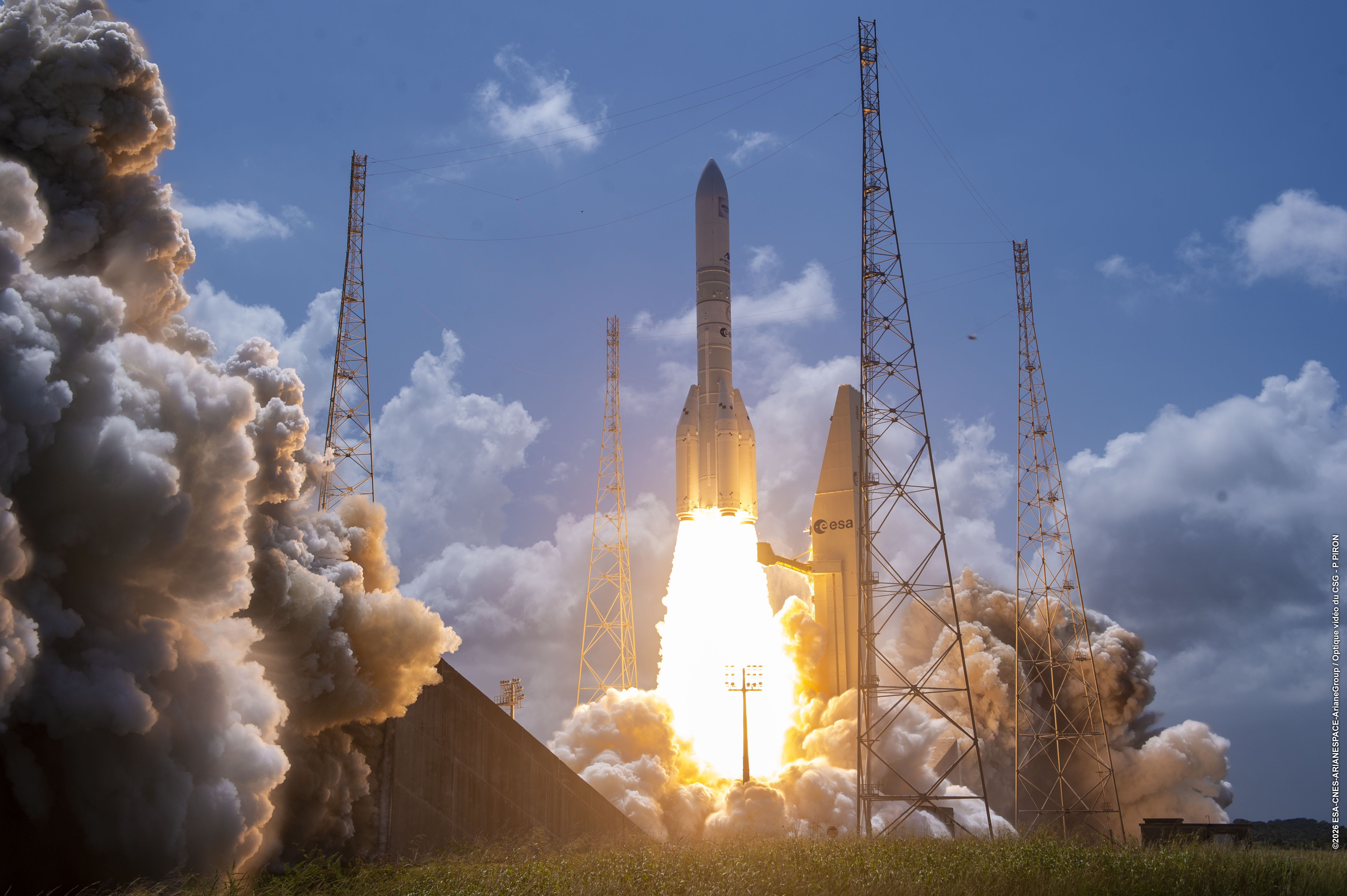
- Amazon Leo (LE-03) from Guiana Space Centre, French Guiana (11:53 UTC) Carrying 36 satellites for Amazon’s Leo broadband internet constellation, formerly known as Project Kuiper. The full constellation is planned to comprise 3,276 satellites across 98 orbital planes at altitudes of 590–630 km, providing high-speed internet access to underserved and remote communities worldwide.
-
Rocket Lab Electron | Ten Owl Of Ten (StriX Launch 10):
- Ten Owl Of Ten (StriX Launch 10) from Rocket Lab Launch Complex 1, Mahia Peninsula, New Zealand (20:40 UTC) Tenth StriX-series synthetic aperture radar Earth observation satellite for Japanese imaging company Synspective, to be deployed into sun-synchronous orbit.
June 18
- SpaceX Falcon 9 Block 5 | NROL-179:
- NROL-179 from Vandenberg Space Force Base, CA, USA (08:54 UTC) Fourteenth batch of satellites for a classified reconnaissance constellation built by SpaceX and Northrop Grumman for the National Reconnaissance Office, providing imaging and other intelligence, surveillance, and reconnaissance capabilities. Watch Live
June 20
-
SpaceX Falcon 9 Block 5 | Globalstar 2-R Mission 1 (x 9):
- Globalstar 2-R Mission 1 (x 9) from Cape Canaveral Space Force Station, FL, USA (06:39 UTC) Nine HIBLEO-4 replenishment satellites for Globalstar, representing the first of two launches to refresh the company’s low Earth orbit fleet. Booster B1090, flying for its 12th time, will target a landing on the drone ship A Shortfall of Gravitas in the Atlantic Ocean. Watch Live Launch Preview
-
SpaceX Falcon 9 Block 5 | Starlink Group 17-28:
- Starlink Group 17-28 from Vandenberg Space Force Base, CA, USA (14:00 UTC) Batch of 24 Starlink satellites for SpaceX’s broadband internet mega-constellation. Watch Live
June 21
- SpaceX Falcon 9 Block 5 | Project Starfall Demonstration Mission:
- Project Starfall Demonstration Mission from Cape Canaveral Space Force Station, FL, USA (10:43 UTC) Demonstration mission for SpaceX’s Project Starfall, a program to mass-produce autonomous reentry capsules capable of returning customer experiments and manufactured goods safely from orbit to Earth. The Starfall capsule is approximately 0.75 m tall with a 3.1 m diameter, weighs roughly 2,100 kg, and can carry up to 1,000 kg of payload. It is designed for deployment on Starship missions. Full mission details are pending.
Schedule Changes
- New Addition — SpaceX Falcon 9 Block 5 | Starlink Group 17-28: Added to the manifest with a status of Go for Launch, targeting 14:00 UTC on June 20 from Vandenberg Space Force Base.
- New Addition — SpaceX Falcon 9 Block 5 | Project Starfall Demonstration Mission: Added to the manifest with a status of To Be Confirmed, targeting 10:43 UTC on June 21 from Cape Canaveral Space Force Station.
- SpaceX Falcon 9 Block 5 | Starlink Group 17-54: Status updated from Go for Launch to Launch Successful; removed from the upcoming launch calendar.
Note: Launch dates and times are subject to change due to technical or weather considerations.

Maurice Stellarski