· space brief · 8 min read
SpaceX IPO at $1.77T as SDA Faces Consolidation | KeepTrack Space Brief
SpaceX launches Starlink while debuting on Nasdaq at $1.77 trillion valuation. Meanwhile, Senate FY2027 NDAA would dissolve SDA into Space Force, affecting Tranche constellation tracking.

Top Stories
Senate FY2027 NDAA Would Dissolve SDA and Space RCO as Standalone Agencies
The Senate Armed Services Committee’s FY2027 defense bill includes language to eliminate separate statutory requirements for both the Space Development Agency and the Space Rapid Capabilities Office, folding both into Space Force. The move is part of a broader Pentagon acquisition reform push. If enacted, it consolidates two organizations that have operated with distinct acquisition authorities and timelines since their founding.
For satellite trackers: SDA’s Tranche constellation — the Transport and Tracking Layer satellites building out the proliferated LEO architecture — would continue under Space Force command. You can monitor cataloged SDA assets directly in KeepTrack.
Read the full story: SpaceNews
SpaceX Goes Public on Nasdaq at $1.77 Trillion Valuation
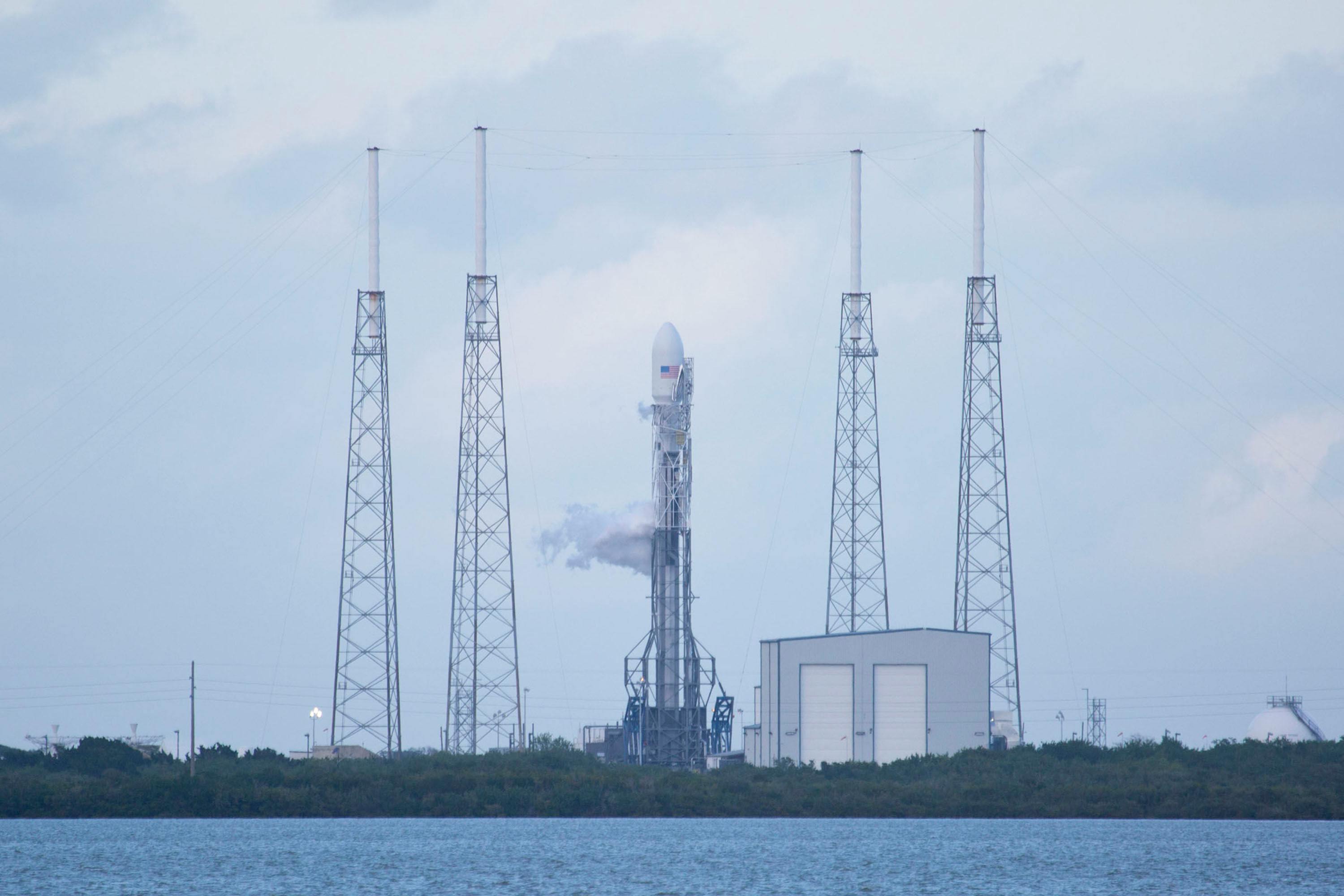
SpaceX began trading on the Nasdaq under ticker “SPCX” on June 12, opening with a $1.77 trillion market cap. The IPO coincided with a Starlink launch from pad 40 at Cape Canaveral Space Force Station, with liftoff scheduled at 8:37 a.m. EDT (1237 UTC).
The timing was deliberate. Pairing the public debut with an active launch put hardware in orbit on the same day the company entered public markets. Starlink’s constellation now exceeds 7,000 operational satellites — trackable in real time on KeepTrack.
Read the full story: Spaceflight Now
Space Force Opens New Vandenberg Launch Site to Small and Medium Rockets
U.S. Space Force is soliciting potential users for a new launch facility at Vandenberg Space Force Base designed for small and medium-class vehicles. No specific pad designation or operator has been announced yet.
Vandenberg already hosts launches to sun-synchronous and polar orbits — trajectories that cover most of Earth’s surface and are heavily used for reconnaissance, weather, and scientific missions. Adding dedicated infrastructure for smaller vehicles increases throughput without competing for existing pad time at SLC-4 or SLC-6.
Read the full story: SpaceNews
F-35 Full Mission Capable Rate Dropped to 25% in FY2025, GAO Finds
The F-35’s full mission capable rate fell to 25% in fiscal year 2025, according to a new GAO report. The Pentagon is requesting a $13.7 billion boost to address the readiness shortfall.
A 25% FMC rate means three out of four F-35s in the fleet cannot execute all assigned missions on a given day. That figure covers all three variants across the services. The funding request targets sustainment, spare parts, and depot-level maintenance backlogs.
Read the full story: Breaking Defense
Leonardo in Advanced Talks to Expand Italian Army AW-249 Fleet
Leonardo is in advanced negotiations to add more AW-249 Fenice combat helicopters to the Italian Army’s inventory. Marco Marinoni, head of the AH-249 acquisition program, described one intended mission profile as flying at high speed and low altitude to penetrate deep into enemy territory.
Italy fielded its first AW-249s under an initial contract. Expanding the fleet would give the Army more attack aviation capacity aligned with high-intensity conflict scenarios, a priority across NATO ground forces since 2022.
Read the full story: Breaking Defense
Elbit and Diehl Defence Partner to Pitch SkyStriker Loitering Munition to Germany
Elbit Systems and Germany’s Diehl Defence have teamed to bid SkyStriker loitering munitions for the German military. The arrangement includes local manufacturing and assembly in Germany, giving Berlin a path to domestic production rather than straight foreign military sales.
Germany has moved aggressively to rearm since 2022. Pairing an Israeli system with a German prime contractor addresses both capability gaps and political requirements around sovereign industrial capacity.
Read the full story: Breaking Defense
Poland Warns NATO Allies Face Multi-Year Delays on U.S. Weapons Deliveries
Poland’s Military Representative to NATO, Lieutenant General Piotr Błazeusz, warned European allies are caught between urgent defense needs and U.S. delivery timelines stretching to 2029–2030 — with possible further delays. He described a pattern where allies request U.S. systems and are told the hardware won’t arrive for years.
The warning came at the Berlin Air Show. It reflects a broader tension: European demand for U.S. equipment has surged, but the U.S. defense industrial base has not scaled production commensurately. Several nations are now hedging by pursuing European alternatives or accelerating domestic programs.
Read the full story: Breaking Defense
Satellite of the Day
COSMOS 1619
COSMOS 1619 is a Soviet-era military communication satellite that has been on orbit since January 15, 1985, launched from Plesetsk Cosmodrome via Tsiklon-3 rocket. Manufactured by NPOPM for the Soviet Ministry of Defence (GUKOS), this compact spacecraft carries a Strela-3 communication payload designed to support secure military communications. At just 225 kg and featuring a cylindrical body with deployable solar panels spanning 7 meters, COSMOS 1619 represents the efficient engineering philosophy of Cold War-era Soviet space systems.
Orbiting at a high inclination of 82.6°, this satellite exemplifies the Soviet approach to global coverage using polar and near-polar orbits. Despite nearly four decades in space, COSMOS 1619 remains of interest to space domain awareness trackers as a long-lived relic of the Soviet space program. Its longevity in orbit—far exceeding typical design lifespans for military communication satellites of that era—makes it a notable fixture in low Earth orbit and a testament to robust Soviet spacecraft engineering.
| Detail | Value |
|---|---|
| NORAD ID | 15471 |
| Operator | GUKOS (Soviet Union) |
| Launch Date | January 15, 1985 |
| Orbit | Low Earth Orbit, 82.6° inclination |
| Purpose | Military Communication |
| Status | Active |
Track this satellite in real-time: Track COSMOS 1619
Upcoming Space Launches
June 12
- SpaceX Falcon 9 Block 5:
- Starlink Group 10-54 from Space Launch Complex 40, Cape Canaveral Space Force Station, FL, USA (12:27 UTC) A batch of 24 Starlink V2 Mini Optimized satellites launching to low Earth orbit. Booster B1071 will land on drone ship Of Course I Still Love You in the Pacific Ocean. Watch Live Launch Preview
June 15
-
CAS Space Kinetica 1:
- Unknown Payload from Launch Area 130, Jiuquan Satellite Launch Center, People’s Republic of China (03:34 UTC) Kinetica 1 (Lijian-1) is a Chinese solid-propellant light launch vehicle capable of placing approximately 2 tonnes into low Earth orbit. Payload details are to be determined. Launch Preview
-
SpaceX Falcon 9 Block 5:
- Starlink Group 17-54 from Space Launch Complex 4E, Vandenberg Space Force Base, CA, USA (14:00 UTC) A batch of 24 Starlink V2 Mini Optimized satellites launching to low Earth orbit. Watch Live Launch Preview
-
Isar Aerospace Spectrum:
- Onward and Upward from Orbital Launch Pad, Andøya Spaceport, Norway (20:00 UTC) The second test flight of Isar Aerospace’s Spectrum small launch vehicle. The two-stage rocket is carrying five CubeSats — CyBEEsat (TU Berlin), TriSat-S (University of Maribor), Platform 6 (EnduroSat), FramSat-1 (NTNU), and SpaceTeamSat1 (TU Wien Space Team) — along with a Dcubed experiment called “Let it Go.” Exolaunch is managing payload integration and deployment. (Status: To Be Confirmed) Watch Live Launch Preview
June 16
- China Aerospace Science and Technology Corporation Long March 3B/E:
- Unknown Payload from Launch Complex 2 (LC-2), Xichang Satellite Launch Center, People’s Republic of China (09:37 UTC) The Long March 3B/E is the most capable variant of the CZ-3 series, developed primarily for heavy communications satellites to geostationary transfer orbit. It features stretched boosters, extended first-stage fuel tanks, and a larger payload fairing. Payload details are to be determined. Launch Preview
June 17
-
China Aerospace Science and Technology Corporation Long March 12:
- Unknown Payload from Commercial LC-2, Wenchang Space Launch Site, People’s Republic of China (02:00 UTC) The Long March 12 is a medium-lift launch vehicle developed by the Shanghai Academy of Spaceflight Technology, using liquid oxygen and kerosene propellant. It is capable of lifting at least 10 tonnes to low Earth orbit. Payload details are to be determined. (Status: To Be Confirmed) Launch Preview
-
SpaceX Falcon 9 Block 5:
- BlueBird Block 2 #3-5 from Space Launch Complex 40, Cape Canaveral Space Force Station, FL, USA (06:39 UTC) This mission will deploy three AST SpaceMobile BlueBird Block 2 satellites, which offer up to 10 times the bandwidth capacity of Block 1 satellites. The Block 2 BlueBirds feature communications arrays as large as 2,400 square feet, making them the largest satellites ever commercially deployed in low Earth orbit. They are designed to support 24/7 continuous cellular broadband coverage with peak data speeds up to 120 Mbps. Watch Live
-
Arianespace Ariane 64 Block 2:
- Amazon Leo (LE-03) from Ariane Launch Area 4, Guiana Space Centre, French Guiana (11:53 UTC) Arianespace’s Ariane 6 will carry 36 satellites for Amazon’s Leo constellation (formerly Project Kuiper), a planned 3,276-satellite broadband internet constellation in low Earth orbit. Satellites will be distributed across orbital shells at 590, 610, and 630 km altitude, aiming to deliver high-speed, low-latency internet access to underserved and remote regions globally.
-
Rocket Lab Electron:
- Ten Owl Of Ten (StriX Launch 10) from Rocket Lab Launch Complex 1, Mahia Peninsula, New Zealand (20:40 UTC) The tenth launch of a Synspective StriX synthetic aperture radar satellite, supporting the Japanese Earth imaging company’s growing constellation for high-resolution ground observation.
Schedule Changes
- Arianespace Ariane 64 Block 2 | Amazon Leo (LE-03) has been newly added to the schedule, with a launch window opening 17 June 2026 at 11:53 UTC from the Guiana Space Centre.
- Rocket Lab Electron | Ten Owl Of Ten (StriX Launch 10) has been newly added to the schedule, targeting 17 June 2026 at 20:40 UTC from Rocket Lab Launch Complex 1, Mahia Peninsula, New Zealand.
- China Aerospace Science and Technology Corporation H3-30 | H3-30 Test Flight has been removed from the upcoming launch calendar following a successful launch.
- SpaceX Falcon 9 Block 5 | Starlink Group 17-44 has been removed from the upcoming launch calendar following a successful launch.
Note: Launch dates and times are subject to change due to technical or weather considerations.

Maurice Stellarski