Top Stories
HASC Pushes Back on Space Force Satellite Cancellations in NDAA Markup
The House Armed Services Committee is moving to preserve a missile-warning satellite program the Pentagon has proposed canceling. The markup also takes aim at a recent tactical communications satellite procurement and raises concerns about GPS program oversight.
The missile-warning program in question feeds directly into space domain awareness. If you’re tracking missile warning satellites or monitoring geosynchronous orbits where these assets typically operate, the outcome of this budget fight will determine what gets built and when. Watch this one through conference.
Read the full story: SpaceNews
NASA Pushes Blue Origin to Find New Launcher After New Glenn Explosion
NASA Administrator confirmed the agency wants Blue Origin to identify an alternate launch vehicle for its Human Landing System moon landers. The directive came one week after a New Glenn test explosion destroyed the rocket and damaged Launch Complex 36 at Cape Canaveral.
Blue Origin’s HLS contract is on the critical path for Artemis lunar surface missions. With LC-36 damaged and New Glenn grounded, there’s no current timeline for when the pad returns to service. NASA’s pressure to swap launch vehicles reflects real schedule risk to Artemis, not just bureaucratic caution.
Read the full story: Spaceflight Now
House Passes Ukraine Support Act 226-195, Authorizing $8B in Military Loans
The House voted 226-195 to pass the Ukraine Support Act. The bill authorizes $8 billion in military finance loans to Ukraine and extends the Ukraine Security Assistance Initiative through 2027.
The margin was narrow. Extension of USAI through 2027 keeps the legal framework in place for continued weapons and equipment transfers, including satellite communications and ISR systems that have been part of prior aid packages.
Read the full story: Breaking Defense
USS Theodore Roosevelt Deploys With Unmanned Surface Vessel
The Navy’s USS Theodore Roosevelt carrier strike group is heading out with an autonomous ship in company — the first carrier deployment paired with an unmanned surface vessel. The integration is being watched closely as a test of how the Navy builds concept of operations for unmanned systems at scale.
The deployment is less about this single ship and more about what data it generates. How the unmanned vessel performs in sustained blue-water operations will shape procurement decisions and fleet architecture for years.
Read the full story: Breaking Defense
Pentagon Cyber Defense Command Building Joint Task Force for Critical Infrastructure
DoD Cyber Defense Command is drafting a plan to establish a joint task force focused on defending critical infrastructure from cyberattack. No public timeline has been announced for standing up the JTF.
Space ground infrastructure — launch control, satellite command links, GPS ground stations — falls under the critical infrastructure umbrella this command is scoping. Any formal JTF structure would be relevant to how space assets are defended against cyber intrusion.
Read the full story: Breaking Defense
HASC Battleship Funding Amendment Fails; Cost Overruns Expected
An amendment to strip funding from the BBG(X) battleship program failed during the HASC NDAA markup. Rep. Adam Smith (D-WA) publicly predicted the program’s costs will exceed current estimates, telling colleagues to “take the over” on whatever number is presented.
Smith’s comment is a direct flag that at least some members expect this program to grow. Cost growth on major Navy shipbuilding programs historically crowds out other defense budgets, including space systems procurement.
Read the full story: Breaking Defense
Brazil Plans to Purchase 20 Additional Gripen Fighter Jets
Brazilian Air Force Chief Gen. Marcelo Kanitz Damasceno confirmed Brazil intends to buy 20 more Saab Gripen fighters. The decision follows an internal assessment of Brazil’s air power requirements.
Brazil already operates Gripens and has domestic final assembly underway at Embraer. Adding 20 frames expands a fleet that increasingly factors into South American airspace and radar coverage, relevant context for regional space launch activity out of Alcântara.
Read the full story: Breaking Defense
Satellite of the Day
YAOGAN-30 10B
YAOGAN-30 10B is a Chinese reconnaissance satellite launched on June 18, 2021, from the Xichang Satellite Launch Center aboard a Chang Zheng 2C rocket. Part of China’s YAOGAN (Remote Sensing) series, this spacecraft is believed to be dedicated to signals intelligence (SIGINT) gathering, though Beijing maintains official secrecy around its precise mission parameters—a common practice among national security space assets. The satellite carries the Chuangxin-5 26 payload and was manufactured by the Shanghai Engineering Center for Microsatellites (SECM).
Weighing 500 kilograms and featuring a compact box-shaped design with deployable solar arrays, YAOGAN-30 10B operates in a low Earth orbit and maintains a 34.99° inclination, allowing it to monitor mid-latitude regions of interest. The YAOGAN-30 constellation represents a significant component of China’s space-based intelligence collection infrastructure, complementing its optical and radar reconnaissance satellites. Tracking this spacecraft provides valuable insights into China’s space activities and the growing sophistication of its remote sensing capabilities.
| Detail | Value |
|---|---|
| NORAD ID | 48861 |
| Operator | ZLZB (China) |
| Launch Date | June 18, 2021 |
| Orbit | Low Earth Orbit, 34.99° inclination |
| Purpose | SIGINT (suspected) |
| Status | Active |
Track this satellite in real-time: Track YAOGAN-30 10B
Upcoming Space Launches
June 7
- SpaceX Falcon 9 Block 5:
- Starlink Group 17-43 from Vandenberg Space Force Base Space Launch Complex 4E (02:00 UTC) A batch of 24 Starlink V2 Mini Optimized satellites launching to low Earth orbit. Watch Live
June 8
-
Agency for Defense Development South Korean ADD Solid-Fuel SLV:
- Demo Flight from Sea Launch Offshore Platform (05:00 UTC) Test flight of South Korea’s solid-fuel space launch vehicle demonstrator to low Earth orbit. Launch Preview
-
SpaceX Falcon 9 Block 5:
- Starlink Group 10-35 from Cape Canaveral Space Force Station Space Launch Complex 40 (10:07 UTC) A batch of 24 Starlink V2 Mini Optimized satellites launching to low Earth orbit. Watch Live
June 9
- LandSpace Zhuque-2E Block 2:
- Unknown Payload from Jiuquan Satellite Launch Center Launch Area 96A (08:11 UTC) The Zhuque-2E Block 2 is an enhanced liquid oxygen/methane medium-lift rocket capable of delivering up to 6,000 kg to low Earth orbit. The Block 2 variant features a lengthened first stage with increased propellant capacity and upgraded TQ-12A and TQ-15A engines. Payload details are not yet available.
June 10
-
Indian Space Research Organization GSLV Mk II:
- GISAT-1A (EOS-05) from Satish Dhawan Space Centre Second Launch Pad (00:00 UTC) GISAT-1A (GEO Imaging Satellite) is an Indian Earth observation satellite designed to operate from geostationary orbit, enabling continuous surveillance of the Indian subcontinent and rapid monitoring of natural hazards and disasters. The GSLV Mk II is India’s largest operational launch vehicle, featuring an indigenous cryogenic upper stage.
-
China Rocket Co. Ltd. Smart Dragon 3:
- Unknown Payload from Haiyang Oriental Spaceport Offshore Launch Location (00:30 UTC) Smart Dragon-3 is a commercial solid-fuel orbital rocket developed by a subsidiary of CASC. Payload details are not yet available.
-
Mitsubishi Heavy Industries H3-30:
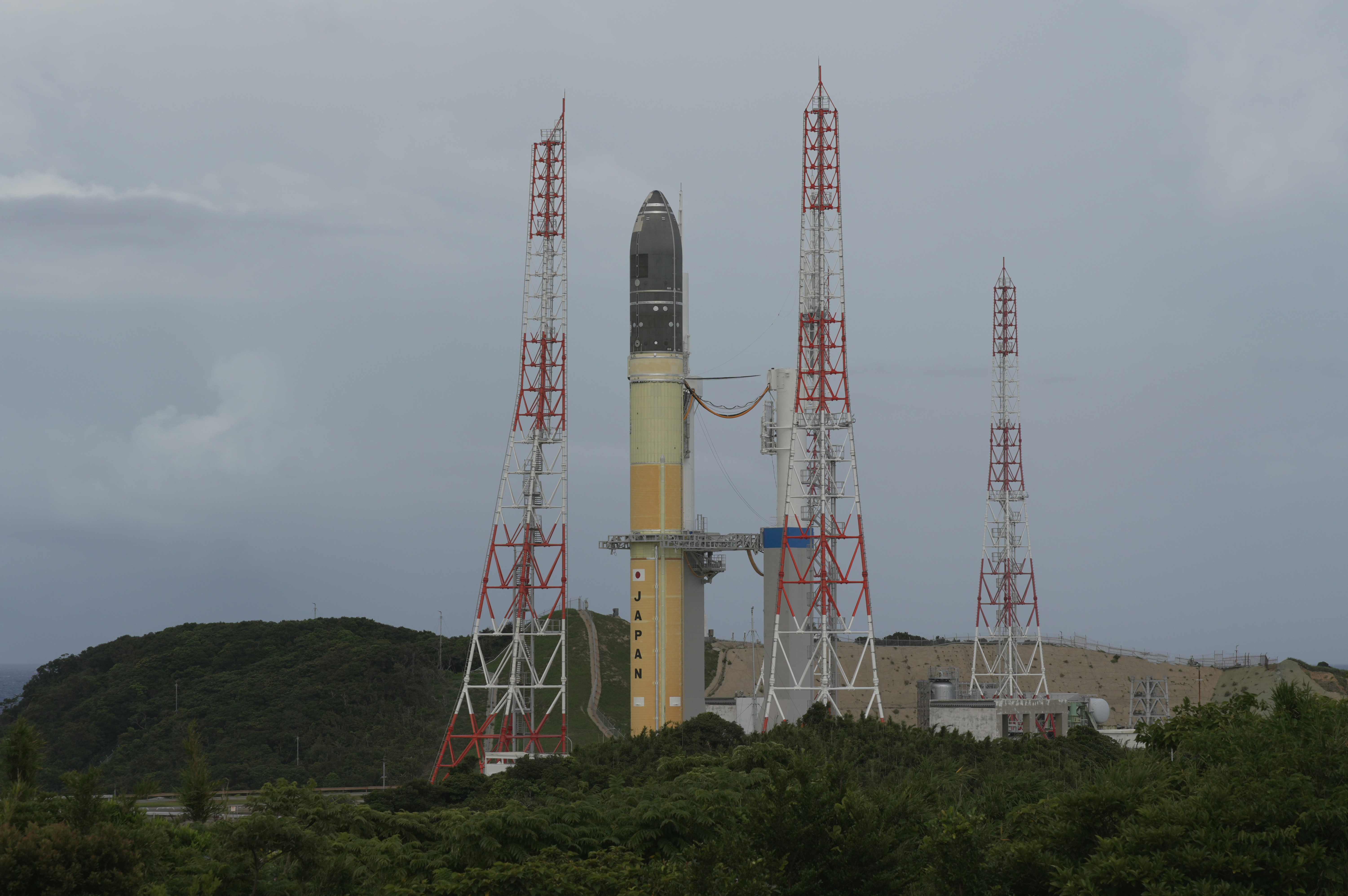
- H3-30 Test Flight from Tanegashima Space Center Yoshinobu Launch Complex LP-2 (00:53 UTC) Test flight of the H3-30 variant, featuring three LE-9 engines on the first stage and no solid rocket boosters. The mission will carry a dummy primary payload (Vehicle Evaluation Payload 5 / VEP-5) along with five small hitchhiker satellites: PETREL, STARS-X, BRO-22, VERTECS, and HORN-L/R. The H3, developed by Mitsubishi Heavy Industries and JAXA, is Japan’s next-generation expendable launch vehicle with a launch mass of approximately 274 tonnes.
-
China Aerospace Science and Technology Corporation Long March 5:
- Unknown Payload from Wenchang Space Launch Site Pad 101 (07:22 UTC) China’s heavy-lift Long March 5 rocket, capable of delivering up to 25,000 kg to low Earth orbit, launches with an as-yet undisclosed payload. The Long March 5 is China’s first launch vehicle designed around non-hypergolic liquid propellants and roughly matches the performance of the Delta IV Heavy.
-
SpaceX Falcon 9 Block 5:
- Starlink Group 17-44 from Vandenberg Space Force Base Space Launch Complex 4E (14:00 UTC) A batch of 24 Starlink V2 Mini Optimized satellites launching to low Earth orbit. Watch Live
June 11
- Rocket Lab HASTE:
- Curveball from Wallops Flight Facility Rocket Lab Launch Complex 2 (04:00 UTC) A suborbital launch under Rocket Lab’s Hypersonic Accelerator Suborbital Test Electron (HASTE) program. HASTE uses a modified Electron rocket as a testbed for hypersonic research and technology demonstration. Further mission details are not yet available.
Schedule Changes
- New launches added: LandSpace Zhuque-2E Block 2 carrying an unknown payload (June 9, 08:11 UTC from Jiuquan Satellite Launch Center) has been added to the manifest. Rocket Lab HASTE | Curveball (June 11, 04:00 UTC from Wallops Flight Facility) has also been newly added.
- Launch Successful: SpaceX Falcon 9 Block 5 | Starlink Group 10-43, China Aerospace Science and Technology Corporation Long March 8 | SpaceSail Polar Group #12, and Long March 6A | SpaceSail Polar Group #11 have all completed their missions successfully and been removed from the upcoming calendar.
- Status update: China Aerospace Science and Technology Corporation Long March 5 | Unknown Payload has been upgraded from To Be Confirmed to Go for Launch.
Note: Launch dates and times are subject to change due to technical or weather considerations.