📰Top Stories
China and India Achieve Launch Milestones
China has successfully launched its first geostationary orbit (GEO) Yaogan reconnaissance satellite, marking a significant advancement in their satellite capabilities. Concurrently, India set a record by launching its heaviest communications satellite, underscoring their expanding influence in space technology. These developments point to increased satellite activity in Asia, which is crucial for regional tracking efforts.
Read the full story: SpaceNews
Army Eyes New Laser Systems for Drone Defense
The U.S. Army is exploring industry proposals for the Enduring-High Energy Laser (E-HEL) program, aimed at developing advanced counter-drone laser systems. This initiative represents the Army’s first program of record for a series of high-energy lasers, highlighting ongoing investment in defensive technologies that could influence future military satellite deployment and defense strategies.
Read the full story: Breaking Defense
Australia’s Naval Enhancement with Ghost Shark AUVs
The Australian navy has received its first Ghost Shark Extra Large Autonomous Underwater Vehicle (AUV), which is part of a broader effort to enhance maritime security capabilities. This delivery signifies a step forward in adopting unmanned systems for defensive operations, potentially affecting both regional security dynamics and technological standards in underwater and satellite communications.
Read the full story: Breaking Defense
AI Standards and Military Competition with China
Experts from the Center for a New American Security (CNAS) emphasize the importance of the U.S. setting global standards in military artificial intelligence (AI) to compete effectively with China. This strategic positioning is essential in maintaining technological superiority and could influence how AI integrates with satellite reconnaissance and defense systems, impacting global military balance.
Read the full story: Breaking Defense
Advancements in Maritime Autonomy
A small Australian startup is collaborating with Austal to integrate autonomous systems across all Royal Navy ships. This initiative aims to position the company as a leader in maritime autonomy, which could revolutionize naval operations and influence satellite-based tracking and communication technologies across maritime vessels.
Read the full story: Breaking Defense
Devastation from Hurricane Melissa Captured by Satellites
New satellite imagery vividly captures the catastrophic impact of Hurricane Melissa on Jamaica. This powerful storm resulted in widespread destruction, showcasing the vital role of satellite technology in disaster monitoring and providing insights for relief operations. Satellite tracking allows for real-time updates and enhanced preparedness for future natural disasters.
Read the full story: Space.com
🛰️Satellite Spotlight
- Satellite Name: OPS 6157 (DSP 4)
- NORAD ID: 06691
- Launch Date: June 12, 1973
- Mission: This satellite serves as an early warning system, designed to detect missile launches and other critical defense-related events.
- Orbit: Low Earth Orbit (LEO)
- Operator: SAMSO
- Fun Fact: OPS 6157, also known as DSP F4, was part of the Defense Support Program and was equipped with advanced sensors for its time, capable of detecting heat signatures from rocket launches.
Track this satellite in real-time on our web app: Track OPS 6157 (DSP 4)
🌌Space Weather
Next 24 Hours
-
Radio Blackouts Probability
- Minor: 55
- Major: 10
- Risk: None
-
Solar Radiation
- Probability: 1
- Risk: None
-
Geomagnetic Storming
- Scale: 0
- Impact: none
- Activity: Low
-
Impact Summary
- Next 24 hours: No risk of radio blackouts.
- No risk of solar radiation storms.
- Geomagnetic outlook: G1 (Minor) geomagnetic storms are likely on 06 Nov due to CME/HSS arrival.
- Radiation outlook: No S1 (Minor) or greater solar radiation storms are expected.
- No significant active region activity favorable for radiation storm production is forecast.
- Radio blackout outlook: R1-R2 (Minor-Moderate) radio blackouts are likely, with a slight chance for an isolated (R3-Strong) event through 06 Nov.
Long Term Forecast
- Impact Summary
- Forecast period: 03 November - 29 November.
- Solar activity is expected at moderate levels from 03-17 Nov due to the delayed return of Regions 4246 and 4248, rotating into the Earthside solar disk.
- At least two other regions are expected to emerge from the East limb until 10 Nov.
- Moderate solar activity could continue through 29 Nov if these regions are magnetically complex.
- No proton events are expected at geosynchronous orbit; however, an isolated proton event is possible between 07-12 Nov if Regions 4246 and 4248 show enhanced activity.
- The greater than 2 MeV electron flux at geosynchronous orbit is expected to remain high until 13 Nov, with moderate levels from 14-26 Nov, and high levels returning on 27 Nov.
- Geomagnetic field activity is expected to be mostly quiet to active, with minor storming (G1) likely on 07-08, 15, and 26-27 Nov due to recurrence of CH HSS influences.
🚀Upcoming Space Launches
November 4
- Arianespace Ariane 62:
- Sentinel-1D from Guiana Space Centre, French Guiana (21:03 UTC) Sentinel-1D carries advanced radar technology to provide an all-weather, day-and-night supply of imagery of Earth’s surface as part of the Sentinel-1 constellation.
November 5
-
Rocket Lab Electron:
- The Nation God Navigates (iQPS Launch 5) from Rocket Lab Launch Complex 1, Mahia Peninsula, New Zealand (19:45 UTC) Synthetic aperture radar Earth observation satellite for Japanese Earth imaging company iQPS.
-
SpaceX Falcon 9:
- Starlink Group 6-81 from Cape Canaveral SFS, FL, USA (23:08 UTC) A batch of 29 satellites for the Starlink mega-constellation, SpaceX’s project for space-based Internet communication system.
November 6
-
United Launch Alliance Atlas V 551:
- ViaSat-3 F2 (ViaSat-3 EMEA) from Cape Canaveral SFS, FL, USA (03:24 UTC) The ViaSat-3 is a series of three Ka-band satellites expected to provide vastly superior capabilities in terms of service speed and flexibility.
-
SpaceX Falcon 9:
- Starlink Group 11-14 from Vandenberg SFB, CA, USA (20:56 UTC) A batch of 28 satellites for the Starlink mega-constellation.
November 7
-
CAS Space Kinetica 1:
- Unknown Payload from Jiuquan Satellite Launch Center, People’s Republic of China (03:23 UTC) Details TBD.
-
Blue Origin New Glenn:
- EscaPADE from Cape Canaveral SFS, FL, USA (19:51 UTC) Maiden flight of Blue Origin’s New Glenn launch vehicle, carrying a dual-spacecraft mission to study ion and sputtered escape from Mars.
November 8
- SpaceX Falcon 9:
- Starlink Group 10-51 from Kennedy Space Center, FL, USA (08:30 UTC) A batch of 29 satellites for the Starlink mega-constellation.
November 10
-
SpaceX Falcon 9:
- Transporter 15 (Dedicated SSO Rideshare) from Vandenberg SFB, CA, USA (00:00 UTC) Dedicated rideshare flight to a sun-synchronous orbit with dozens of small microsatellites and nanosatellites for commercial and government customers.
-
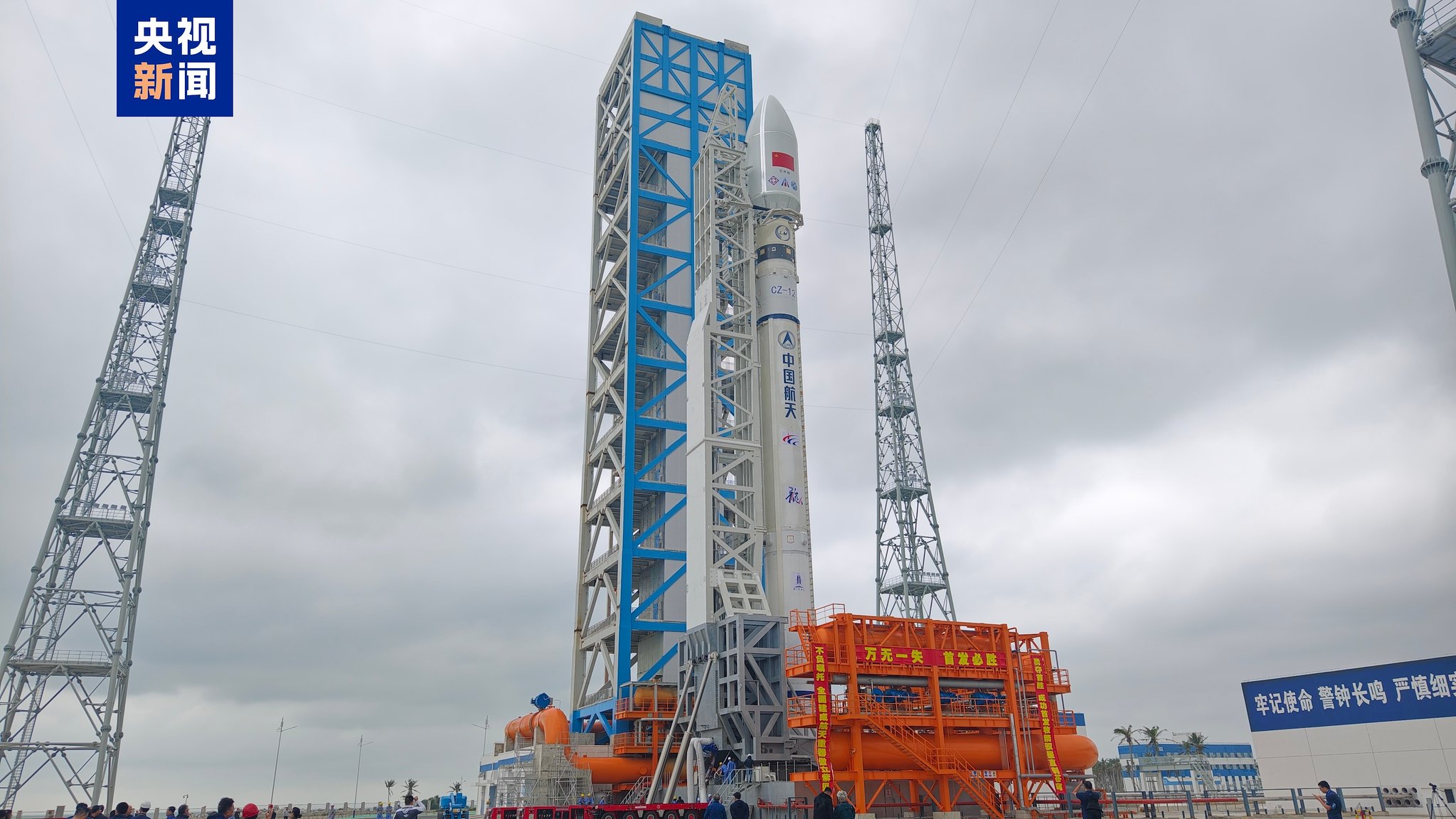
China Aerospace Science and Technology Corporation Long March 12:
- Unknown Payload from Wenchang Space Launch Site, People’s Republic of China (02:35 UTC) Details TBD.
Note: Launch dates and times are subject to change due to technical or weather considerations.