SL-8 DEB (09834)

COSPAR: 1977-011B | Alt Name: deb Kosmos-893
DECAYED

Image
SL-8 DEB Satellite Image
Additional Sources
Launch Details

Launch Date

February 15, 1977

Launch Site

PLMSC

Launch Pad

LC132/2

Launch Vehicle

Kosmos 11K65M

Orbital Elements

NORAD ID

09834

International Designator

1977-011B

Decay Date

4/17/1978

Basic Satellite Info

Name

SL-8 DEB

Alternative Name

deb Kosmos-893

Type

Debris

Status

Space Junk

Owner

YUZH

Country

USSR

Constellation

N/A

Related Satellites

Major Events

N/A

Summary
Space debris, also known as space junk, encompasses all non-functional objects orbiting Earth such as defunct satellites, spent rocket stages, and fragments from collisions or disintegrations. Over time, this debris can accumulate and create an increasingly hazardous environment in orbit. Even tiny fragments, traveling at extremely high velocities, can inflict significant damage on operational satellites and spacecraft. If left unmanaged, the density of debris raises the risk of catastrophic collisions and further fragmentation, compounding the problem and threatening the safety and sustainability of space activities.
Physical Characteristics

Length

0

Diameter

0

Span

0

Dry Mass

0

Launch Mass

0

Shape

N/A

Radar Cross Section

Unknown

Visual Magnitude

Unknown

Color

Unknown

Material Composition

Unknown

Technical Details

Payload

Unknown

Purpose

Unknown

Mission

Unknown

Manufacturer

Unknown

Life Expectancy

Unknown

Bus

Unknown

Configuration

Unknown

Motor

Unknown

Equipment

Unknown

Power System

Unknown

ADCS

Unknown

Transmitter Frequency

Unknown

Satellite Articles

View All Posts »

Learn more about satellites and other related topics.

Roman Space Telescope Arrives at KSC for August 30 Falcon Heavy Launch | KeepTrack Space Brief

Roman Space Telescope Arrives at KSC for August 30 Falcon Heavy Launch | KeepTrack Space Brief

NASA's $4.3B Nancy Grace Roman Space Telescope arrived at Kennedy Space Center for 70 days of prelaunch processing ahead of its August 30 Falcon Heavy launch.

Australian Space Centre Cape York

Australian Space Centre Cape York

When your landlord won't sign the lease, you move. How Equatorial Launch Australia abandoned Arnhem Land and pivoted to Queensland - and what it means for Australia's equatorial launch ambitions.

House Backs $55.5B Space Force Budget, Excludes $350B Reconciliation | KeepTrack Space Brief

House Backs $55.5B Space Force Budget, Excludes $350B Reconciliation | KeepTrack Space Brief

House appropriators approved $55.5 billion for Space Force but omitted $350 billion reconciliation funds, threatening Golden Dome and large-scale space programs' acquisition timelines.

X Report 29 Apr 2025

X Report 29 Apr 2025

SpaceX achieves a significant milestone with its 250th Starlink mission, and Starlink eyes expansion into South Korea amid rising global demand for satellite internet. Meanwhile, Amazon's Project Kuiper launches its first operational mission, marking increased competition for Starlink.

ULA Launches 29 Amazon Kuiper Satellites; Falcon Heavy Returns | KeepTrack Space Brief

ULA Launches 29 Amazon Kuiper Satellites; Falcon Heavy Returns | KeepTrack Space Brief

ULA's Atlas V deployed 29 Amazon Kuiper LEO satellites on April 27. Falcon Heavy returns this week with ViaSat-3 F3. Six orbital launches scheduled across three continents.

Space Brief 16 Sep 2025

Space Brief 16 Sep 2025

Today's brief highlights the impact of military spending and technology competition on the space economy, new satellite connectivity partnerships, and defense spending pledges in Europe.

Iran Strikes UAE and Saudi Targets, Space Force Opens Tracking to Commercial Firms | KeepTrack Space Brief

Iran Strikes UAE and Saudi Targets, Space Force Opens Tracking to Commercial Firms | KeepTrack Space Brief

Iran launches drones and missiles at UAE and Saudi targets. Space Force opens secretive tracking data to commercial firms. Falcon 9 breakup linked to lithium pollution in upper atmosphere.

Falcon Heavy Returns | A Six-Ton Bet on Geostationary Broadband

Falcon Heavy Returns | A Six-Ton Bet on Geostationary Broadband

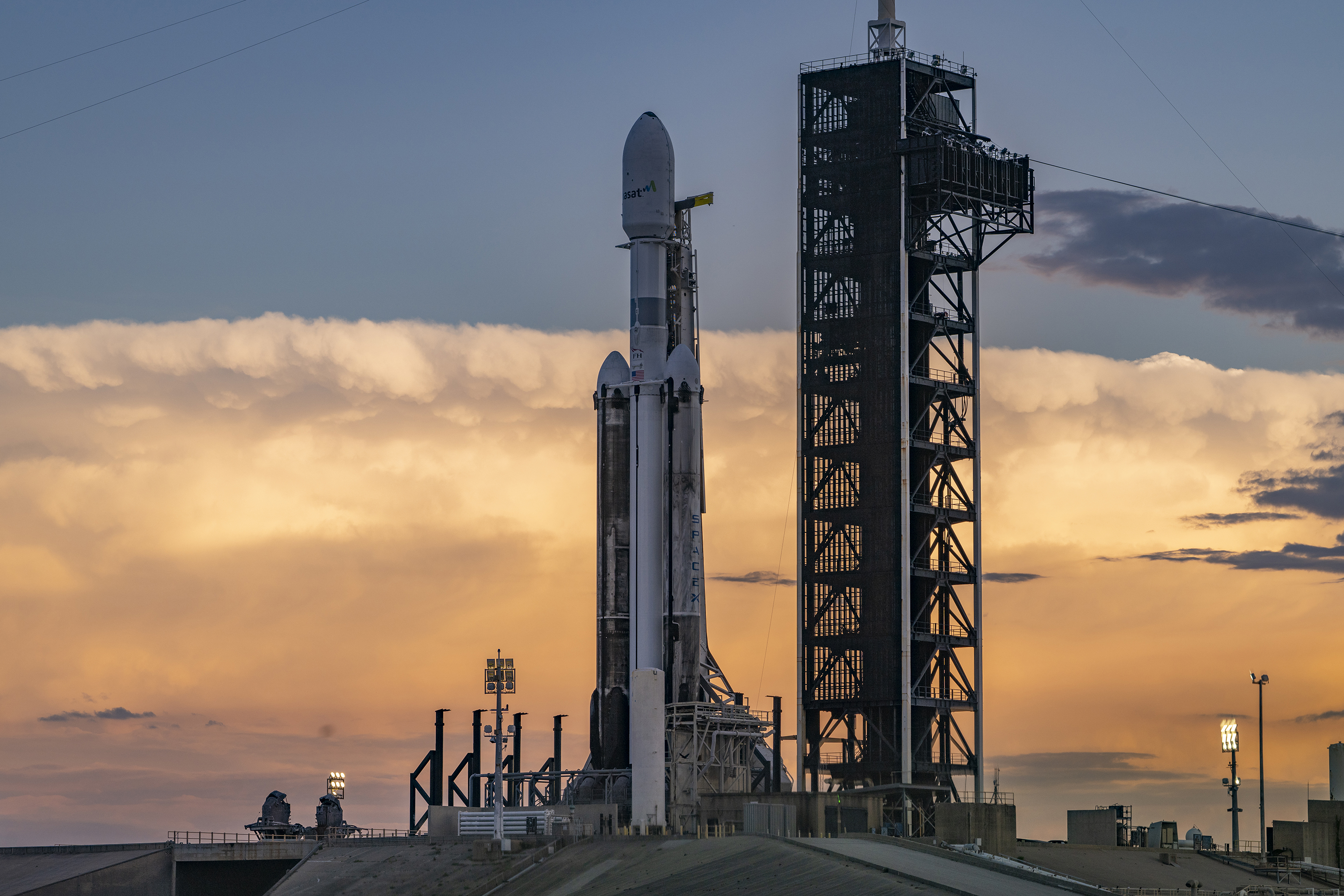
Falcon Heavy flew for the first time in eighteen months on April 29, 2026, expending its center core to push Viasat's final ViaSat-3 satellite toward geostationary orbit. The mission is a flagship rocket doing what only it can still do, for an operator betting six tons of high-throughput hardware on a market Starlink is rapidly redefining.