X Report 10 Apr 2025
SpaceX gears up for multiple Falcon 9 launches, amidst challenges from Project Kuiper and environmental concerns.
Launch Date
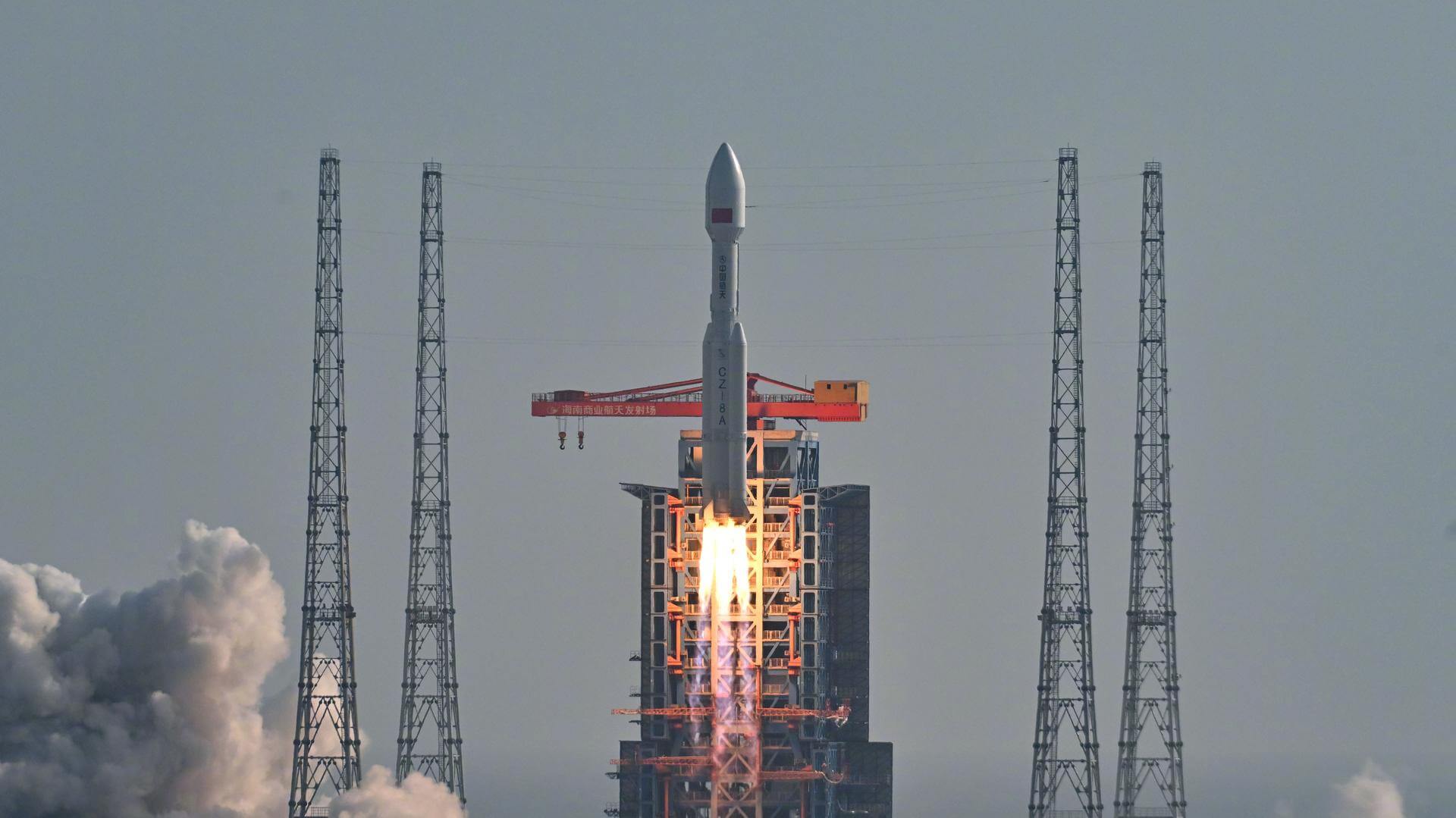
December 25, 2025
Launch Site
WSC
Launch Pad
LC201
Launch Vehicle
Chang Zheng 8A
NORAD ID
67240
International Designator
2025-311E
Epoch
Sun, 19 Jul 2026 18:45:08 GMT
Apogee
Calculating...
Perigee
Calculating...
Inclination
50.01°
Right Ascension
358.98°
Eccentricity
Calculating...
Argument of Perigee
88.49°
Period
108.33 min
Mean Motion
13.29 rev/day
Latitude
Calculating...
Longitude
Calculating...
Altitude
Calculating...
Velocity
Calculating...
Name
HULIANWANG DIGUI-132
Alternative Name
N/A
Type
Status
Owner
ZXW
Country
China
Constellation
N/A
Related Satellites
Major Events
N/A
1 67240U 25311E 26200.78135144 -.00000114 00000+0 22191-4 0 9999
2 67240 50.0077 358.9821 0000904 88.4870 271.6106 13.29324269 27670
Source: Celestrak
Apologies, there is no summary for this satellite yet. I am working to generate these for every object in the catalog, but it is going to take time.
Length
3.0
Diameter
1.0
Span
10.0
Dry Mass
700
Launch Mass
700
Shape
Box + 2 Pan
Radar Cross Section
Unknown
Visual Magnitude
Unknown
Color
Unknown
Material Composition
Unknown
Payload
Xingwang Digui 17-05
Purpose
Unknown
Mission
Unknown
Manufacturer
CAST
Life Expectancy
Unknown
Bus
Xingwang C
Configuration
Unknown
Motor
Unknown
Equipment
Unknown
Power System
Unknown
ADCS
Unknown
Transmitter Frequency
Unknown
Learn more about satellites and other related topics.
SpaceX gears up for multiple Falcon 9 launches, amidst challenges from Project Kuiper and environmental concerns.
An exciting day in space with potential maneuver revelations from the X-37B, SpaceX's resumption of Falcon 9 launches, and significant advancements in lunar exploration tied to new U.S. spacesuits.
Wall Street analyst Dan Ives predicts a Tesla-SpaceX merger by 2027, while a quantum magnetometer launches March 30 on Falcon 9 rideshare.
SpaceX continues to push forward with its ambitious plans as the FAA investigates Starship debris reports, while Starlink maintains robust satellite operations.
On May 4, 1989, Space Shuttle Atlantis lifted off from LC-39B carrying Magellan, NASA's first interplanetary mission since 1978. The eleven-year drought ended in a payload bay, and the radar that emerged would map ninety-eight percent of Venus through clouds that no camera could ever see through.
SpaceX completed two launches June 28, orbiting the 15,000-lb SXM-11 satellite and 24 Starlink V2 craft from Vandenberg.
Exactly 62 years ago, Defense Secretary Robert McNamara ended the X-20 Dyna-Soar program, canceling one of the most ambitious spaceplane projects of the early Space Race - a vehicle that could have put aircraft in orbit decades before the Space Shuttle.
How a groundbreaking radar network is transforming our ability to monitor threats in deep space while strengthening international security partnerships