


SpaceX IPO Surges 20%; China Debuts Tallest Rocket | KeepTrack Space Brief
SpaceX shares jump 20% on first trading day after historic IPO. China launches tallest rocket while LandSpace preps second landing attempt. Tracking data.



Launch Date
October 5, 2023
Launch Site
Launch Pad
LC40
Launch Vehicle
NORAD ID
57997
International Designator
2023-153G
Epoch
Sun, 19 Jul 2026 13:22:46 GMT
Apogee
Calculating...
Perigee
Calculating...
Inclination
43.01°
Right Ascension
42.36°
Eccentricity
Calculating...
Argument of Perigee
268.06°
Period
94.27 min
Mean Motion
15.28 rev/day
Latitude
Calculating...
Longitude
Calculating...
Altitude
Calculating...
Velocity
Calculating...
Name
STARLINK-30523
Alternative Name
Starlink 30523
Type
Status
Owner
SPXS
Country
United States
Constellation
N/A
Related Satellites
Major Events
N/A
1 57997U 23153G 26200.55747742 .00000499 00000+0 27658-4 0 9995
2 57997 43.0062 42.3562 0001668 268.0566 92.0094 15.27575831155065
Source: Celestrak
Length
0.3
Diameter
4.1
Span
29
Dry Mass
700
Launch Mass
730
Shape
Box + pan
Radar Cross Section
Unknown
Visual Magnitude
Unknown
Color
Unknown
Material Composition
Unknown
Payload
Starlink Group 6-21-07
Purpose
Communication
Mission
Communication
Manufacturer
SPXS
Life Expectancy
Unknown
Bus
Starlink V2M
Configuration
Starlink v2 Mini
Motor
Argon ion thrusters
Equipment
Ku/Ka/E-band payload, optical inter-satellite link
Power System
Solar arrays, batteries
ADCS
Unknown
Transmitter Frequency
Unknown
Learn more about satellites and other related topics.
SpaceX shares jump 20% on first trading day after historic IPO. China launches tallest rocket while LandSpace preps second landing attempt. Tracking data.

Ask anyone on the street who the smartest person ever was, and most will say Albert Einstein. Exactly 71 years ago today, this genius departed from the world. Today, we examine Einstein's innumerable contributions to astronomy and how he shaped space history for years to come.

SpaceX successfully launched Northrop Grumman's new Cygnus XL cargo spacecraft to the ISS, marking a significant advancement in cargo delivery capabilities.

Today's Space Brief covers reentries, the impact of NOAA dismissals on space weather tracking, a strategic academic partnership probing cosmic mysteries, and a newly unveiled space motto.
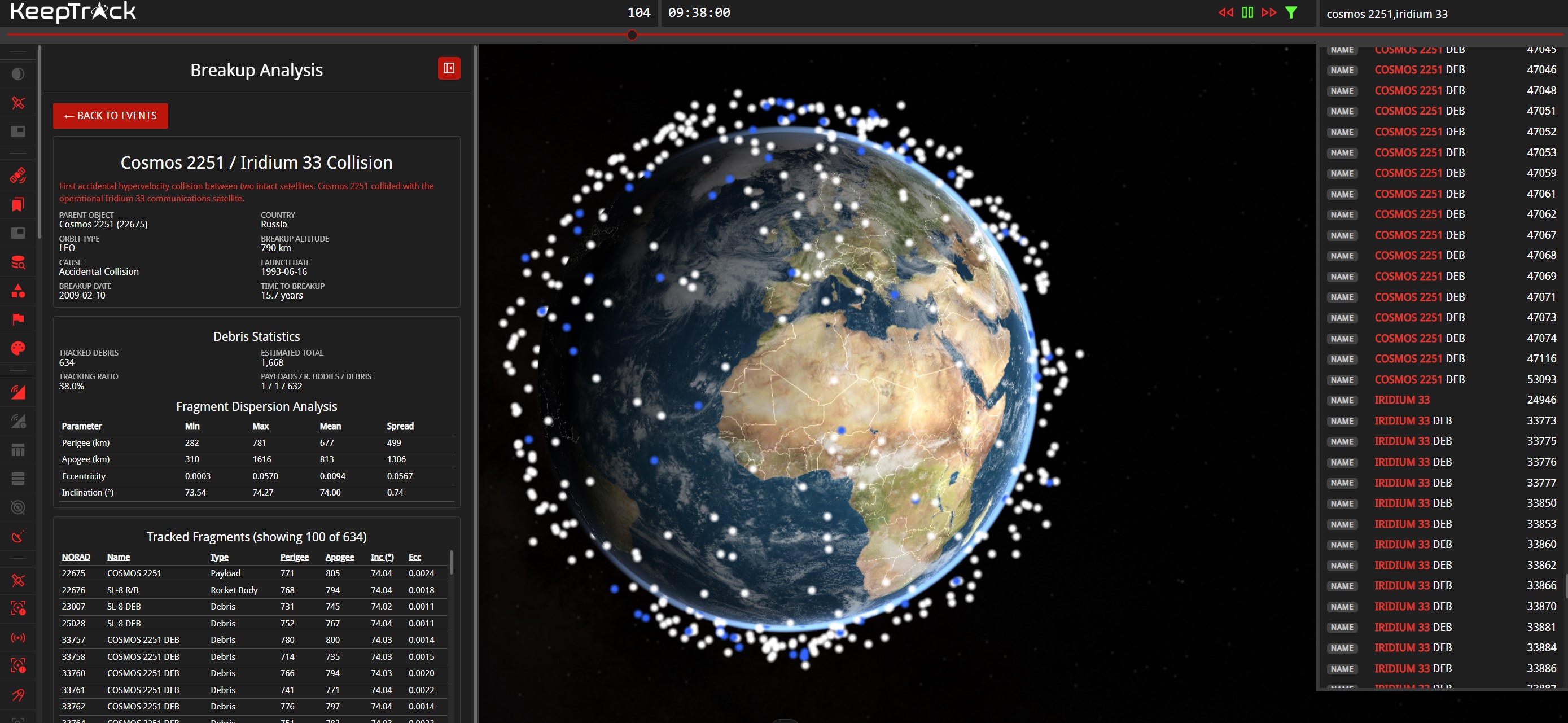
On February 10, 2009, an active Iridium communications satellite and a derelict Soviet military spacecraft slammed into each other 789 kilometers above Siberia. The collision produced more than 2,300 pieces of trackable debris that are still up there. Seventeen years later, the Iridium-Cosmos collision remains the event that made space debris a policy problem the world could no longer ignore.
Today's highlights include Rocket Lab's progress on the Space Force's VICTUS HAZE mission, BlackSky's new government contract, and AEI's policy recommendations for Space Force restructuring.

Space Force commits to operational space tugs and on-orbit refueling by 2030. New capabilities will complicate conjunction analysis for GEO and MEO satellite tracking.
Today's highlights include a Minotaur IV launch of U.S. spy satellites, Rocket Lab's new defense contracts, and the unveiling of Space Force's warfighting framework. Plus, the Satellite Spotlight dives into METEOR 3-1.