STARLINK-5814 (55777)

COSPAR: 2023-028AN | Alt Name: Starlink 5814

Image
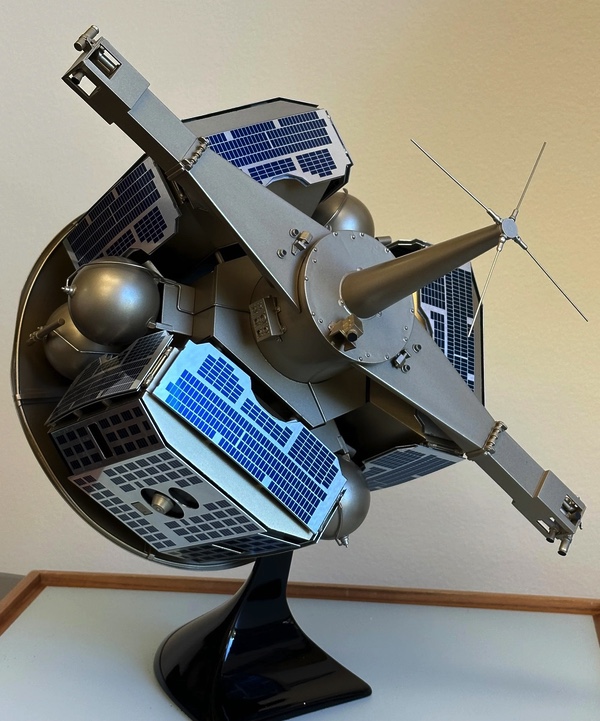
STARLINK-5814 Satellite Image
Additional Sources
Launch Details

Launch Date

March 3, 2023

Launch Site

AFWTR

Launch Pad

SLC4E

Launch Vehicle

Falcon 9

Orbital Elements

NORAD ID

55777

International Designator

2023-028AN

Epoch

Sun, 19 Jul 2026 14:11:19 GMT

Apogee

Calculating...

Perigee

Calculating...

Inclination

70.00°

Right Ascension

251.76°

Eccentricity

Calculating...

Argument of Perigee

268.36°

Period

96.11 min

Mean Motion

14.98 rev/day

Latitude

Calculating...

Longitude

Calculating...

Altitude

Calculating...

Velocity

Calculating...

Polar Plot
3D Visualization
Basic Satellite Info

Name

STARLINK-5814

Alternative Name

Starlink 5814

Type

Payload

Status

Operational

Owner

SPXS

Country

United States

Constellation

N/A

Related Satellites

Major Events

N/A

Latest TLEs
1 55777U 23028AN  26200.59119984 -.00000048  00000+0  37602-5 0  9997
2 55777  69.9981 251.7631 0003708 268.3625  91.7110 14.98331373186297

Source: Celestrak

Summary
STARLINK-5814 is a communication satellite launched by SpaceX (SPXS) on March 3, 2023, from Space Launch Complex 4E at Vandenberg Space Force Base using a Falcon 9 launch vehicle. The spacecraft has dimensions of 0.2 meters in length and 2.8 meters in diameter with a span of 9 meters due to its solar arrays or antennas. It carries a dry mass of 290 kilograms and was launched with a total mass of 305 kilograms. The satellite is equipped with Ku/Ka-band payload for communication purposes, an optical inter-satellite link, and uses krypton ion thrusters as its motor system. Its power generation comes from solar arrays along with batteries. It belongs to the Starlink constellation under the "Starlink Group 2-7-37" payload category.

Starlink is a satellite constellation developed by SpaceX with the aim of providing global broadband internet coverage. Thousands of small satellites are deployed in low Earth orbit (LEO), enabling high-speed internet access even in remote areas. However, the rapid increase in satellites raises concerns about space debris and the potential for collisions, which can lead to further debris creation and endanger other spacecraft. Additionally, the sheer number of Starlink satellites can affect astronomical observations by increasing light pollution. Proper deorbiting plans and international coordination are essential to mitigate these challenges and ensure long-term sustainability in space.
Physical Characteristics

Length

0.2

Diameter

2.8

Span

9

Dry Mass

290

Launch Mass

305

Shape

Box + pan

Radar Cross Section

Unknown

Visual Magnitude

Unknown

Color

Unknown

Material Composition

Unknown

Technical Details

Payload

Starlink Group 2-7-37

Purpose

Communication

Mission

Communication

Manufacturer

SPXS

Life Expectancy

Unknown

Bus

Starlink

Configuration

Unknown

Motor

Krypton ion thrusters

Equipment

Ku/Ka-band payload, optical inter-satellite link

Power System

Solar arrays, batteries

ADCS

Unknown

Transmitter Frequency

Unknown

Map
This tool will help you track the satellite's position and predict its upcoming passes over your location. Simply input the coordinates or click the geolocation button to get started.
Next Pass
Azimuth Elevation Time (Local)
Start Azimuth
Max Elevation
Stop Azimuth
Time Until
Pass Duration

Satellite Articles

View All Posts »

Learn more about satellites and other related topics.

GOES-G | The Day a Weather Satellite Exploded Over the Atlantic

GOES-G | The Day a Weather Satellite Exploded Over the Atlantic

Forty years ago today, a Delta 3914 lifted off Cape Canaveral with a weather satellite the country could not afford to lose. Seventy-one seconds later, its main engine cut off. Ninety-one seconds in, the range safety officer pressed his button. The third domino of a brutal 1986 had fallen.

Rocket Lab Neutron Books 5 Launches, Space Brief 8 May 2026

Rocket Lab Neutron Books 5 Launches, Space Brief 8 May 2026

Rocket Lab Neutron launch schedule holds at Q4 2026 for the first flight as a five-launch contract lands; barge recovery starts on flight two.

Space Force Modernizes Networks Across 14 Bases, SDA Expands $3.5B Satellite Program | KeepTrack Space Brief

Space Force Modernizes Networks Across 14 Bases, SDA Expands $3.5B Satellite Program | KeepTrack Space Brief

Space Force initiates cybersecurity network upgrades across 14 bases. SDA expands $3.5B Tracking Layer with 72 new satellites. SpaceX and China drive record orbital launches in 2025.

Space Brief 30 Apr 2025

Space Brief 30 Apr 2025

Today's briefing covers a significant hypersonic missile launch by the U.S. Army, the declassification of spy satellite photos aiding demining efforts, and the deployment of cutting-edge research payloads to the ISS.

The Day the Navy's Eyes Reached Orbit

The Day the Navy's Eyes Reached Orbit

Forty-two years ago, an Atlas H rocket climbed into the California sky carrying four objects that would help the U.S. Navy track every Soviet warship on the planet - a mission so secret that even the satellites' true name wasn't declassified until 2023

Space Force Awards Counter-Surveillance Payload Contracts | KeepTrack Space Brief

Space Force Awards Counter-Surveillance Payload Contracts | KeepTrack Space Brief

Space Force RCO awarded SBIR contracts for radar-detection payloads to counter adversary surveillance of U.S. satellites. Follow-on miniaturization effort already planned.

X Report 13 Mar 2025

X Report 13 Mar 2025

SpaceX scrubs Crew-10 launch due to hydraulics issue; successful Falcon 9 launch for NASA missions, and Texas supports SpaceX expansion.

Space Brief 17 Nov 2025

Space Brief 17 Nov 2025

Today's highlights include key advancements for the Dream Chaser, SpaceX's record launches, Moon mission crowding concerns, and updates in European space policy.