FALCON 9 DEB (52384)

COSPAR: 2022-045BF | Alt Name: Starlink deployment rail
DECAYED

Image
FALCON 9 DEB Satellite Image
Additional Sources
Launch Details

Launch Date

April 29, 2022

Launch Pad

LC40

Launch Vehicle

Falcon 9

Orbital Elements

NORAD ID

52384

International Designator

2022-045BF

Decay Date

6/8/2022

Basic Satellite Info

Name

FALCON 9 DEB

Alternative Name

Starlink deployment rail

Type

Debris

Status

Space Junk

Owner

SPXS

Country

United States

Constellation

N/A

Related Satellites

Major Events

N/A

Summary
Space debris, also known as space junk, encompasses all non-functional objects orbiting Earth such as defunct satellites, spent rocket stages, and fragments from collisions or disintegrations. Over time, this debris can accumulate and create an increasingly hazardous environment in orbit. Even tiny fragments, traveling at extremely high velocities, can inflict significant damage on operational satellites and spacecraft. If left unmanaged, the density of debris raises the risk of catastrophic collisions and further fragmentation, compounding the problem and threatening the safety and sustainability of space activities.
Physical Characteristics

Length

7

Diameter

0.02

Span

7

Dry Mass

50

Launch Mass

50

Shape

Cyl

Radar Cross Section

Unknown

Visual Magnitude

Unknown

Color

Unknown

Material Composition

Unknown

Technical Details

Payload

Unknown

Purpose

Unknown

Mission

Unknown

Manufacturer

SPXS

Life Expectancy

Unknown

Bus

Unknown

Configuration

Unknown

Motor

Unknown

Equipment

Unknown

Power System

Unknown

ADCS

Unknown

Transmitter Frequency

Unknown

Satellite Articles

View All Posts »

Learn more about satellites and other related topics.

Artemis II Crew Sets Human Distance Record at Moon | KeepTrack Space Brief

Artemis II Crew Sets Human Distance Record at Moon | KeepTrack Space Brief

Artemis II crew surpassed Apollo 13's distance record during April 6 lunar flyby. Orion carried 4 astronauts—including Canadian Jeremy Hansen—farther from Earth than any humans.

The Day South Korea Achieved Independent Space Launch Capability

The Day South Korea Achieved Independent Space Launch Capability

Twelve years ago, South Korea successfully launched a satellite using its own launch vehicle and facilities for the first time, marking a crucial milestone in its journey to space independence

Three Chinese Rocket Bodies Exploded, Generating Decades of LEO Debris | KeepTrack Space Brief

Three Chinese Rocket Bodies Exploded, Generating Decades of LEO Debris | KeepTrack Space Brief

Three Chinese rocket bodies have exploded over four years, creating debris clouds that will linger for decades to centuries, according to LeoLabs analysis. Fragmentation events threaten commercial and military operators.

Falcon Heavy Returns After 18-Month Hiatus | KeepTrack X Report

Falcon Heavy Returns After 18-Month Hiatus | KeepTrack X Report

SpaceX's Falcon Heavy flew for the first time in 18 months on April 29, while Starlink hit 51 Falcon 9 launches in 2026 with 10,280 satellites working.

Space Brief 9 Jan 2025

Space Brief 9 Jan 2025

Today's briefing includes new appointments in U.S. military and defense sectors, X-37B's continued mission, and international policy shifts affecting satellite technology sales.

Hypersonica Missile Hits Mach 6 in Norway Flight Test | KeepTrack Space Brief

Hypersonica Missile Hits Mach 6 in Norway Flight Test | KeepTrack Space Brief

Hypersonica completes Mach 6+ hypersonic missile flight test in Norway covering 300+ km. Pentagon seeks commercial GEO spy satellites. Gilat wins $9M Israeli defense satcom deal.

X Report 9 Aug 2025

X Report 9 Aug 2025

SpaceX's Crew-10 astronauts are set to return to Earth after a five-month mission, while the company prepares for the launch of 24 new Starlink satellites from Vandenberg Space Force Base.

The Day Two Satellites Hit Each Other at 26,000 MPH

The Day Two Satellites Hit Each Other at 26,000 MPH

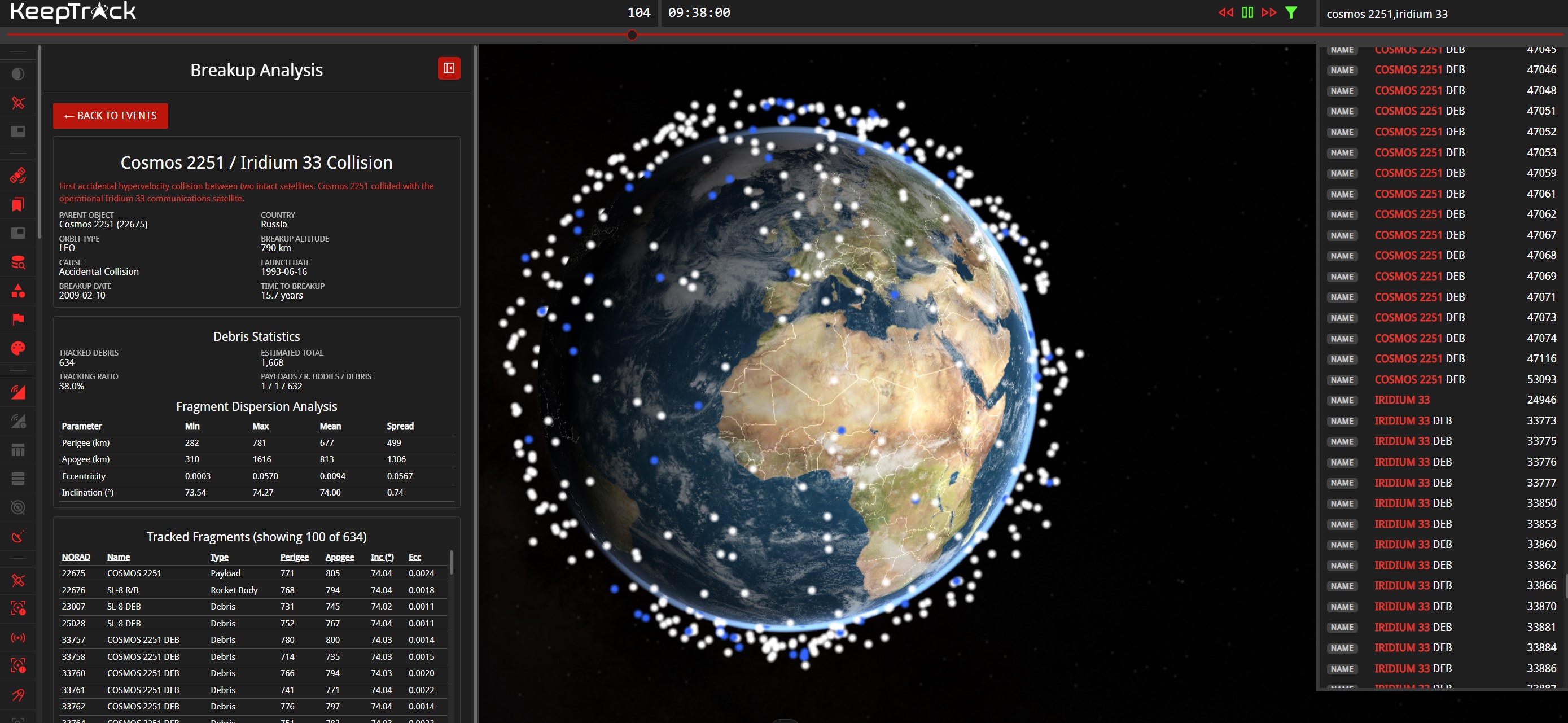
On February 10, 2009, an active Iridium communications satellite and a derelict Soviet military spacecraft slammed into each other 789 kilometers above Siberia. The collision produced more than 2,300 pieces of trackable debris that are still up there. Seventeen years later, the Iridium-Cosmos collision remains the event that made space debris a policy problem the world could no longer ignore.