CZ-4B R/B (39359)

COSPAR: 2013-057B | Alt Name: CZ-4B Y25 Stage 3
DECAYED

Image
CZ-4B R/B Satellite Image
Additional Sources
Launch Details

Launch Date

October 25, 2013

Launch Site

JSC

Launch Pad

LC603

Launch Vehicle

Chang Zheng 4B

Orbital Elements

NORAD ID

39359

International Designator

2013-057B

Decay Date

9/9/2025

Basic Satellite Info

Name

CZ-4B R/B

Alternative Name

CZ-4B Y25 Stage 3

Type

Rocket Body

Status

Space Junk

Owner

CNSA

Country

China

Constellation

N/A

Related Satellites

Major Events

N/A

Summary
A rocket body, also commonly referred to as an upper stage or spent rocket stage, is the structural shell left behind after a rocket has delivered its payload to orbit. These large and often heavy pieces of space hardware can remain in orbit for years, posing significant collision hazards as part of the growing space debris problem. If left uncontrolled, rocket bodies have the potential to reenter Earth's atmosphere unpredictably, which can lead to falling debris in populated areas. Additionally, they risk colliding with operational satellites or the International Space Station, creating more debris and putting human life at risk.
Physical Characteristics

Length

6.9

Diameter

2.9

Span

6.9

Dry Mass

1000

Launch Mass

1000

Shape

Cyl

Radar Cross Section

8.4034

Visual Magnitude

Unknown

Color

Unknown

Material Composition

Unknown

Technical Details

Payload

CZ-4B Stage 3

Purpose

Unknown

Mission

Unknown

Manufacturer

SAST

Life Expectancy

Unknown

Bus

CZ-4 Stage 3

Configuration

Unknown

Motor

Unknown

Equipment

Unknown

Power System

Unknown

ADCS

Unknown

Transmitter Frequency

Unknown

Satellite Articles

View All Posts »

Learn more about satellites and other related topics.

NASA Postpones Spacewalk Over Medical Concern, Sierra Space Delivers SDA Satellites Early | KeepTrack Space Brief

NASA Postpones Spacewalk Over Medical Concern, Sierra Space Delivers SDA Satellites Early | KeepTrack Space Brief

NASA delays first 2026 spacewalk due to ISS crew medical issue. Sierra Space completes SDA Tranche 2 satellite structures ahead of schedule. Space Force advances Handle 2.0 standardization.

Space Brief 27 Aug 2025

Space Brief 27 Aug 2025

Today's key space events include SpaceX's launch of the secretive X-37B military drone, XTAR's U.S. defense market strategy, and China's space station AI upgrade.

Space Force Awards Counter-Surveillance Payload Contracts | KeepTrack Space Brief

Space Force Awards Counter-Surveillance Payload Contracts | KeepTrack Space Brief

Space Force RCO awarded SBIR contracts for radar-detection payloads to counter adversary surveillance of U.S. satellites. Follow-on miniaturization effort already planned.

Iran Strikes UAE and Saudi Targets, Space Force Opens Tracking to Commercial Firms | KeepTrack Space Brief

Iran Strikes UAE and Saudi Targets, Space Force Opens Tracking to Commercial Firms | KeepTrack Space Brief

Iran launches drones and missiles at UAE and Saudi targets. Space Force opens secretive tracking data to commercial firms. Falcon 9 breakup linked to lithium pollution in upper atmosphere.

SpaceX Targets 600th Falcon Booster Landing on Starlink 17-22 | KeepTrack X Report

SpaceX Targets 600th Falcon Booster Landing on Starlink 17-22 | KeepTrack X Report

SpaceX attempts its 600th Falcon 9 booster landing during the Starlink 17-22 mission, adding 25 satellites from Vandenberg SFB.

X Report 16 Jun 2025

X Report 16 Jun 2025

SpaceX progresses with plans for Starship launches from a ULA site while continuing its Starlink expansion. New satellite tracking update enhances user engagement.

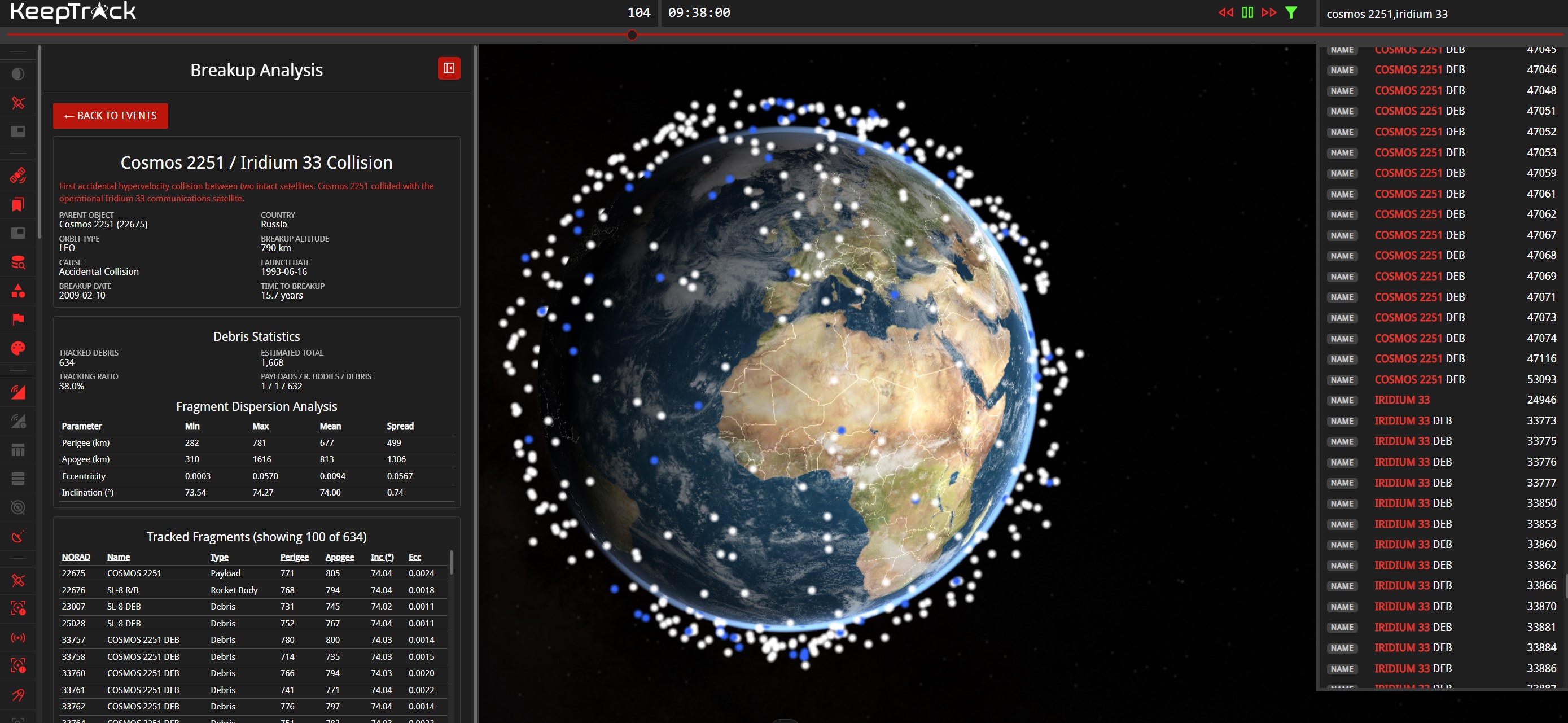
The Day Two Satellites Hit Each Other at 26,000 MPH

The Day Two Satellites Hit Each Other at 26,000 MPH

On February 10, 2009, an active Iridium communications satellite and a derelict Soviet military spacecraft slammed into each other 789 kilometers above Siberia. The collision produced more than 2,300 pieces of trackable debris that are still up there. Seventeen years later, the Iridium-Cosmos collision remains the event that made space debris a policy problem the world could no longer ignore.

The Day Earth Became a Pale Blue Dot

The Day Earth Became a Pale Blue Dot

Thirty-five years ago, Voyager 1 captured a revolutionary series of images from the edge of our solar system, forever changing how humanity sees its place in the cosmos