
COSMOS 2251 DEB (36008)

COSPAR: 1993-036AXA | Alt Name: deb Kosmos-2251

Image
COSMOS 2251 DEB Satellite Image
Additional Sources
Launch Details

Launch Date

June 16, 1993

Launch Site

PLMSC

Launch Pad

LC132/1

Launch Vehicle

Kosmos 11K65M

Orbital Elements

NORAD ID

36008

International Designator

1993-036AXA

Epoch

Sun, 13 Nov 2022 17:38:03 GMT

Apogee

Calculating...

Perigee

Calculating...

Inclination

74.03°

Right Ascension

95.65°

Eccentricity

Calculating...

Argument of Perigee

134.83°

Period

102.95 min

Mean Motion

13.99 rev/day

Latitude

Calculating...

Longitude

Calculating...

Altitude

Calculating...

Velocity

Calculating...

Polar Plot
3D Visualization
Basic Satellite Info

Name

COSMOS 2251 DEB

Alternative Name

deb Kosmos-2251

Type

Debris

Status

Space Junk

Owner

KVR

Country

Russia

Constellation

N/A

Related Satellites

Major Events

N/A

Latest TLEs
1 36008U 93036AXA 22316.73476749  .00006282  00000-0  35316-2 0  9997
2 36008  74.0250  95.6476 0224105 134.8314 227.1278 13.98751242681367

Source: Celestrak

Summary
Space debris, also known as space junk, encompasses all non-functional objects orbiting Earth such as defunct satellites, spent rocket stages, and fragments from collisions or disintegrations. Over time, this debris can accumulate and create an increasingly hazardous environment in orbit. Even tiny fragments, traveling at extremely high velocities, can inflict significant damage on operational satellites and spacecraft. If left unmanaged, the density of debris raises the risk of catastrophic collisions and further fragmentation, compounding the problem and threatening the safety and sustainability of space activities.
Physical Characteristics

Length

0

Diameter

0

Span

0

Dry Mass

0

Launch Mass

0

Shape

N/A

Radar Cross Section

0.0107

Visual Magnitude

Unknown

Color

Unknown

Material Composition

Unknown

Technical Details

Payload

Unknown

Purpose

Unknown

Mission

Unknown

Manufacturer

Unknown

Life Expectancy

Unknown

Bus

Unknown

Configuration

Unknown

Motor

Unknown

Equipment

Unknown

Power System

Unknown

ADCS

Unknown

Transmitter Frequency

Unknown

Map
This tool will help you track the satellite's position and predict its upcoming passes over your location. Simply input the coordinates or click the geolocation button to get started.
Next Pass
Azimuth Elevation Time (Local)
Start Azimuth
Max Elevation
Stop Azimuth
Time Until
Pass Duration

Satellite Articles

View All Posts »

Learn more about satellites and other related topics.

Falling Space Debris Risk to Aircraft Grows, North Korea Tests Hypersonic Missiles | KeepTrack Space Brief

Falling Space Debris Risk to Aircraft Grows, North Korea Tests Hypersonic Missiles | KeepTrack Space Brief

Experts warn falling space debris risk to aircraft is increasing. North Korea tests advanced hypersonic missiles. Space Force seeks launch providers for Cape Canaveral and Vandenberg pads.
Van Allen Probe A Reenters After 14 Years; NASA Designates Starliner Type A Mishap | KeepTrack Space Brief

Van Allen Probe A Reenters After 14 Years; NASA Designates Starliner Type A Mishap | KeepTrack Space Brief

NASA's 590 kg Van Allen Probe A reentered March 10 after 14 years studying Earth's radiation belts. Meanwhile, Boeing Starliner classified as Type A mishap after leaving astronauts stranded on ISS.

The Day That Changed Spaceflight Forever

The Day That Changed Spaceflight Forever

Thirty-nine years ago, the loss of Space Shuttle Challenger and its seven crew members forever transformed our approach to spaceflight safety and risk management

Space Brief 1 Feb 2025

Space Brief 1 Feb 2025

Today's brief covers advances in satellite docking technology, challenges faced by space companies with government navigation, and China's leap in space autonomy through AI developments.

Roman Space Telescope Arrives at KSC for August 30 Falcon Heavy Launch | KeepTrack Space Brief

Roman Space Telescope Arrives at KSC for August 30 Falcon Heavy Launch | KeepTrack Space Brief

NASA's $4.3B Nancy Grace Roman Space Telescope arrived at Kennedy Space Center for 70 days of prelaunch processing ahead of its August 30 Falcon Heavy launch.

The Day Two Satellites Hit Each Other at 26,000 MPH

The Day Two Satellites Hit Each Other at 26,000 MPH

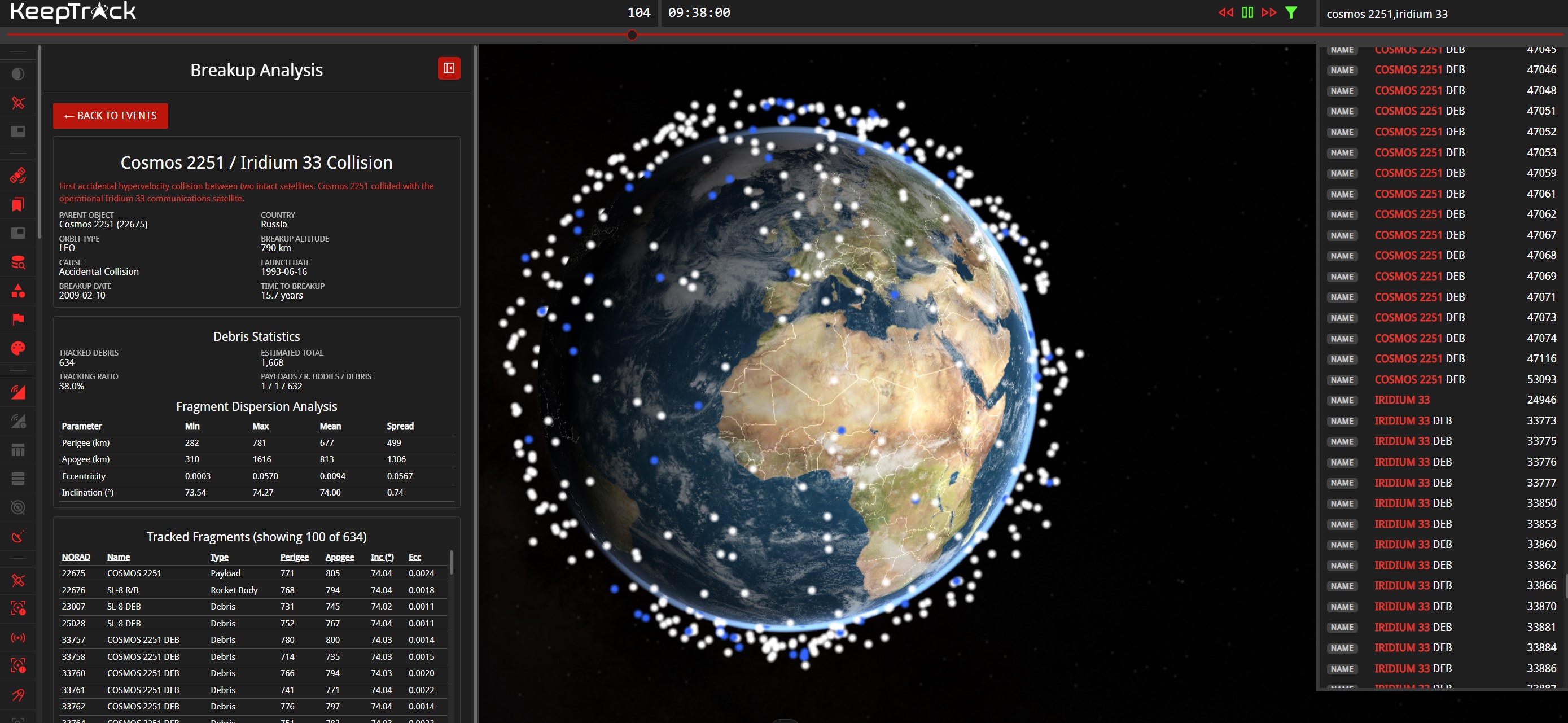
On February 10, 2009, an active Iridium communications satellite and a derelict Soviet military spacecraft slammed into each other 789 kilometers above Siberia. The collision produced more than 2,300 pieces of trackable debris that are still up there. Seventeen years later, the Iridium-Cosmos collision remains the event that made space debris a policy problem the world could no longer ignore.

Andøya Spaceport

Andøya Spaceport

Europe's Arctic gateway to orbit. How Norway's Andøya Spaceport is positioning itself as the continent's answer to launch congestion - and what the failed Isar Aerospace test flight means for the road ahead.

Space Brief 31 Dec 2024

Space Brief 31 Dec 2024

Today's Space Brief highlights the latest developments in China's megaconstellation funding, Russia's nuclear posturing in Europe, and other significant military activities.