


Space Brief 30 Jun 2025
Today's highlights include SpaceX's record-breaking launches, Japan's final H-2A launch, and significant developments in satellite data policies impacting weather forecasting.



Launch Date
December 7, 1983
Launch Site
PLMSC
Launch Pad
LC41/1
Launch Vehicle
Soyuz-U
NORAD ID
14580
International Designator
1983-119K
Decay Date
12/28/1983
Name
COSMOS 1512 DEB
Alternative Name
KDU part
Type
Status
Owner
GUKOS
Country
USSR
Constellation
N/A
Related Satellites
Major Events
N/A
Length
0
Diameter
0
Span
0
Dry Mass
0
Launch Mass
0
Shape
N/A
Radar Cross Section
Unknown
Visual Magnitude
Unknown
Color
Unknown
Material Composition
Unknown
Payload
KDU part
Purpose
Unknown
Mission
Unknown
Manufacturer
TSSKB
Life Expectancy
Unknown
Bus
Zenit deb
Configuration
Unknown
Motor
Unknown
Equipment
Unknown
Power System
Unknown
ADCS
Unknown
Transmitter Frequency
Unknown
Learn more about satellites and other related topics.
Today's highlights include SpaceX's record-breaking launches, Japan's final H-2A launch, and significant developments in satellite data policies impacting weather forecasting.
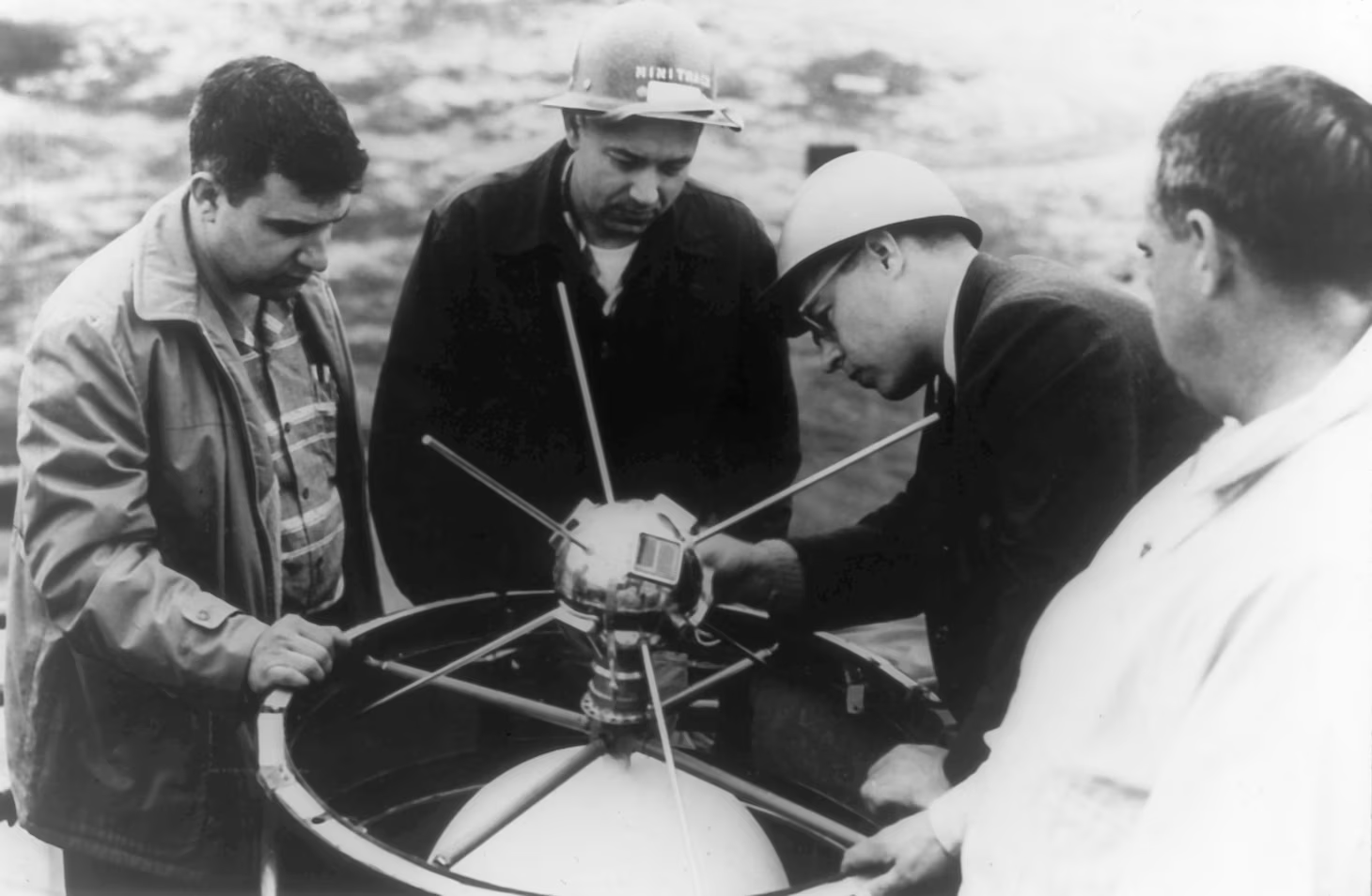
How the U.S. Navy's Vanguard rocket became a Cold War icon, launched the world's oldest satellite still in orbit, and laid the groundwork for NASA's space exploration efforts.

SpaceX awarded $739M for nine national security missions. FCC approves 7,500 additional Starlink satellites. NASA announces early Crew-11 return from ISS due to medical issue.

SpaceX successfully launched its 60th mission of the year, deploying 27 Starlink satellites from California. The company continues to hit milestones, confirming its dominance in spaceflight as Elon Musk acknowledges the achievement. Spire also expands its partnership with Deloitte to enhance cybersecurity in orbit.

Falcon Heavy flew for the first time in eighteen months on April 29, 2026, expending its center core to push Viasat's final ViaSat-3 satellite toward geostationary orbit. The mission is a flagship rocket doing what only it can still do, for an operator betting six tons of high-throughput hardware on a market Starlink is rapidly redefining.

Today's Space Brief highlights Globalstar's new military focus, technological innovations in the Army's tactical systems, and a deeper look at key military satellite communications developments.
Today's Space Brief covers a major partnership in space tech distribution, China's orbital refueling preparations under U.S. scrutiny, recent U.S. defense budget reveals, and an exciting hyperspectral imagery release from Xplore.

Space Force stands up 2 cyber defense squadrons at Cape Canaveral and Vandenberg to protect launch operations against adversary interference targeting pad networks and telemetry systems.