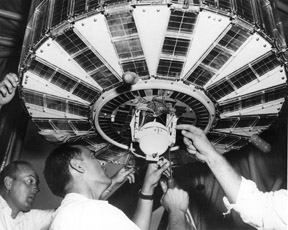
TRANSIT 4A (00116)

COSPAR: 1961-015A | Alt Name: Transit IV-A

Image
TRANSIT 4A Satellite Image
Launch Details

Launch Date

June 29, 1961

Launch Pad

LC-17B

Launch Vehicle

Thor-Ablestar

Orbital Elements

NORAD ID

00116

International Designator

1961-015A

Epoch

Mon, 20 Jul 2026 22:41:33 GMT

Apogee

Calculating...

Perigee

Calculating...

Inclination

66.81°

Right Ascension

168.22°

Eccentricity

Calculating...

Argument of Perigee

251.00°

Period

103.42 min

Mean Motion

13.92 rev/day

Latitude

Calculating...

Longitude

Calculating...

Altitude

Calculating...

Velocity

Calculating...

Polar Plot
3D Visualization
Basic Satellite Info

Name

TRANSIT 4A

Alternative Name

Transit IV-A

Type

Payload

Status

Unknown

Owner

Bureau of Naval Weapons (BUWEPS)

Country

United States

Constellation

Transit

Related Satellites

Major Events

First satellite to carry a radioisotope thermoelectric generator (RTG) into space.

Latest TLEs
1 00116U 61015A   26201.94552663 -.00000007  00000+0  53372-4 0  9993
2 00116  66.8084 168.2218 0081977 250.9994 108.2191 13.92336583301403

Source: Celestrak

Summary
Here is a 2-3 paragraph summary of the satellite: The Transit 4A (also known as Transit IV-A) was a navigation satellite launched by the US on June 29, 1961. The satellite was part of the Transit constellation and was designed to provide navigation data for the US military. It measured approximately 0.8 meters in length and had a diameter of 1.1 meters. The Transit 4A carried a radioisotope thermoelectric generator (RTG) as its power source, which was a significant innovation at the time. The RTG used nuclear energy to generate electricity, making it the first satellite to carry such a device into space. The satellite's instrumentation included radio transmitters operating at 150 MHz and 400 MHz frequencies. The Transit 4A operated for approximately 15 months before its mission concluded, providing navigation data to the US military during that time. Its development marked an important milestone in the use of nuclear power sources in space exploration.
Physical Characteristics

Length

0.8

Diameter

1.1

Span

1.1

Dry Mass

78

Launch Mass

78

Shape

Cylindrical

Radar Cross Section

0.7486

Visual Magnitude

5.5

Color

Silver

Material Composition

Aluminum alloy structure

Technical Details

Payload

Navigation instrumentation and SNAP-3 RTG

Purpose

Navigation

Mission

Navigation

Manufacturer

Applied Physics Laboratory (APL)

Life Expectancy

Operated for approximately 15 months, providing navigation data until its mission concluded.

Bus

Transit 4

Configuration

Cylinder, RTG

Motor

N/A

Equipment

Radio transmitters operating at 150 MHz and 400 MHz for navigation signal dissemination.

Power System

Solar cells (body-mounted) and SNAP-3 RTG

ADCS

Spin stabilization

Transmitter Frequency

150 MHz, 400 MHz

Map
This tool will help you track the satellite's position and predict its upcoming passes over your location. Simply input the coordinates or click the geolocation button to get started.
Next Pass
Azimuth Elevation Time (Local)
Start Azimuth
Max Elevation
Stop Azimuth
Time Until
Pass Duration

Satellite Articles

View All Posts »

Learn more about satellites and other related topics.

Blue Origin's New Glenn Destroyed in Static Fire Test at Cape Canaveral | KeepTrack Space Brief

Blue Origin's New Glenn Destroyed in Static Fire Test at Cape Canaveral | KeepTrack Space Brief

Blue Origin's fourth New Glenn rocket exploded during static fire at LC-36, Cape Canaveral, destroying the fully stacked vehicle and pad infrastructure. Amazon Leo launch postponed indefinitely.


Who Owns the Most Satellites Orbiting Earth?

Who Owns the Most Satellites Orbiting Earth?

Uncover the top companies dominating the satellite industry. From SpaceX to One Web, learn who's leading in space assets. Full list inside.

The NASA Budget Proposal That Nobody Asked For (Again)

The NASA Budget Proposal That Nobody Asked For (Again)

The White House wants to cut NASA's science budget nearly in half for the second year running. Administrator Jared Isaacman says it's enough. Congress already rejected this exact idea once.

Space Force Reassigns GPS III to Falcon 9 After Vulcan Grounding | KeepTrack Space Brief

Space Force Reassigns GPS III to Falcon 9 After Vulcan Grounding | KeepTrack Space Brief

Space Force shifts GPS III satellite launch from ULA's Vulcan to SpaceX Falcon 9 due to persistent solid rocket booster issues. Critical navigation asset reassignment signals operational consequences.

MDA and Hanwha Partner on South Korea K-LEO Defense Network | KeepTrack Space Brief

MDA and Hanwha Partner on South Korea K-LEO Defense Network | KeepTrack Space Brief

MDA Space and Hanwha target South Korea's K-LEO defense satellite network. House passes $839B defense bill. Pentagon picks 25 vendors for $150M drone competition.

Space Brief 29 Apr 2025

Space Brief 29 Apr 2025

Today's space brief covers significant advancements in military counter-drone capabilities, workforce challenges in the Navy related to DOGE budget cuts, and highlights Germany's rise in defense spending. We also shine a spotlight on the communications satellite INTELSAT 901.

Esrange Spaceport

Esrange Spaceport

Europe's bid to break free from the US launch monopoly. How Sweden's Esrange Space Center is transforming access to space, enabling orbital launches, and strengthening strategic independence for the continent.

X Report 27 Sep 2025

X Report 27 Sep 2025

SpaceX continues to make strides in both its Starship program and Starlink satellite deployments, with a successful launch of 24 Starlink satellites and preparations for upcoming missions.
