· deep dive · 9 min read
The $1.5 Million Starlink Jammer That Ukraine Keeps Blowing Up
Russia's Volna Kupol Garant electronic warfare system was purpose-built to jam Starlink. It costs around $1.5 million per unit, covers just 20 square kilometers, and can only target one satellite at a time. Ukraine has been finding and destroying them within days of deployment.
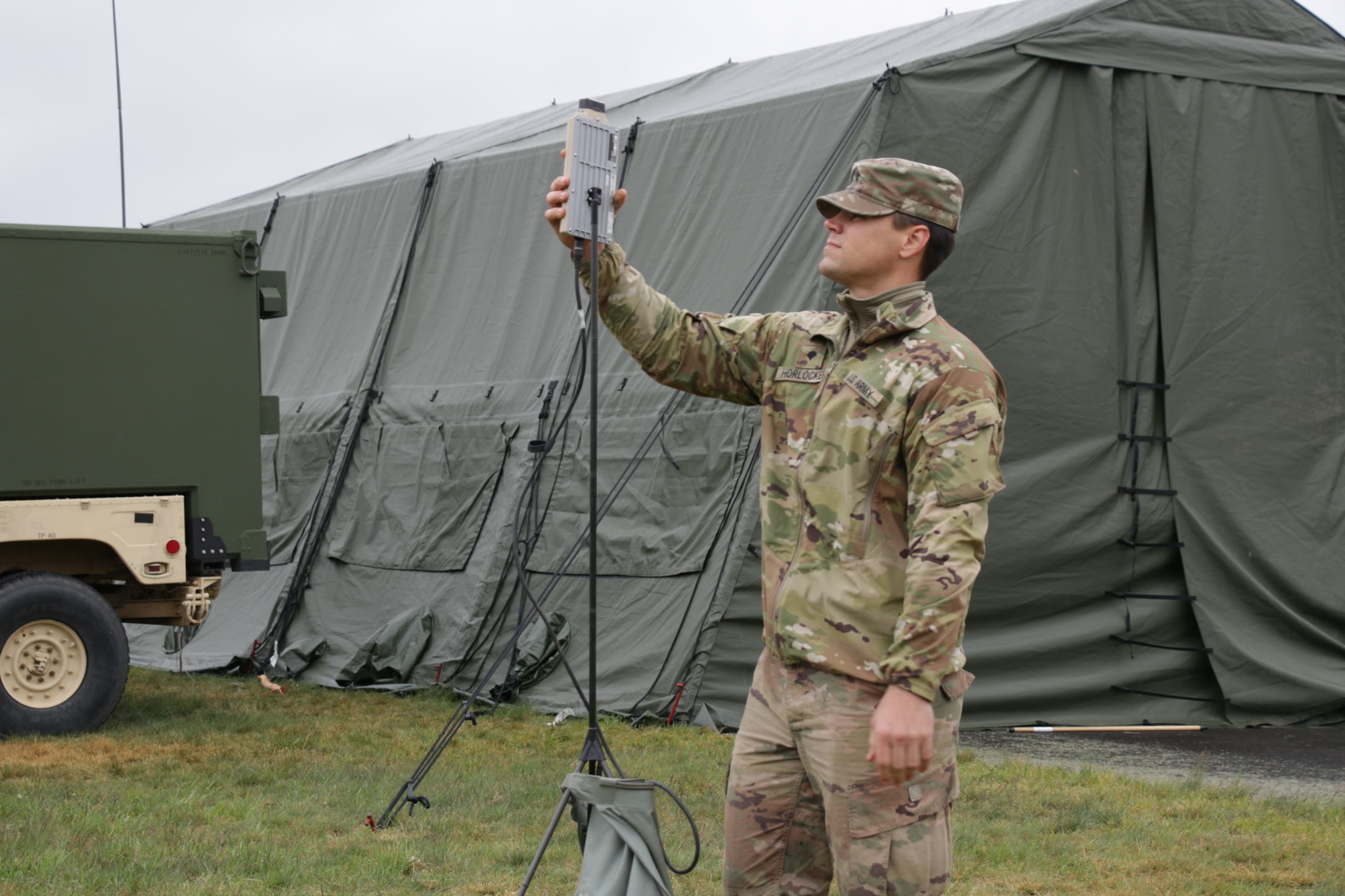
On June 15, 2026, Ukraine’s 422nd Regiment of Unmanned Systems and the SBU’s Special Operations Center “A” released footage of a strike against a cluster of Russian electronic warfare vehicles near the southern front. The video showed six deployed trucks, each carrying a satellite dish pointed skyward, being hit one after another by strike drones. Eight days later, satellite imagery analyzed by the OSINT community Exilenova+ confirmed a second system destroyed in occupied Kerch, Crimea. The target in both cases was the same: Russia’s Volna Kupol Garant, a ground-based jammer built specifically to deny Ukrainian forces access to Starlink satellite internet.
The system represents a real engineering effort to solve a real military problem. Starlink has become critical infrastructure for Ukrainian drone operations, battlefield communications, and medium-range strike coordination, particularly along the supply routes of the “land bridge” connecting Russian territory to Crimea. Russia has good reason to want it gone. But the Volna Kupol Garant also illustrates a deeper mismatch between the economics of jamming a satellite constellation and the economics of building one. At roughly 100 million rubles (around $1.5 million) per unit, with some estimates running to $2 million, the system is expensive. It covers about 20 square kilometers. It can target exactly one satellite at a time. And the powerful radio emissions it needs to do its job make it trivially easy to find.
The result is a cycle that has played out repeatedly through 2026. Russia deploys a system to protect a logistics corridor. Signals intelligence satellites operated by Ukraine’s partners detect the emissions. SpaceX identifies the interference in its communication channels. Ukraine’s drone forces geolocate and destroy the hardware. Russia builds another one.
This is not a story about a wonder weapon on either side. It is a story about orbital mechanics, frequency engineering, and the brutal arithmetic of trying to jam a constellation with ground-based dishes.
Volna Kupol Garant: Capabilities vs. Limitations
What It Can Do
- Targets all 8 Starlink Ku-band uplink channels simultaneously
- Can disrupt stable communications within a ~20 sq km area
- Purpose-built by specialists at Rossiysky Kupol LLC for the Starlink problem
- Effective against a single satellite pass for the duration of that pass
What It Cannot Overcome
- Can only engage one satellite at a time out of dozens visible overhead
- Powerful emissions act as a beacon for SIGINT detection
- ~$1.5M per unit with no scalable path to constellation-wide denial
- Large vehicle footprint makes it vulnerable to drone strikes
- SpaceX can push software updates that neutralize the jamming approach
Eight Dishes for Eight Channels
The Volna Kupol Garant is built around a straightforward targeting concept. Starlink user terminals communicate with satellites overhead in the Ku-band, specifically the 14.0 to 14.5 GHz uplink range. That 500 MHz of spectrum is divided into eight channels of 62.5 MHz each. The system carries eight satellite dish antennas, one per channel, and directs powerful interference signals at a passing Starlink satellite to prevent the ground terminal from establishing or maintaining a stable uplink.
Each antenna tracks a single satellite as it crosses the sky, slewing to follow the spacecraft’s arc from horizon to horizon. Because Starlink operates in low Earth orbit at roughly 550 kilometers altitude, each satellite is only visible from a given ground point for a few minutes before it drops below the horizon and the next one rises into view. The jammer has to continuously reacquire targets.
| Parameter | Value |
|---|---|
| Manufacturer | Rossiysky Kupol LLC (Simferopol, Crimea) |
| Target frequency | 14.0 to 14.5 GHz (Ku-band uplink) |
| Channel coverage | 8 channels at 62.5 MHz each |
| Antennas | 8 satellite dishes, one per channel |
| Simultaneous satellite targets | 1 |
| Effective denial area | ~20 sq km (~2.5 km radius) |
| Estimated unit cost | ~$1.5M (100M rubles) |
| First observed | 2024, near Kharkiv |
| Mass deployment | 2026, southern land bridge |
The system was built by Rossiysky Kupol LLC, a company based in Simferopol, Crimea, that has been placed under Ukrainian sanctions. The location is itself notable: a defense contractor operating out of occupied territory, producing hardware designed to counter a U.S. commercial satellite system being used as wartime infrastructure. Russia began deploying the Volna Kupol Garant in small numbers near Kharkiv in 2024, but mass deployment along the southern land bridge did not begin until 2026, driven by the need to protect fuel truck convoys that had been devastated by Ukrainian medium-range strike drones relying on Starlink for targeting data.
Why Starlink Is Hard to Kill
The fundamental challenge for any ground-based Starlink jammer is that the constellation was designed, from the beginning, to be resilient to exactly this kind of interference. SpaceX did not build Starlink for a peacetime-only world. The company’s work with the U.S. military through the Starshield program, and the real-world stress testing that began when Ukraine started using Starlink terminals in 2022, has produced a system with multiple layers of defense against directed jamming.
The first layer is the phased-array antenna on each Starlink terminal. Unlike a traditional dish that mechanically points at a satellite, phased arrays steer their beam electronically by adjusting the phase of the signal across hundreds of small antenna elements. This means the terminal can shift which satellite it talks to in milliseconds, without moving any physical hardware. If one satellite’s link is being jammed, the terminal can hop to another satellite that is outside the jammer’s targeting cone.
The second layer is frequency hopping. Starlink’s uplink does not sit on a fixed frequency within each channel. The signal hops across frequencies in sequences that are controlled remotely by SpaceX engineers and can be changed with a software update pushed to the entire constellation. When Russia initially had some success jamming Starlink in the early months of the war, SpaceX responded by updating the hopping patterns, and many Russian jammers went silent overnight. The Volna Kupol Garant’s eight-channel approach is meant to address this by covering the full uplink band, but frequency agility within each channel still degrades the jammer’s effectiveness.
The most potent defense is not any single technique. It is the fact that SpaceX can change the rules remotely. A software update pushed from Hawthorne can reconfigure how thousands of satellites handle interference, and the jammer on the ground has no equivalent ability to adapt at that speed.
The third layer is adaptive nulling. The phased-array antenna can create a mathematical null, a direction of zero sensitivity, pointed at the source of interference. This is the same technique used in military anti-jam GPS receivers, applied to a commercial communications terminal. The antenna does not stop receiving signals from the satellite. It simply stops listening in the specific direction the jammer is transmitting from, while continuing to receive from every other direction. For a jammer sitting in a fixed location on the ground, this is devastating, because its position does not change.
The fourth layer is sheer numbers. The Volna Kupol Garant can target one satellite at a time. At any given location on Earth, a Starlink user can typically see a dozen or more satellites simultaneously. The constellation now exceeds 10,000 active spacecraft. Even if the jammer successfully disrupts the link to one satellite for the few minutes it is overhead, the terminal has multiple alternative paths available at all times.
The Arithmetic of Failure
This is where the problem becomes one of pure scale, and the numbers are unforgiving.
935
Jamming Platforms Estimated to Suppress Starlink Over Taiwan
Chinese researchers calculated this figure for a ~36,000 sq km area, highlighting the near-impossibility of ground-based constellation denial at scale.
Chinese military researchers studying the problem of suppressing Starlink over Taiwan estimated that 935 individual jamming platforms would be needed to deny coverage across roughly 36,000 square kilometers. Each Volna Kupol Garant covers about 20 square kilometers and costs around $1.5 million. Scaling even partway toward those numbers would cost billions, require hundreds of vehicle-mounted systems, and create a field of powerful emitters that would be visible to every signals intelligence satellite and aircraft in the theater.
The cost asymmetry runs in entirely the wrong direction. A Starlink satellite costs SpaceX an estimated $250,000 to $500,000 to build and launch. A Volna Kupol Garant costs $1.5 million and can only contest one satellite at a time within a small area. SpaceX launches 20 to 60 satellites on a single Falcon 9 flight. Russia has to truck each jammer to the front, set it up, and hope it survives long enough to matter.
And survival is the core problem. The system’s emissions are its greatest vulnerability. When you point eight high-power antennas at the sky and pump interference into a frequency band that multiple nations’ intelligence satellites are monitoring, you are broadcasting your own location. The cycle from deployment to destruction has been measured in days, not weeks.
The Strategic Irony
There is a deeper contradiction running beneath Russia’s investment in Starlink jamming. Russia is simultaneously developing its own low Earth orbit communications constellation, Rassvet, intended to reduce dependence on Western satellite services and provide sovereign broadband capacity. Rassvet would operate in similar orbital regimes and face the same physics. Any ground-based jamming technique that works against Starlink would work against Rassvet too.
This is the paradox of constellation-era electronic warfare. The proliferated LEO architecture that makes Starlink resilient against jamming is the same architecture every spacefaring nation is converging on. Investing heavily in ground-based jammers that struggle against one constellation while building your own constellation that would be equally vulnerable to the same approach is not a strategy with a coherent long-term logic. It is a tactical response to an immediate battlefield problem, and the battlefield results suggest it is not working especially well even in that limited role.
What the Wreckage Tells Us
The destruction of multiple Volna Kupol Garant systems in June 2026, confirmed by both strike footage and satellite imagery, does not mean Russia will stop trying. Electronic warfare has always been a cycle of measure and countermeasure, and Russia has deep institutional experience in the discipline. Future iterations may be smaller, cheaper, more mobile, or designed to operate in networked clusters that distribute the jamming load across many emitters to complicate targeting.
But the current generation of the system reveals the structural difficulty of the approach. Ground-based, high-power, single-satellite jamming against a constellation with thousands of spacecraft, adaptive antennas, remotely updatable software, and the backing of the world’s most prolific launch provider is a fight with the physics stacked against the jammer. The Volna Kupol Garant is not a failure of engineering. The eight-channel architecture is a clever response to the Starlink uplink structure. It is a failure of arithmetic. The numbers simply do not close, and the wreckage scattered along the southern land bridge is the physical evidence of that gap.
References(6)
- SpaceX Non-Geostationary Satellite System (Ku-band and Ka-band) - FCC Filing
- Starlink Proves its Value in Ukraine War - SpaceNews, 2022
- How Russians Try to Jam Starlink Using a $1.5 Million System, Why It's Barely Working - Defense Express, 2026
- Russia Deploys New Volna Kupol Garant EW Systems to Jam Starlink, Ukraine Already Destroying Them - Militarnyi, 2026
- How Starlink Fought Off Russian Jamming - The Washington Post, 2025
- Chinese Researchers Propose Ways to Destroy Starlink Satellites - SpaceNews, 2024

Theodore Kruczek