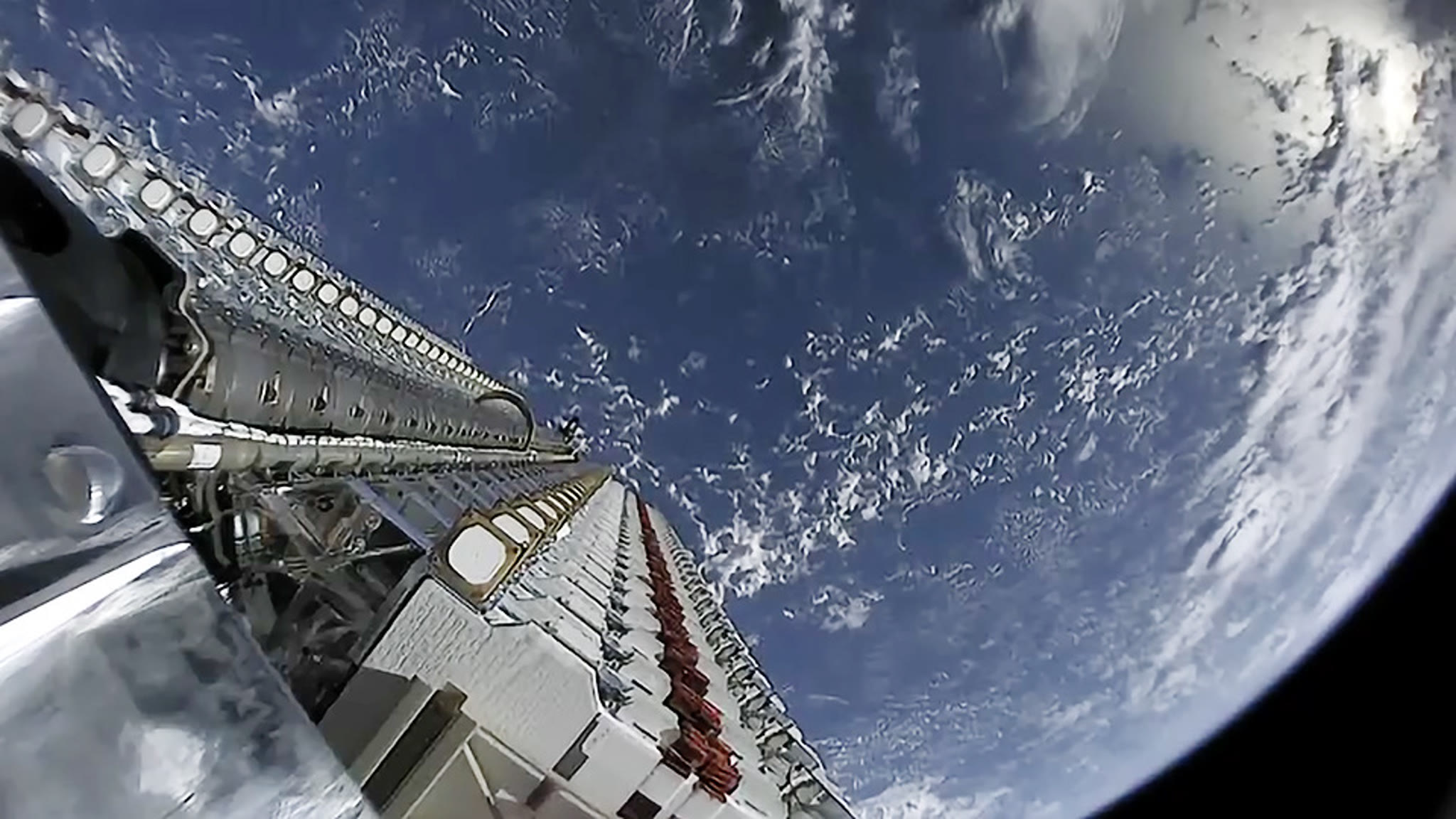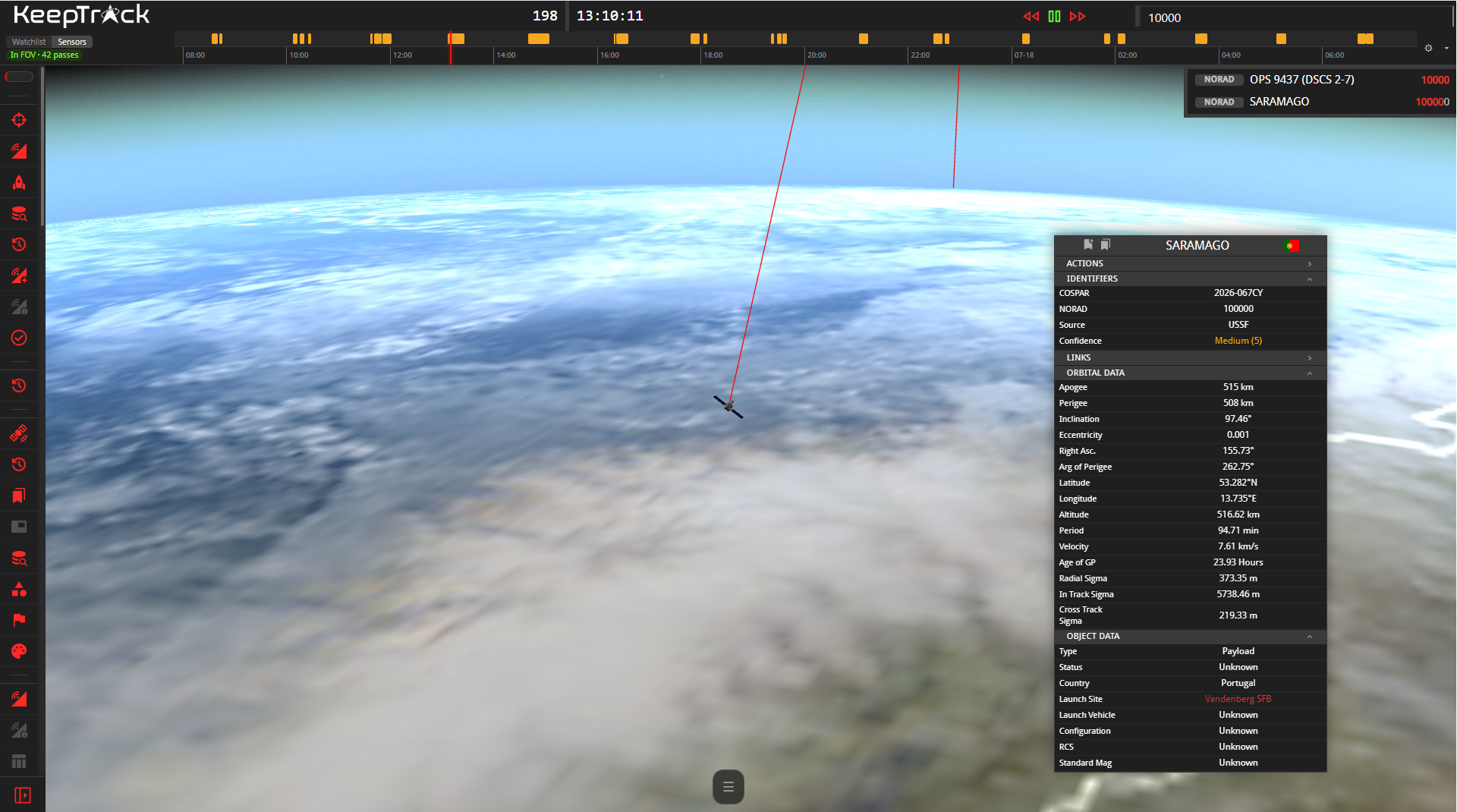
On July 11, 2026, the U.S. Space Force’s satellite catalog handed out its first six-digit number. The object that drew it was not a classified reconnaissance payload or a fresh cloud of debris from a shattered rocket body. It was a shoebox-sized Portuguese CubeSat named after José Saramago, the only writer in the Portuguese language to win the Nobel Prize in Literature.
That satellite is Saramago, and its catalog number is 100000. In the fixed-width text format most of the world’s tracking software still reads, that number does not fit. It runs one digit too wide. So the catalog did not print 100000 at all. It printed A0000, borrowing a letter rather than growing a sixth column.
Saramago is one of a planned twelve small satellites in the Lusíada constellation, designed and built entirely in Portugal by the Lisbon company LusoSpace. Its job is useful and unglamorous. It listens for the radio beacons that ships broadcast, the Automatic Identification System (AIS) and its newer sibling, the VHF Data Exchange System (VDES), and relays them to shore. That gives Portuguese authorities a live picture of vessel traffic across roughly 1.7 million square kilometers of Atlantic, including the waters around the Azores and the busy transatlantic routes toward North America. LusoSpace likes to call the system a “Waze for the oceans.”
The reason Saramago matters beyond Lisbon has nothing to do with ships. It is the number it drew. For sixty-nine years, every object in the catalog fit inside five digits. Saramago is the first that does not. How the catalog got here, and why it jumped from 69,999 straight to 100,000, is a story about how crowded low Earth orbit has become and how much old software is about to break.
Saramago
activeThe satellite that drew the round number
Nothing about Saramago was meant to be historic. It reached orbit on March 30, 2026, riding a SpaceX Falcon 9 rideshare out of California into a sun-synchronous orbit around 500 kilometers up, alongside its constellation-mates Camões, Agustina, and Pessoa. The names are a deliberate thread of national pride. Luís de Camões wrote the Portuguese national epic, Fernando Pessoa reinvented modern poetry under a crowd of invented alter egos, and Agustina Bessa-Luís anchored twentieth-century Portuguese fiction. A later batch launched in July 2026 continued the theme with Florbela, Torga, and Cesário.
The number is an accident of timing. Catalog numbers are not handed out at launch. The 18th Space Defense Squadron assigns them once a tracked object has been observed enough to pin down a stable orbit and tell it apart from everything else on the same rocket. They also do not run cleanly from 1 to 99,999. The public catalog stops at 69,999. The blocks above it were set aside long ago: the 70,000s for nominal pre-launch elements, the 80,000s for analyst objects, and the 90,000s for uncorrelated targets, the stray tracks a sensor records but cannot yet tie to a launch. When the running count of ordinary objects reached 69,999, the next number could not be 70,000. It skipped the reserved blocks and became 100,000.
Which object would draw it came down to processing order. Saramago reached orbit on March 30, more than three months before it was cataloged. It spent those months uncataloged, one more payload from a crowded rideshare waiting for a confirmed orbit and a permanent number. That number came due on July 11, by which point the old range was spent, and Saramago was next in line. It holds 100,000 because of when its orbit was pinned down, not because of anything it did in space.
The first object across a boundary that had held since 1957 was chosen by paperwork. A Portuguese maritime-tracking CubeSat now sits in the catalog beside Sputnik, which holds number 00002 behind its rocket body at 00001. Portugal has been working toward this for years. Its first university-built CubeSat, ISTSat-1, flew on the maiden flight of Ariane 6 in 2024. A small country with a modest space budget ended up holding the six-figure milestone.
Why five digits lasted sixty-nine years
The reason it reads “A0000” and not “100000” is the format that still runs orbital mechanics for most of the planet. It is called the Two-Line Element set, or TLE, and its roots trace to the analytical drag models Max Lane developed in the 1960s, which became NORAD’s operational standard in the early 1970s. The format packs an object’s orbit into two lines of exactly 69 characters each, with every field pinned to a fixed column position.
The catalog number lives in columns 3 through 7 of each line. Five characters. No more. That rigidity was a feature in an era of punch cards and teletype, when a parser could grab columns 3 through 7 and trust that they held the satellite number and nothing else. It became a liability the moment the catalog produced its first six-digit number, because thousands of programs, spreadsheets, and embedded systems around the world assume, deep in their logic, that a satellite number is exactly five characters of pure digits.
For decades the ceiling felt comfortably distant. The catalog did not cross 10,000 until 1977, two decades after Sputnik, when a U.S. military communications satellite drew that number. By the time the International Space Station’s first module launched in 1998, the count had only reached 25544, the number the station still carries. Growth was steady but slow. Then the megaconstellation era arrived. Starlink alone added thousands of tracked objects. Rideshare launches began dispensing a hundred satellites at a time. Anti-satellite tests and accidental breakups poured debris into the count. The catalog stopped climbing and started sprinting, and the five-digit wall that had stood for the entire Space Age suddenly had a date on it.
The Alpha-5 workaround
The Space Force’s answer, rolled out in 2020, was a stopgap with a name that sounds like a fighter squadron. They called it Alpha-5. The idea behind it is almost stubbornly simple. Keep the five-character field. Keep every downstream parser happy. Just let the first character be a letter instead of a digit, and use that letter to encode an extra ten thousand count. “A” in the leading position means 100000, “B” means 110000, and so on up the alphabet.
Two letters get skipped, “I” and “O,” because they are too easy to confuse with the digits 1 and 0 in a monospaced readout. That leaves 24 usable letters, which adds 240,000 numbers above the old five-digit range. Saramago, at 100,000, is the first of them, printed as A0000. The scheme also gives analyst objects room to grow. The tracks that once filled the 80,000s now get a dedicated block at the top of the Alpha-5 range, from 270,000 up, printed with a leading T.
| Alpha-5 code | Catalog number | What it marks |
|---|---|---|
| A0000 | 100,000 | First Alpha-5 object (Saramago) |
| B0000 | 110,000 | Next block up |
| T0000 | 270,000 | Start of the analyst-object range |
| Z9999 | 339,999 | Highest number Alpha-5 can express |
The elegance of Alpha-5 is that a legacy program often keeps running without a crash. The ugliness is that it keeps running while quietly getting things wrong. Sort a list of Alpha-5 catalog numbers as plain text and “A0000” lands before “99999,” because a capital A sorts ahead of the digit 9 in most character encodings. Feed “A0000” to a routine that expects five digits and calls the field an integer, and it either throws an error or, worse, silently coerces it into something meaningless. Alpha-5 does not fix the problem. It hides it inside software that believes it is fine.
The real fix is nine digits
Alpha-5 was never meant to be permanent, and its own numbers give away the expiration date. The scheme tops out at Z9999, which is catalog number 339,999. That sounds like room to spare until you look at the slope of the curve.
339,999
The highest catalog number Alpha-5 can ever express
A0000 through Z9999 adds 240,000 numbers above the old five-digit range. At the current pace of launches, breakups, and sharper sensors, that headroom is measured in years, not decades.
The real fix already exists, and it does not involve squeezing letters into a five-character box. Since 2020, Space-Track and CelesTrak have distributed orbital data in a modern format called the Orbit Mean-Elements Message, or OMM, standardized by the Consultative Committee for Space Data Systems. OMM is not fixed-column. It is structured data, delivered as XML, JSON, KVN, or CSV, and it treats the catalog number as an actual number rather than a five-slot cell. That single change raises the ceiling from 99,999 to 999,999,999. Nine digits. The catalog can grow by four orders of magnitude before anyone has to think about this problem again.
The catch is the same one that made Alpha-5 necessary in the first place. Migrating is work, and the TLE is entrenched everywhere. Space-Track has signaled that it will eventually retire the old TLE and OMM application interfaces in favor of a unified “GP” (general perturbations) data class that speaks the new format natively, while keeping the human-readable TLE around for as long as people depend on it. In other words, the ground truth is moving to nine digits whether or not a given piece of software is ready. Alpha-5 is the rope bridge that keeps the old systems usable while everyone walks across to the new format.
What breaks at six digits
For anyone who tracks satellites for a living, the milestone is less a celebration than a deadline made visible. Every tool that ingests orbital data now has to answer a question it could ignore a week ago. What does it do when it meets an “A0000”?
The jump to six figures is also a readout of how fast low Earth orbit has filled. The catalog needed about two decades to log its first ten thousand objects and roughly seven to exhaust its classic range, and most of that surge is recent. At current rates it will fill the rest of the Alpha-5 range, another 240,000 numbers, in a small fraction of that time. The growth comes from constellations that number in the thousands, rideshares that deploy dozens of CubeSats at once, and sensors sharp enough to catalog debris that would have been invisible a generation ago.
The number in perspective
It is tempting to read catalog number 100000 as an alarm bell. It is not one, at least not physically. Low Earth orbit is enormous, and the tens of thousands of tracked objects spread through that volume are still, on average, far apart. What the number measures is tracking workload, and that is what strains under acceleration. More objects mean more conjunction warnings, more work to keep the catalog correlated and clean, and more load on formats and pipelines built for a quieter era.
Alpha-5 buys the tracking community time, and the move to OMM buys more. Neither removes a single object from orbit. The catalog will keep climbing, 339,999 will arrive sooner than it sounds, and the operators still leaning on five-digit assumptions have run out of runway. The nine-digit future was never in question. Saramago only fixed the date.
For now, the object that opened the six-digit era is a maritime-tracking CubeSat listening for ships over the North Atlantic, doing routine work under a landmark number. The next 240,000 will not wait long behind it.
References(17)
- Track SARAMAGO (NORAD ID: 100000) - Satcat
- GCAT: General Catalog of Artificial Space Objects - Jonathan McDowell, Jonathan's Space Report
- Space Force Analyst Objects - Jonathan McDowell, GCAT
- Satellite Catalog (SATCAT) - CelesTrak
- LusoSpace - Satellite Constellation - NewSpace Index
- Satellite Catalog Number - Wikipedia
- Two-line element set - Wikipedia
- A New Way to Obtain GP Data - CelesTrak
- Help Documentation - Space-Track.org
- 18th Space Defense Squadron - U.S. Space Force Fact Sheet
- Specifications on Orbit Mean-Elements Message Data - U.S. Department of Commerce TraCSS, 2026
- Portugal launches satellites honoring national literary figures - Portugal Global, April 2026
- Portuguese satellites enabling real-time maritime navigation service launched - Government of Portugal
- LUSIADA Constellation Powered by Instituto de Telecomunicacoes Next-Generation AIS/VDES Antennas - Instituto de Telecomunicacoes
- Portuguese satellite launch was a success - The Portugal News, March 2026
- ISTSat-1 - Wikipedia
- Demystifying the USSPACECOM Two-Line Element Set Format - KeepTrack