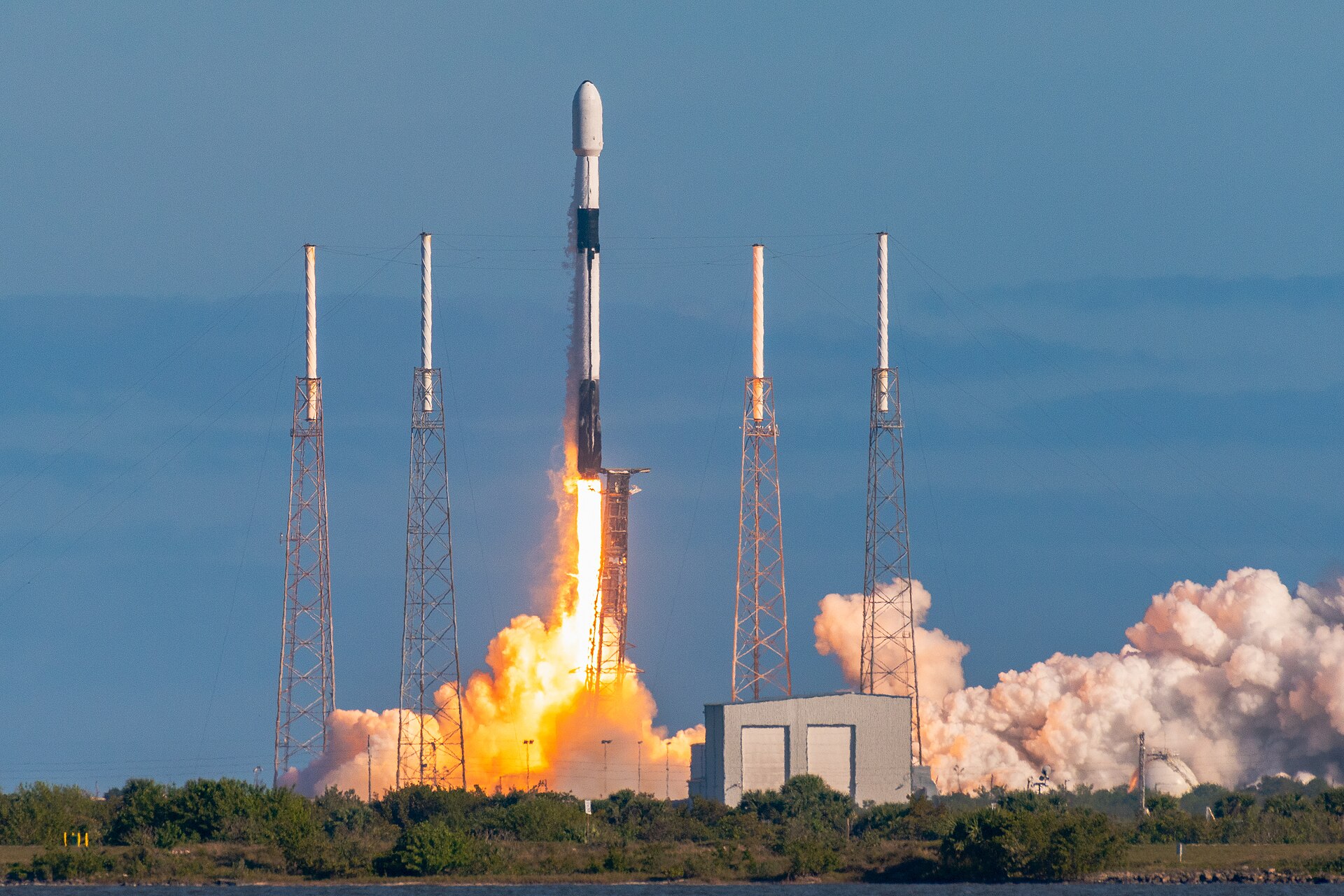
On January 3, 2023, a Falcon 9 lifted off from Cape Canaveral carrying 114 spacecraft, one of the densest rideshare manifests SpaceX had ever flown. Somewhere in that stack of CubeSats, PocketQubes, and hosted payloads sat a refrigerator-sized vehicle that the U.S. catalog would soon log as object 55056. Its name was Vigoride 5, and it belonged to a company that could not afford for it to fail.
Vigoride is a space tug. The idea is simple enough to fit on a pitch deck. A rideshare rocket drops dozens of satellites into one generic orbit, and a tug then ferries individual customers to the specific altitude and plane they actually paid for. It is a last-mile delivery service for low Earth orbit. The company selling it, Momentus, had spent the previous two years demonstrating that the gap between a clean pitch deck and a working spacecraft can swallow an entire business.
By the time Vigoride 5 reached orbit, Momentus had already lost its founder to a national security review, paid millions to settle Securities and Exchange Commission fraud charges, watched its first tug lose power and strand customer satellites, and seen its stock slide toward a delisting warning. Vigoride 5 was not a routine flight. It had to prove the company still had a product.
The Company Behind Object 55056
Momentus was founded in 2017 with a genuinely appealing premise. Rideshare launches were getting cheap, but they left operators with a logistics problem. If you buy a seat on a Falcon 9 rideshare, you go where the rocket goes. A tug that could pick up your satellite at the drop-off point and move it somewhere useful was a real gap in the market, and Momentus moved fast to fill it.
The problem was never the market. It was almost everything else. When Momentus tried to go public through a SPAC merger in 2021, the deal detonated under regulatory scrutiny, and the SEC eventually described the company’s public statements in language that no space startup wants attached to its name.
Momentus’s former CEO is alleged to have engaged in fraud by misrepresenting the viability of the company’s technology and his status as a national security threat, inducing shareholders to approve a merger in which he stood to obtain shares worth upwards of $200 million.
The SEC’s case had two halves. One was the rocket science. The other was the man who built the company. Both were baked into the pitch investors approved, and both, in the regulator’s telling, were known to be shaky by the people making it.
Water, Microwaves, and a Very Big Promise
The technical promise rested on an unusual propulsion system. Rather than the toxic hydrazine or high-pressure xenon that most spacecraft use, Vigoride was designed around a microwave electrothermal thruster, or MET, that used water as its only propellant. Microwaves superheat water into a plasma, and the plasma is expelled to produce thrust. Water is cheap, non-toxic, easy to handle on the ground, and politically uncomplicated to launch. On paper it was elegant.
A fully fueled Vigoride was pitched as capable of moving up to 750 kilograms of payload and delivering a meaningful velocity change once on orbit. That is enough to take a satellite from a crowded rideshare drop-off and place it in a genuinely different orbit, which is the entire value proposition of a tug.
2 km/s
Velocity change a fully fueled Vigoride was designed to deliver
All of it produced by superheating water into plasma, the propulsion concept Momentus told investors it had already proven in space when, according to the SEC, it had not.
The trouble was the word “proven.” Momentus pointed to a 2019 in-space test as evidence that the water plasma thruster worked. The SEC found that the test did not demonstrate the thruster’s ability to provide commercial service. It returned insufficient data and failed to meet Momentus’s own internal criteria for success. The company nonetheless described it publicly as a successful test, and the SPAC that was preparing to take Momentus public repeated that characterization to investors without independently checking it. The core technical claim underpinning a company valued in the hundreds of millions of dollars was, in the regulator’s view, not supported by the very test cited to back it up.
The Founder Who Couldn’t Stay
The second problem was Mikhail Kokorich. A Russian-born physicist and serial entrepreneur, Kokorich had already founded Dauria Aerospace, one of Russia’s first private satellite makers, along with the U.S. startups Astro Digital and Helios Wire before starting Momentus. He was, by most accounts, a talented and relentless founder. He was also, in the eyes of the U.S. government, a national security problem.
The signs were there years before the SPAC. In 2018, the government denied Momentus an export license on the grounds that Kokorich was not an acceptable recipient of U.S.-origin items controlled for national security reasons. He could not legally review technical details of his own company’s core technology. The Committee on Foreign Investment in the United States, the interagency panel known as CFIUS that screens foreign ownership of sensitive American businesses, had already forced Kokorich to divest his interest in another space venture. None of this was disclosed to investors with the clarity the SEC later demanded.
In January 2021, with the public offering looming, Kokorich resigned. The company said his departure was in its best interest to speed the resolution of national security and foreign ownership concerns. He eventually left the United States entirely. To satisfy the government, Momentus signed a National Security Agreement in June 2021 with the Departments of Defense and Treasury acting for CFIUS, committing to tightened security controls, new oversight hires, and a government-approved director on its board. As part of the same deal, Kokorich and his fellow co-founders were required to sell their entire stake, roughly a third of the company, back to Momentus for up to 50 million dollars, formally severing the founders from the business they had built. Momentus hired John Rood, a former Under Secretary of Defense for Policy, as chief executive, and brought on a retired two-star admiral as its security director. A space tug startup had effectively been placed under adult supervision from the national security establishment.
A SPAC on Thin Ice
The financial engineering that was supposed to fund all of this came apart in slow motion. Momentus went public by merging with Stable Road Acquisition Corp, a blank-check company. The deal was first announced in October 2020 with a headline valuation of roughly 1.2 billion dollars. As the regulatory problems surfaced, that number was cut. By mid-2021 the implied enterprise value had been slashed to around 700 million dollars, and investors who had committed to the private placement supporting the merger began walking away. Backers accounting for 118 million of the 175 million dollars pledged to the PIPE round terminated their agreements before closing.
The merger limped across the finish line in August 2021, with Momentus raising roughly 247 million dollars in gross proceeds before fees and the repurchase of its co-founders’ shares, and began trading on the Nasdaq as MNTS. A month earlier, the SEC had settled with nearly everyone involved. The penalties were unusual for how widely they were spread across the deal.
| Party | Role | Outcome |
|---|---|---|
| Momentus | Merger target | 7.0 million dollar penalty |
| Stable Road Acquisition Corp | The SPAC | 1.0 million dollar penalty |
| SRC-NI | Deal sponsor | Forfeited 250,000 founder shares |
| Brian Kabot | Stable Road CEO | 40,000 dollar penalty |
| Mikhail Kokorich | Momentus founder | 2.0 million dollar penalty, five-year officer and director bar |
Kokorich did not settle in 2021. He fought the charges from abroad and only reached terms years later, agreeing in a final judgment entered in November 2024 to a two million dollar civil penalty and a five-year bar on serving as an officer or director of a public company. The SEC also required the sponsor to give PIPE investors the right to back out and imposed detailed investor-protection undertakings on the surviving company.
Vigoride’s Hard Landing
Then Momentus had to actually fly the thing. Its first Vigoride to reach orbit, Vigoride 3, launched in May 2022 on the Transporter-5 rideshare carrying nine small satellites. It went badly. The deployable solar arrays, supplied by a third party, failed to open properly. Only the body-mounted panels worked, leaving the vehicle short on power and struggling to communicate. Momentus managed to deploy a handful of customer satellites over the following weeks, but it lost reliable contact with the tug and never demonstrated the propulsion maneuvers that were the entire point of the mission. The company later traced the anomaly to the array mechanism and recovered a partial set of deployments, but the debut was a public failure of the core vehicle.
Momentus spent its formative years lurching from one self-inflicted crisis to the next while trying to build a hard piece of hardware at the same time.
Momentus founded
Kokorich launches the space tug startup in Silicon Valley.
Water plasma test
An in-orbit thruster demo the SEC later says failed its own success criteria.
SPAC deal announced
Stable Road merger unveiled at a roughly $1.2B valuation.
Kokorich resigns
Founder steps down under national security and export-control pressure.
National Security Agreement
Momentus signs a mitigation deal with DoD and Treasury for CFIUS.
SEC charges
Regulators charge the SPAC, sponsor, CEOs, and Momentus over misleading claims.
Public at last
De-SPAC closes at a reduced valuation; shares trade as MNTS.
Vigoride 3 falters
First Vigoride to fly loses power when its solar arrays fail to deploy.
Vigoride 5 launches
Object 55056 reaches orbit on Transporter-6 with both arrays deployed.
Vigoride 6 succeeds
Third tug deploys all its payloads, the company's cleanest flight yet.
First reverse split
A 1-for-50 reverse stock split staves off a Nasdaq delisting.
Redemption on Transporter-6
Vigoride 5 launched on Transporter-6 in January 2023 with the specific job of proving that Momentus had learned from the Vigoride 3 disaster. On its first orbital pass, both solar arrays had deployed, and the vehicle was generating power and charging its batteries. The single failure that had crippled the previous mission did not repeat.
From there the mission delivered the demonstrations Momentus had been promising for years. The team fired the microwave electrothermal thruster more than 35 times, in bursts running from 30 seconds to six minutes, and used those firings to raise the vehicle’s own orbit by more than three kilometers against atmospheric drag. It was the concrete, measurable proof of the water plasma concept that the disputed 2019 test had never provided. Vigoride 5 deployed the Qosmosys Zeus-1 satellite and provided hosted-payload services for Caltech’s Space Solar Power Demonstrator, an experiment testing whether solar power could be collected in orbit and beamed toward Earth. Momentus even requested extra regulatory authorization to keep its tracking beacon alive longer so it could squeeze more data out of the healthy vehicle. Three months later, Vigoride 6 flew on Transporter-7 and deployed all of its payloads cleanly, giving Momentus back-to-back functional missions for the first time.
For a brief window, it looked like Momentus had turned the corner. The technology finally worked in space, roughly as advertised, on two consecutive flights. The company had a government-blessed board, a Pentagon veteran running it, and a product that could point to real orbital results rather than a contested 2019 test. The engineering problem, the one thing everyone assumed would be the hardest part, had largely been solved.
The Slow-Motion Cash Crisis
The engineering was never what killed Momentus. Money was. Even as Vigoride 5 and Vigoride 6 were succeeding, the company was running out of runway. In March 2023, Nasdaq warned that MNTS had traded below the one dollar minimum bid price. That August, Momentus executed a 1-for-50 reverse stock split to stay listed, the corporate equivalent of shrinking the numbers to hide how far they had fallen. Its financial statements carried going-concern warnings, the auditor’s formal signal of doubt that a business can survive the year.
The pattern repeated. A 1-for-14 reverse split followed in December 2024. Fresh Nasdaq deficiency notices arrived over stock price and shareholders’ equity. To patch a capital shortfall, Momentus struck a deal with the manufacturing company Velo3D, trading stock for spacecraft components rather than cash, including a 3D-printed fuel tank destined for the next tug. The company leaned harder into government work, winning a NASA contract to demonstrate a rotating detonation rocket engine and, by late 2025, a place on the Missile Defense Agency’s SHIELD contract vehicle. A former Under Secretary of Defense was suddenly a useful person to have signed the paperwork.
By the standards of the 2021 SPAC boom, Momentus outlasted many of its peers, several of which simply vanished. But it emerged a fraction of the company that went public. The tug worked. The business model of selling last-mile orbital transport at a profit, on a schedule, to enough customers to cover the cost of building the vehicles, remained unproven.
What Object 55056 Represents
Vigoride 5 was the flight where Momentus finally did the hard technical thing it had promised. It was also proof that doing the hard technical thing was never going to be enough. The company’s fatal wounds were self-inflicted and had almost nothing to do with engineering. Its founder’s background got downplayed until the government forced the issue. Its own regulator called its disclosures misleading. And it carried a capital structure built for a valuation the business never earned.
The crowded field of space tug and orbital transfer startups faces the same problem Momentus did. The market for last-mile orbital delivery is real, but it is thin, price-sensitive, and unforgiving of the multi-year gap between raising money on a promise and flying hardware that works. Momentus proved the physics. It never proved the economics. Vigoride 5 did its job. The company just needed it to do far more than one satellite ever could.
References(18)
- SEC Charges SPAC, Sponsor, Merger Target, and CEOs for Misleading Disclosures Ahead of Proposed Business Combination - U.S. Securities and Exchange Commission, July 2021
- Stable Road and Momentus reach SEC settlement over false claims - SpaceNews, July 2021
- Litigation Release: Mikhail Kokorich - U.S. Securities and Exchange Commission, November 2024
- Momentus Founder Agrees to $2 Million Civil Penalty Over Merger - Bloomberg Law, November 2024
- Momentus CEO resigns amid U.S. government concerns - SpaceNews, January 2021
- Momentus CEO Mikhail Kokorich Resigns Over Regulatory Concerns - Via Satellite, January 2021
- Investors drop out of Momentus SPAC deal - SpaceNews, 2021
- Shareholders Approve Momentus SPAC Merger After Rocky Start - Via Satellite, August 2021
- Momentus looks ahead under new chief executive - SpaceNews, 2021
- Momentus orbital transfer vehicle suffers power problem after launch - Spaceflight Now, June 2022
- Momentus Identifies Cause of Vigoride-3 Anomaly, Deploys 4 More Satellites - Via Satellite, August 2022
- Momentus troubleshooting problems with Vigoride space tug - Space.com, 2022
- Momentus Deploys All Payloads from Vigoride-6 Mission - Business Wire, July 2023
- Momentus meets Nasdaq equity requirement with Velo3D deal - Investing.com, 2024
- Stable Road Acquisition Corp and Momentus Revise Merger Agreement and Financial Outlook - Business Wire, June 2021
- Momentus tug raises orbit with water-fueled thruster - SpaceNews, May 2023
- In a First, Caltech's Space Solar Power Demonstrator Wirelessly Transmits Power in Space - Caltech, June 2023
- SpaceX launches 114 small satellites on first mission of 2023 - Spaceflight Now, January 2023