· deep dive · 12 min read
The 300,000 Swerves Keeping Low Earth Orbit From Crashing
Starlink satellites fired their thrusters to dodge a collision roughly 300,000 times in 2025, about 822 times a day. Behind that number is a fragile, half-automated system of warnings, probabilities, and judgment calls that decides which close approaches are worth a maneuver and which are just noise.
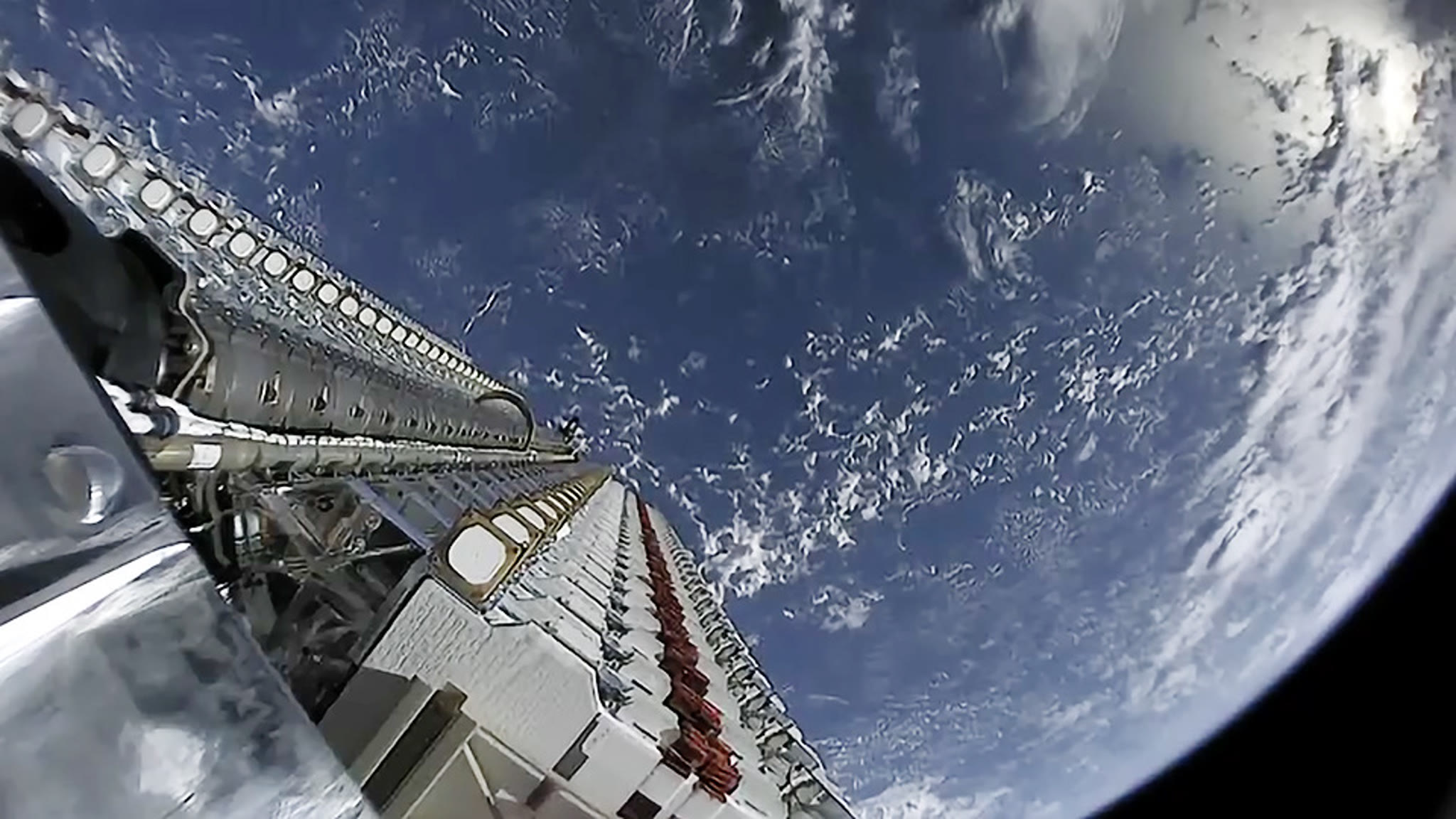
Somewhere above you right now, a Starlink satellite is deciding whether to get out of the way. A piece of dead rocket body or a defunct spacecraft is on a track that brings it within a few kilometers, the onboard software has run the numbers, and a krypton-fed Hall thruster is about to nudge the satellite onto a slightly different path. By the time the close approach actually happens, hours or days from now, the two objects will miss each other by a comfortable margin that no one on the ground will ever notice.
This happens about 822 times a day across the Starlink fleet alone. In 2025, SpaceX reported roughly 300,000 collision-avoidance maneuvers to the Federal Communications Commission, up about 50 percent from the 200,000 it logged in 2024. The most recent semiannual filing, covering June through November 2025, listed 148,696 propulsive maneuvers across the constellation. The fleet now averages roughly 30 dodges per satellite per year, and at the current rate of growth, SpaceX could be performing close to a million maneuvers annually by 2027.
Those numbers describe the single largest collision-avoidance operation in the history of spaceflight, and almost none of it is visible. There is no air traffic controller clearing each move, no global authority adjudicating who has the right of way, and no shared map that every operator trusts. What exists instead is a patchwork of probability calculations, government warning messages, commercial radar feeds, and operator judgment, stitched together fast enough to keep low Earth orbit from turning into a demolition derby. It mostly works. Understanding why it mostly works, and where it is starting to strain, is one of the more important questions in space right now.
300,000
Starlink Collision-Avoidance Maneuvers in 2025
Up roughly 50 percent from 2024. The fleet now swerves about 822 times a day, and SpaceX projects close to one million maneuvers a year by 2027 if growth continues.
A Conjunction Is a Probability, Not a Crash
The first thing to understand is that a “conjunction” is not a collision. It is a predicted close approach between two cataloged objects, and the entire discipline of conjunction assessment exists because we cannot actually know where anything is with perfect precision. Every tracked object has an orbit estimate wrapped in a cloud of uncertainty, a covariance ellipsoid that describes how confident the tracking system is about the object’s true position. For a well-tracked active satellite in low Earth orbit, that uncertainty might be tens or hundreds of meters. For an old, tumbling, poorly tracked piece of debris, it can be kilometers.
When analysts screen for conjunctions, they are not asking “will these two objects occupy the same point?” They are asking “given everything we are uncertain about, what is the probability that they do?” That number is the probability of collision, or Pc, and it is computed by projecting both objects’ uncertainty clouds onto the plane where they cross and integrating the overlap against the combined physical size of the two objects. The result is a single figure that folds together miss distance, uncertainty, and object size in one mathematically honest package.
The convention that has governed the field for years is that a Pc above 1 in 10,000, written as 1e-4, is “actionable.” NASA’s Conjunction Assessment Risk Analysis program uses thresholds in this range as a red line for its own missions, and most commercial and government operators have adopted something similar. Below that, the close approach is logged and watched but generally not acted on. The logic is partly statistical and partly economic. Maneuvers cost propellant, interrupt the mission, and, as we will see, create their own problems. You do not want to burn fuel dodging a phantom.
There is a counterintuitive wrinkle here that trips up newcomers. As a close approach gets nearer in time, the tracking improves and the uncertainty shrinks, which can cause the calculated probability to go down even as the objects get closer, because a tighter covariance means the analyst is more confident the two will miss. A conjunction that looks alarming three days out can deflate to nothing by the day of closest approach. This is why operators do not maneuver on the first warning. They watch the probability evolve across a sequence of updates and act only when it stays high as the uncertainty collapses.
How a Warning Reaches an Operator
For most of the world’s satellites, the warning pipeline begins with the U.S. Space Force. The 18th and 19th Space Defense Squadrons maintain the public catalog of space objects and run the conjunction screening that underpins global spaceflight safety, with the 18th covering objects up to geosynchronous altitude and the 19th handling everything beyond. They screen every cataloged object against every other one, a calculation that scales with the square of the catalog size and now involves on the order of a billion pairwise comparisons per screening run, repeated multiple times a day against a catalog of roughly 47,000 tracked objects.
When the screening flags a close approach, the squadron issues a Conjunction Data Message, or CDM, to the affected operator. A CDM names the two objects, gives the time of closest approach, the predicted miss distance, the calculated probability, and the covariance for each object so the operator can run their own analysis. A single high-interest conjunction does not produce one CDM. It produces a stream of them, updated as fresh tracking comes in, and the operator watches that stream evolve. After the 2009 Iridium-Cosmos collision, the Space Force expanded screening from a curated list of high-value assets to the entire active catalog, and the daily CDM volume jumped from hundreds to tens of thousands.
That volume is the heart of the problem. The overwhelming majority of CDMs describe approaches that will never come close to the action threshold. Operators have to triage thousands of warnings to find the handful that matter, and the cost of a missed signal is catastrophic while the cost of a false alarm is merely expensive. The legacy government catalog also delivers data with accuracy measured in kilometers, derived from the same two-line element sets that have served since the 1960s, which is why a market grew up around doing this better. Commercial firms like LeoLabs, Slingshot Aerospace, COMSPOC, and Kayhan Space now sell higher-fidelity tracking, faster updates, and software that automates the triage, pushing position accuracy from kilometers down to the hundred-meter range.
The Starlink Machine
SpaceX does not wait for a human to read each CDM. Starlink satellites ingest the public conjunction data and the company’s own tracking, and an onboard autonomous system decides when to maneuver and computes the burn without a person in the loop. This is the only practical way to operate a fleet of more than 10,000 satellites, which is what SpaceX now flies. Starlink makes up more than half of every active satellite in orbit, and no team of human analysts could read the resulting torrent of warnings in time.
SpaceX also runs a far more cautious threshold than anyone else. While most operators act around the 1-in-10,000 mark, Starlink satellites will maneuver when the probability of collision exceeds roughly 3 in 10 million, written 3e-7. That is more than 300 times more conservative than the industry convention. The company argues this is responsible behavior for the largest constellation ever built, and on its face it is hard to disagree. If any single operator is going to over-maneuver, better the one with the most satellites.
| Reporting Period | Maneuvers | Notes |
|---|---|---|
| Dec 2022 - May 2023 | ~25,000 | First period reported in this detail |
| Dec 2023 - May 2024 | ~50,000 | Roughly doubled in a year |
| Full-year 2024 | ~200,000 | Constellation still expanding |
| Jun - Nov 2025 | 148,696 | 44,559 Gen1, 104,137 Gen2 |
| Full-year 2025 | ~300,000 | About 30 maneuvers per satellite |
The tradeoff is that the conservative threshold roughly doubles the maneuver count. University of Southampton astrophysicist Hugh Lewis has estimated that the figure for one recent six-month period would have been about half as large had SpaceX used a less cautious threshold. Each of those maneuvers is cheap in propellant and SpaceX maintains a deorbit policy that keeps its satellites from becoming debris. But the maneuvers are not free for everyone else, and that is where the story gets complicated.
The Autonomy Paradox
Here is the uncomfortable part. Every time a satellite maneuvers, it invalidates the orbit prediction that everyone else was using to screen against it. A COMSPOC analysis found that a single collision-avoidance maneuver can throw off trajectory forecasts for several days, with position errors reaching as much as 40 kilometers. When one satellite moves to avoid a conjunction, it can create new, unpredictable conjunctions with other objects, and it degrades the quality of the data that other operators rely on to make their own decisions.
Now multiply that by 822 maneuvers a day, performed autonomously, by satellites whose post-maneuver orbits are not always shared with the rest of the world before they happen. The most-maneuvered objects in orbit become some of the hardest to predict, precisely because they are doing the responsible thing. The system that keeps Starlink safe makes the broader orbital environment noisier for everyone screening against it.
The safest possible behavior for one operator can quietly raise the screening burden for all the others. A maneuver that prevents one collision scrambles the trajectory forecasts that everyone else depends on, sometimes for days.
This exposes the deeper gap: there is no agreed protocol for who moves. When a conjunction involves one maneuverable satellite and one piece of dead debris, the answer is obvious. When it involves two active, maneuverable satellites operated by different companies or countries, both might maneuver, neither might, or both might move into each other’s new path. The aviation world solved this a century ago with right-of-way rules and a controller who can issue binding instructions. Orbit has neither. Coordination today happens through voluntary data sharing, direct operator-to-operator phone calls, and a handful of emerging conventions, none of them enforceable.
The Institutional Scramble
Governments are aware of the gap and are building toward something better, slowly. In the United States, civil space traffic coordination is being moved out of the Defense Department and into the Commerce Department’s Office of Space Commerce, which is standing up the Traffic Coordination System for Space, or TraCSS. The system reached initial operating capability in 2024 and has been expanding through a beta program. As of early 2026 it was providing screening services covering more than 8,000 spacecraft, close to 80 percent of all active satellites, with 17 organizations as pilot users and direct operator registration now open. The goal is a cloud-based, civil-run service that becomes the world’s primary source of spaceflight safety warnings, fed by both government sensors and commercial data providers.
Europe is pursuing automation directly. The European Space Agency’s CREAM initiative, short for Collision Risk Estimation and Automated Mitigation, aims to automate the entire decision chain, assessing risk, planning maneuvers, and coordinating between operators with minimal human intervention. ESA reports that its own satellites now require more than one collision-avoidance maneuver per spacecraft per year on average, a workload that is becoming impractical to handle by hand, which is exactly the pressure that pushes toward automation.
The commercial layer is filling in faster than the government one. The same companies selling tracking data are now selling the decision software on top of it. Kayhan Space markets autonomous conjunction screening and maneuver planning to smaller operators who cannot build their own. COMSPOC and Slingshot fuse multiple sensor sources into a single picture. This is the part of the system that has scaled most gracefully, because it has a clear business model: every new operator that cannot afford a Space Force-grade analysis team is a customer.
Why It Gets Harder From Here
The trend lines are not reassuring. Low Earth orbit held roughly 2,500 active satellites in 2020 and more than 10,000 today, with credible forecasts projecting 70,000 or more by 2030. Starlink alone could be maneuvering a million times a year within two years. And the constellation operators are no longer all playing by the same informal rules. China’s Guowang and Qianfan constellations are deploying thousands of satellites into the same crowded shells, and there is no equivalent of the FCC semiannual report giving the rest of the world visibility into how, or whether, they maneuver.
Collision avoidance has so far scaled faster than orbital density, which is the only reason there has not been a second Iridium-Cosmos since 2009. But the margin is being eaten from both ends. More satellites mean more conjunctions, more maneuvers mean noisier predictions, and more operators outside any shared coordination framework mean more cases where the question “who moves?” has no answer. The nightmare that Kessler syndrome describes, a cascade of collisions feeding on its own debris, does not require a war or a deliberate test to begin. It can start with two automated systems that each correctly calculated that the other one would get out of the way.
The honest assessment is this. The machinery keeping low Earth orbit safe is far more sophisticated than it was in 2009, and the people building it are serious and competent. But it is held together by voluntary cooperation, incompatible data standards, and the goodwill of the largest operator. It has no enforcement mechanism, no universal map, and no controller. It works today because SpaceX chose to be cautious and most other large operators chose to cooperate. That is a thin foundation for the most valuable orbital real estate in the solar system, and the 300,000 swerves of 2025 are less a sign that the problem is solved than a measure of how fast it is growing.
References(13)
- NASA Conjunction Assessment Risk Analysis (CARA) Overview - NASA Goddard Space Flight Center
- NASA Spacecraft Conjunction Assessment and Collision Avoidance Best Practices Handbook - NASA, 2023
- SpaceX Starlink Satellites Made 50,000 Collision-Avoidance Maneuvers in the Past 6 Months - Space.com, 2024
- SpaceX Semi-Annual Update on Starlink Network Health and Collision Risk - Kratos Space
- Collision Avoidance Maneuvers by Starlink Satellites Increasing Exponentially - AIAA, July 2023
- Heavy Traffic Ahead - Aerospace America, AIAA
- Starlink Dodged 300,000 Collisions in 2025 - TeslaNorth, Jan. 2026
- CREAM: Avoiding Collisions in Space Through Automation - European Space Agency, 2025
- Traffic Coordination System for Space (TraCSS) - U.S. Office of Space Commerce
- Commerce Department's New Traffic Coordination System for Space Launches Initial Capabilities - Office of Space Commerce
- 19th Space Defense Squadron Fact Sheet - United States Space Force
- Hejduk, M.D. - Probability of Collision: Valuation, Variability, Visualization, and Validity, Acta Astronautica, 2019
- ESA Annual Space Environment Report - European Space Agency

Theodore Kruczek