· deep dive · 13 min read
Why Nobody Can See What Is Happening Near the Moon
The volume of space between Earth and the Moon is roughly a thousand times larger than the orbit we actually watch, and almost none of it is under surveillance. As the U.S. and China race to build lunar outposts, the Space Force is scrambling to put eyes on a region it has been effectively blind to.
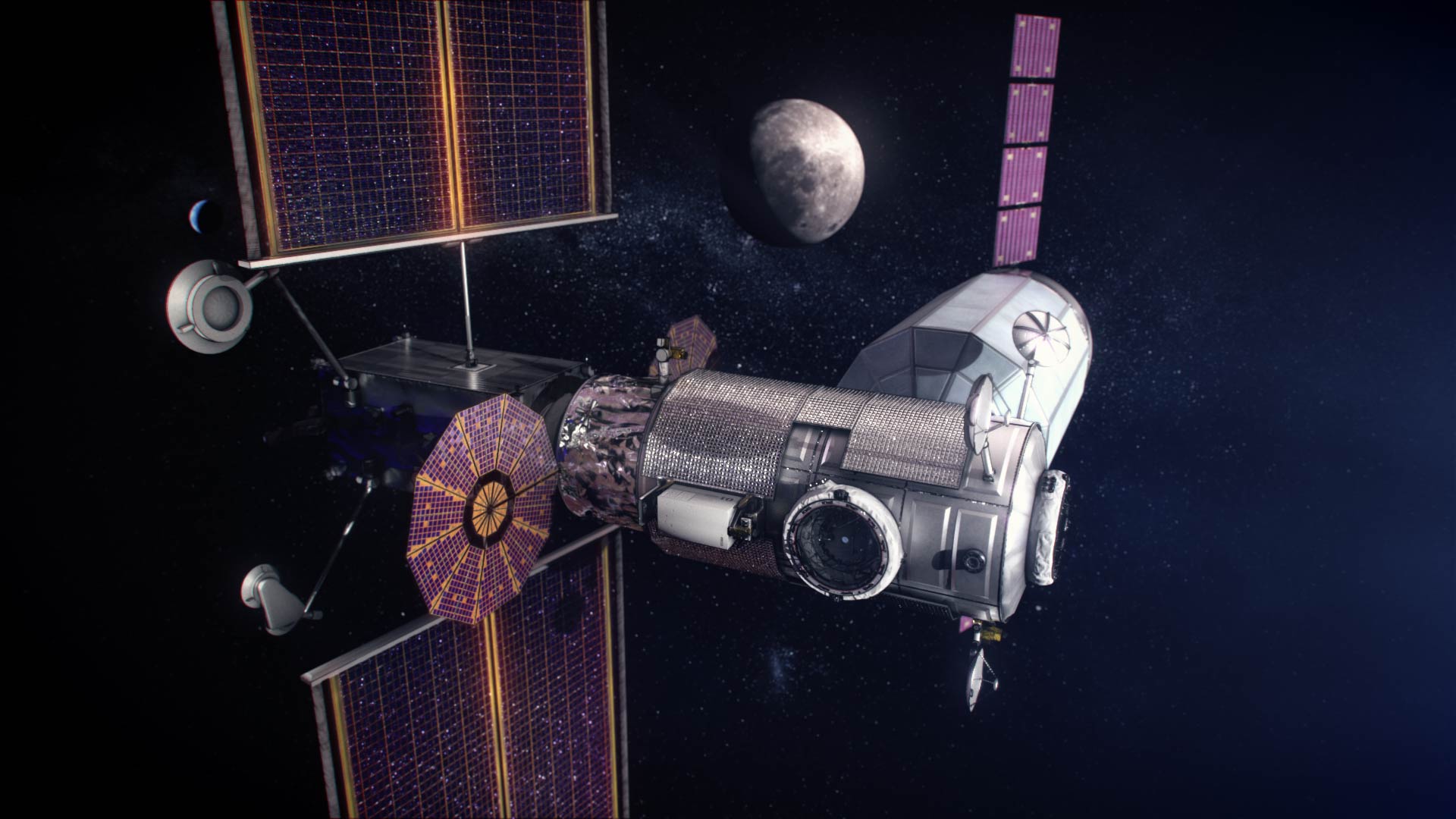
In March 2024, China launched a small satellite called Queqiao-2 into a stretched, looping orbit around the Moon to relay signals from its Chang’e lunar landers. It is a communications relay, not a weapon, and Beijing was open about what it was. But here is the uncomfortable detail for anyone responsible for U.S. space security. Once Queqiao-2 settled into its 26-hour orbit swinging out past 16,000 kilometers above the lunar surface, no reliable American sensor could keep continuous track of it. For long stretches it simply was not being watched by anyone outside of China.
That is not an exotic edge case. It is the normal state of affairs in cislunar space, the enormous region between geosynchronous orbit and the Moon. We have spent six decades building a global apparatus to track objects in low Earth orbit and the geostationary belt, with radars, optical telescopes, and a catalog of roughly 47,000 objects updated several times a day. Push past that belt toward the Moon and the map goes blank. The sensors that work close to home stop working, the orbits stop behaving the way our software expects, and the objects themselves fade to the brink of invisibility.
For most of the space age this did not matter, because almost nothing went out there. A handful of science probes transited cislunar space on their way to somewhere else, and the region was empty enough that you could safely ignore it. That assumption is now collapsing. The United States and China are both committed to permanent crewed presence on and around the Moon by the early 2030s, commercial landers are launching on a near-monthly cadence, and the traffic in the cislunar volume is about to go from a curiosity to a crowd. The Space Force has decided it can no longer afford to be blind out there, and the scramble to fix that is one of the more revealing stories in military space right now.
The strategic logic is blunt, and the Chief of Space Operations has not been subtle about it.
Wherever US interests go, so will go the US Space Force.
A Domain a Thousand Times Too Big to Watch
Start with the geometry, because it explains almost everything else. The geostationary belt that we treat as the far edge of trackable space sits about 36,000 kilometers up. The Moon is roughly 384,000 kilometers away, nearly ten times farther. Because volume scales with the cube of distance, the spherical region out to the Moon is on the order of a thousand times larger than the volume enclosed by the GEO belt. There is simply an enormous amount of empty space to search, and the objects in it are sparse, dim, and far away.
Distance is brutal for the two main ways we track things. Radar is the worse off of the two. The strength of a radar return falls off with the fourth power of range, because the signal weakens on the way out and again on the way back. A radar powerful enough to paint a small object in low Earth orbit would need an almost unimaginable increase in power to get a usable echo off the same object near the Moon. Ground-based radar is essentially a non-starter at lunar distances. Optical telescopes do better, since they collect reflected sunlight rather than paying the round-trip penalty, but they have their own curse. An object near the Moon has to compete with the glare of the sunlit lunar disk, and it can sit at angles where it is lost in that brightness or hidden behind the Moon entirely. Tracking analysts call these blind regions the cone of silence.
Then there is the physics of the orbits themselves. Close to Earth, a satellite is dominated by a single gravitational pull, and its path is a clean ellipse you can propagate forward for days with a simple model. In cislunar space, objects are tugged by Earth and the Moon at the same time, a three-body problem with no tidy closed-form solution. Trajectories can be chaotic, sensitive to tiny errors, and capable of drifting between wildly different paths with small nudges. The catalog software that keeps low Earth orbit organized, built on decades-old two-line element sets and simple orbit models, does not even pretend to describe these regimes. Tracking something near the Moon is not just harder than tracking something in LEO. It is a different mathematical discipline.
The Lagrange Trick, and Why It Cuts Both Ways
The same three-body dynamics that make cislunar space hard to model also create a handful of genuinely useful places. At five points in the Earth-Moon system, the gravitational pulls and orbital motion balance in a way that lets a spacecraft loosely hold station with very little fuel. These are the Lagrange points, and they are prime real estate. L1, between Earth and the Moon, and L2, just behind the Moon, are especially valuable. A satellite parked in a looping halo orbit around one of these points can keep a steady line of sight on the Moon and on broad swaths of the cislunar volume while sipping propellant.
That makes Lagrange points the obvious perches for surveillance. It also makes them the obvious places to hide. A spacecraft loitering near Earth-Moon L2, on the far side of the Moon, is shielded from Earth-based observation by the lunar body itself. If you wanted to position an asset where the United States could not easily see it, the dynamics of the system hand you a menu of options. The cone of silence is not a temporary gap that better telescopes will close. It is baked into the geometry, which is why the answer has to be sensors that go out and watch from inside the region rather than squinting at it from the ground.
You cannot fix cislunar blindness by building a bigger radar in the desert. The blind spots are created by the Moon’s own bulk and the angles of sunlight, so the only durable solution is to place the sensors out in the region itself, looking around from the inside.
Oracle, America’s First Cislunar Sentinels
The U.S. effort to do exactly that lives at the Air Force Research Laboratory, and it has been through a telling rebrand. The program started life as the Cislunar Highway Patrol System, or CHPS, a name that captured the mission of patrolling the transit routes to the Moon but carried a whiff of law enforcement that the Pentagon evidently decided was too aggressive for a domain it is trying to frame as one of stewardship. The effort is now called Oracle, and it has grown into a family of two spacecraft with complementary jobs.
Oracle-Prime, sometimes written Oracle-P, is the purpose-built surveillance satellite. Advanced Space, the Colorado company that ran NASA’s CAPSTONE mission and proved out navigation in a lunar halo orbit, is the prime contractor, working with Terran Orbital and Quantum Space. The plan is to position Oracle-Prime near Earth-Moon L1 and have it perform what the program calls un-cued surveillance, meaning it searches for objects it was not told to look for rather than simply confirming the position of things already in a catalog. It carries both wide-field and narrow-field sensors, with enough onboard processing to sift its own imagery and cut down the volume of data it has to beam home. The goal is to demonstrate that a single well-placed satellite can find unknown objects and maintain custody of known ones across the cislunar volume for a two-year mission.
Oracle-Mobility, or Oracle-M, attacks the problem from a different angle. Rather than holding a fixed vantage point, it is designed to roam, using Hall-effect thrusters that ionize xenon into a plasma and fling it out the back for efficient, sustained maneuvering. The idea is that a mobile sensor can reposition to chase down and inspect objects that a stationary watcher could only glimpse. Oracle-M completed a full integrated propulsion hot-fire test at Edwards Air Force Base in March 2025, a milestone that proved its thrusters, propellant feed, and power system work together, and the finished spacecraft has since been placed in storage at Kirtland Air Force Base waiting for a ride.
The Two Halves of Oracle
| Oracle-Prime | Oracle-Mobility (Oracle-M) | |
|---|---|---|
| Role | Dedicated cislunar surveillance | Maneuver and tracking demonstrator |
| Approach | Un-cued search and custody | Roam and inspect known objects |
| Vantage | Near Earth-Moon L1 | Mobile across cislunar space |
| Sensors | Wide and narrow field, onboard processing | Tracking and navigation payload |
| Prime contractor | Advanced Space | AFRL with Space Systems Command |
| Status | Delivery targeted 2026, seeking launch 2027 | Hot-fire complete, awaiting launch |
- Role
- Dedicated cislunar surveillance
- Approach
- Un-cued search and custody
- Vantage
- Near Earth-Moon L1
- Sensors
- Wide and narrow field, onboard processing
- Prime contractor
- Advanced Space
- Status
- Delivery targeted 2026, seeking launch 2027
- Role
- Maneuver and tracking demonstrator
- Approach
- Roam and inspect known objects
- Vantage
- Mobile across cislunar space
- Sensors
- Tracking and navigation payload
- Prime contractor
- AFRL with Space Systems Command
- Status
- Hot-fire complete, awaiting launch
That wait is the catch. Oracle-M was slated to fly on a United Launch Alliance Vulcan rocket, but Vulcan has been grounded for national security launches while ULA and the Space Force investigate a solid rocket motor anomaly from a February 2026 flight. Officials have said Oracle-M could still fly by the end of 2026 if the schedule holds, but the satellite is, for now, a finished spacecraft sitting in a clean room in New Mexico, blocked by a problem that has nothing to do with cislunar space. Oracle-Prime, the more capable of the two, is working toward delivery in 2026 and hunting for a launch opportunity in 2027.
Maneuverability Is the Real Currency
Look across the broader U.S. portfolio and a theme emerges that goes beyond simply seeing the region. DARPA has been building out its own set of lunar bets, including the DRACO nuclear thermal propulsion demonstrator and the Lunar Assay via Small Satellite Orbiter, or LASSO, which in April 2025 saw DARPA pick Benchmark Space Systems, Quantum Space, and Revolution Space to study concepts. LASSO is framed publicly around prospecting for water ice from very low lunar orbits, as low as 10 kilometers, where the Moon’s lumpy gravity field forces constant corrections. The science is real, but the connecting thread across DARPA’s lunar work is not science. It is maneuverability, the ability to operate agilely in an environment where staying in any given orbit is expensive and hard.
This is the same instinct behind Oracle-M’s roaming design, and it reflects a recognition that cislunar awareness is not only about detection. It is about being able to act on what you detect. A sensor that spots an unidentified object near L2 is of limited use if nothing can get close enough to characterize it. The agility-first emphasis suggests the Space Force is thinking past the first generation of eyes toward a posture where assets can investigate, shadow, and respond, the way it already aspires to do closer to Earth.
The Institutional Catch-Up
Hardware is only half the story. In the spring of 2026, the Space Force stood up a Cislunar Coordination Office inside its acquisition enterprise, a move announced by Maj. Gen. Stephen Purdy and handed to Jamie Stearns, who had been running space control operations at AFRL’s Space Vehicles Directorate. The driver was an executive order on space superiority issued in December that directed the government to field the initial elements of a permanent lunar outpost by 2030, which forces the question of who, exactly, is responsible for knowing what is happening in the space around that outpost.
Part of the office’s job is simply to inventory the sprawl. Purdy has noted a surprising amount of government involvement in cislunar activity already, spread across DARPA, AFRL, the intelligence community, and the wider Defense Department, with NASA as the central partner. Cislunar awareness has been growing in a dozen places at once without a single owner, and the new office is meant to map that landscape, write acquisition roadmaps, and keep the surveillance, communications, and launch-tempo pieces from being built in isolation. It is the bureaucratic admission that this is now a real mission area rather than a research curiosity.
The commercial sector is moving in parallel, and arguably faster. Firms that built their businesses tracking objects closer to Earth are extending outward. ExoAnalytic Solutions, which operates a global network of optical telescopes, has begun supporting commercial lunar missions, and companies like LeoLabs and Numerica are pushing their sensing and orbit-determination capabilities toward the cislunar regime. The same pattern that played out in low Earth orbit, where commercial providers ended up supplying much of the conjunction screening and tracking data that operators rely on, looks likely to repeat at lunar distances, with the government as an anchor customer rather than the sole operator.
What to Actually Expect
It is worth being clear-eyed about the state of play. As of mid-2026, the United States does not yet have a single operational sensor dedicated to watching cislunar space. Oracle-M is finished but grounded by a rocket problem. Oracle-Prime, the more capable satellite, is still more than a year from a launch it does not yet have booked. Everything currently flying is a demonstrator or a borrowed asset, and the catalog that governs spaceflight safety still effectively stops at the geostationary belt. The blindness is real, present tense, and not going away on any near-term schedule.
What has changed is the seriousness. A few years ago cislunar SDA was a slide in a research briefing. Now it has dedicated spacecraft in storage and on contract, a coordination office with a general’s attention, an executive order setting a 2030 deadline, and a commercial market forming around it. The likeliest path from here is incremental. Oracle-M flies once Vulcan is cleared and proves the mobile-sensor concept, Oracle-Prime follows and demonstrates that a single satellite at L1 can find and hold custody of objects across the region, and the lessons feed an operational architecture sometime in the back half of the decade, probably a mix of a few government sentinels and a layer of commercial tracking bought as a service.
The deeper point is that the era of treating cislunar space as empty is over. China has hardware there now, the United States and its partners are heading to the Moon to stay, and the volume that was safe to ignore for sixty years is about to fill with landers, relays, tugs, and the debris they generate. The cone of silence was tolerable when nothing important happened inside it. Within a few years, a great deal will, and the side that can see into that volume first will have a meaningful advantage over the side that cannot. Oracle is the United States betting it would rather not find out what that feels like from the wrong end.
References(13)
- AFRL's Oracle Family of Systems Developing Nation's 1st Cislunar Space Situational Awareness Capabilities - Air Force Research Laboratory
- With Eyes on Future NASA Moon Base, Space Force Launches Cislunar Acquisition Task Force - Breaking Defense, April 2026
- Oracle - Advanced Space
- US Space Force Test Fires Thrusters for Moon Surveillance Spacecraft - Space.com, 2025
- Cislunar Highway Patrol System (CHPS) Fact Sheet - Air Force Research Laboratory, 2022
- Pentagon Eyes Cislunar Space as Next Strategic Frontier - Aviation Week Network
- DARPA Requests Proposals for Water-Prospecting Lunar Orbiter - SpaceNews
- DARPA Program Seeks Autonomous, Maneuverable Satellites for Cislunar Domain Awareness - Via Satellite, April 2025
- Holzinger, Chow, and Garretson - A Primer on Cislunar Space, Air Force Research Laboratory, 2021
- Acquisition of Objects in Cislunar Space with a Small Spaceborne Telescope - Journal of Spacecraft and Rockets, AIAA
- Overcoming Observation Obstacles in Cislunar Space - a.i. solutions
- Industry Proposals Sought for Cislunar Highway Patrol Satellite - SpaceNews
- ExoAnalytic Solutions: Pioneering Space Domain Awareness - Aerospace and Defense Review

Theodore Kruczek