· deep dive · 10 min read
How Asteroid Sample Return Went From a Long Shot to a Four-Nation Race
In 2010 a wounded Japanese probe limped home with a few specks of asteroid dust. Sixteen years later China's Tianwen-2 is reaching for a chunk of a rock that orbits alongside Earth, and the technique that once seemed impossible has become something close to routine.
Somewhere a few million kilometers from Earth, a Chinese spacecraft is flying formation with a rock the size of a city block. The rock is called Kamoʻoalewa, it is no more than 100 meters across, and it loops around the Sun on a path so close to our own that astronomers call it a quasi-satellite of Earth. Tianwen-2 launched on 28 May 2025, spent roughly 13 months in transit, and reached its target in mid-2026. As this article publishes, the probe is sizing up the asteroid, mapping its surface and spin, and preparing to do something only two space agencies have ever pulled off. It will reach down, grab a piece of an asteroid, and carry it home.
That this is now a credible thing for a spacecraft to attempt says a great deal about how far the field has come in a short time. Sixteen years ago, the idea of asteroid sample return was a punchline waiting to happen. The mission that proved it could work barely survived the attempt.
The story of how we got from there to a four-nation race is one of the most underappreciated arcs in modern spaceflight. It is also, for anyone who cares about tracking objects in space, a story about the same near-Earth asteroids that planetary-defense teams watch for a living.
The probe that should not have made it home
Japan’s first Hayabusa mission was a gambler’s spacecraft. Launched in 2003, it rendezvoused with the asteroid Itokawa in 2005 and proceeded to fail at almost everything. Two of its three reaction wheels broke. A fuel leak crippled its main thrusters. The sampling mechanism, designed to fire a small projectile into the surface and catch the debris, did not work as intended during either touchdown. Communications dropped out for weeks. The mission slipped years behind schedule as engineers improvised their way around one failure after another, nursing the probe back toward Earth using its ion engines in combinations the designers never planned for.
When the return capsule finally streaked over the Australian Outback and parachuted into the Woomera test range in June 2010, nobody knew whether it contained anything at all. Months of painstaking analysis followed. The verdict came back as roughly 1,500 microscopic grains, a few micrograms of dust, clinging to the inside of the sample chamber. It was almost nothing. It was also the first material ever returned from an asteroid, and it confirmed a long-suspected link between the most common meteorites that fall to Earth and the stony S-type asteroids that fill the inner solar system.
Hayabusa returns from Itokawa
First asteroid sample ever returned. Roughly 1,500 dust grains, a few micrograms, after a near-fatal seven-year mission.
Hayabusa2 returns from Ryugu
5.4 grams of a carbonaceous asteroid, including the first deliberately collected subsurface material.
OSIRIS-REx returns from Bennu
121.6 grams, the largest asteroid sample ever, parachuted into the Utah desert.
Tianwen-2 sample return (planned)
China aims to drop a capsule from Kamoʻoalewa, then send the mothership onward to a comet.
A few micrograms does not sound like a triumph. But Hayabusa had answered the only question that mattered for everything that followed. The architecture worked. You could fly to an asteroid, touch it, and bring a piece back. Everything after this was a matter of doing it better.
Doing it right
Japan’s encore left nothing to chance. Hayabusa2 launched in December 2014 toward Ryugu, a carbon-rich C-type asteroid far more scientifically valuable than stony Itokawa, because carbonaceous bodies are the ones that may have seeded the early Earth with water and organic chemistry. This time the spacecraft worked. It deployed small hopping rovers onto the surface, fired a copper impactor to blast an artificial crater, and then descended into that crater to collect material from below the surface, shielded from the radiation and micrometeorite weathering that bombards the topmost layer.
The capsule came home to Woomera in December 2020 carrying 5.4 grams of Ryugu. After Hayabusa’s micrograms, this was a fortune. The samples turned out to be a chemical treasure chest. Laboratories around the world found amino acids, the building blocks of proteins, along with nucleobases and a rich inventory of organic compounds, all preserved in a pristine state that no meteorite recovered on Earth can match. A meteorite sits in our atmosphere, our soil, and our hands before anyone studies it. A returned sample never touches any of that.
Hayabusa2 itself is not finished. With most of its propellant unspent, JAXA pointed it at a tiny, fast-spinning asteroid called 1998 KY26 for a flyby around 2031, an extended mission that costs almost nothing because the hardware is already out there and working.
The 121-gram haul
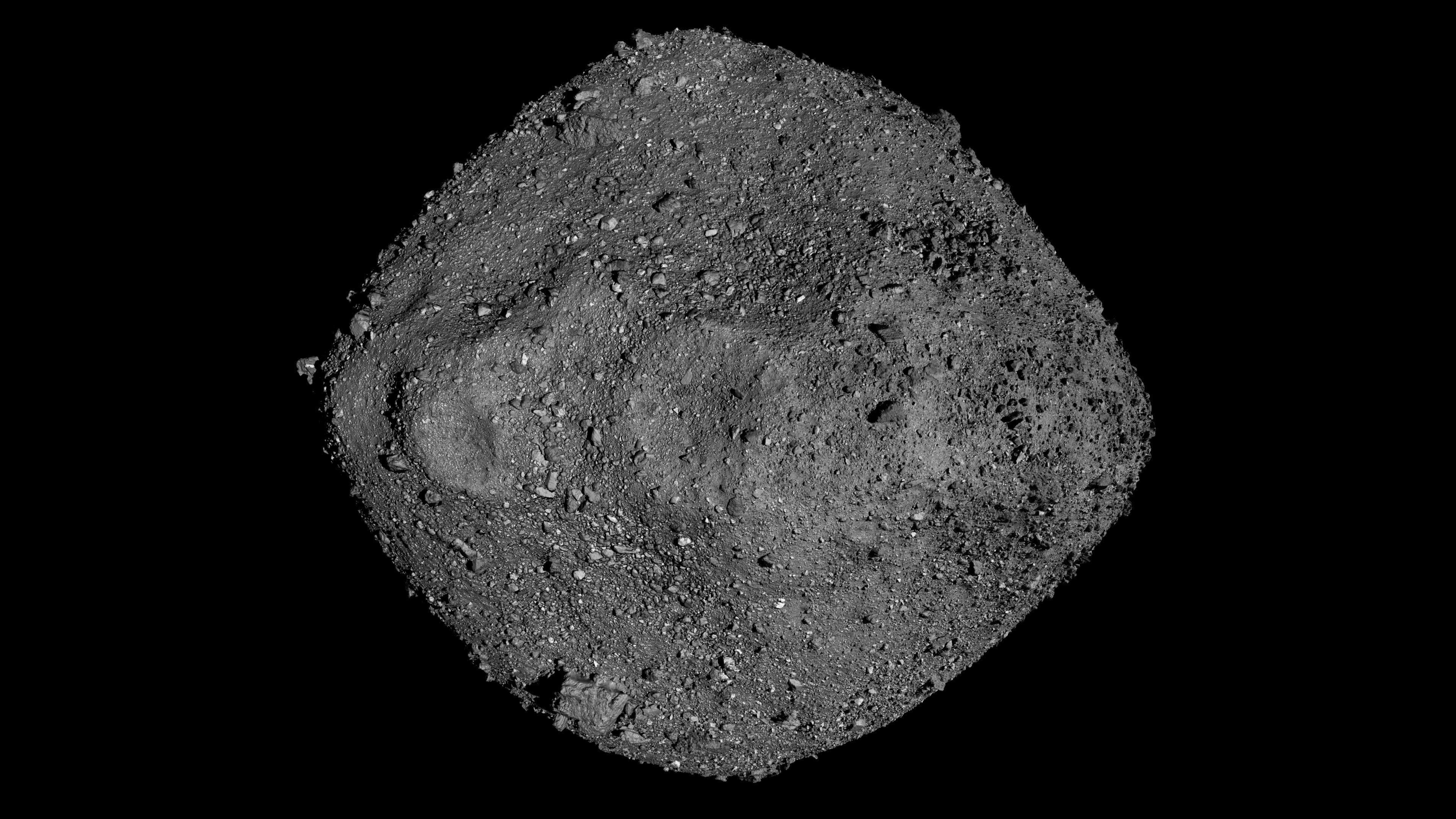
While Japan refined the technique, NASA went big. OSIRIS-REx launched in September 2016 toward Bennu, another carbonaceous near-Earth asteroid, and spent two years mapping it in obsessive detail before attempting a touch. Rather than firing a projectile, NASA’s spacecraft used a device called TAGSAM, a sampler head on the end of a robotic arm that blew a burst of nitrogen gas into the surface and funneled the kicked-up debris into a collection chamber. On 20 October 2020 it executed a touch-and-go that lasted a few seconds, then backed away.
It grabbed so much material that the chamber would not seal properly at first, with particles drifting out through a flap wedged open by rocks. When the capsule landed in the Utah desert on 24 September 2023 and the team finally pried open the stubborn fasteners months later, they measured the haul at 121.6 grams. That is more than twice the mission’s requirement and, by a wide margin, the largest asteroid sample ever brought to Earth.
121.6 g
Bennu sample returned by OSIRIS-REx
More than twice the mission requirement, and over twenty times the mass Hayabusa2 brought back from Ryugu. The single richest asteroid sample on Earth.
The science has been pouring out ever since. Studies published through 2025 reported that Bennu contains 14 of the 20 amino acids life on Earth uses to build proteins, all five of the nucleobases that encode genetic information in DNA and RNA, and an enormous diversity of nitrogen-bearing molecules. Researchers also found salt minerals that form when briny water evaporates, evidence that Bennu’s parent body once held pockets of salty liquid. Later analysis added tryptophan to the amino-acid tally. None of this proves that life came from space, but it strengthens the case that the raw chemical ingredients were delivered to the early Earth by exactly this kind of object.
Four nations, one technique
Tianwen-2 makes China the third entity to attempt asteroid sample return, and it is attempting one of the harder versions of the problem. Kamoʻoalewa is small and weakly bound by gravity, which makes station-keeping and sampling delicate. The mission carries two collection methods. One is a touch-and-go grab like OSIRIS-REx. The other is an anchor-and-attach approach in which the spacecraft would secure itself to the surface and drill, a technique no asteroid mission has demonstrated. Chinese planners have described a target of several hundred grams, which would rank between OSIRIS-REx and Hayabusa2.
The asteroid itself is a genuine scientific mystery. Spectral measurements suggest Kamoʻoalewa may be a fragment blasted off the Moon by an ancient impact, which would make it a piece of lunar crust now orbiting independently. Other recent work argues its surface more closely resembles space-weathered material like Itokawa’s. A returned sample settles the argument in a way no telescope ever could.
| Mission | Agency | Target | Sample returned | Return date |
|---|---|---|---|---|
| Hayabusa | JAXA | Itokawa (S-type) | ~1,500 grains (micrograms) | June 2010 |
| Hayabusa2 | JAXA | Ryugu (C-type) | 5.4 g | December 2020 |
| OSIRIS-REx | NASA | Bennu (C-type) | 121.6 g | September 2023 |
| Tianwen-2 | CNSA | Kamoʻoalewa | several hundred g (planned) | November 2027 (planned) |
If the schedule holds, China plans to release the sample capsule during an Earth flyby on 29 November 2027, dropping it toward a landing in Inner Mongolia. The mothership will not stop there. After delivering its cargo it is slated to spend years cruising to the main-belt comet 311P/PANSTARRS for a rendezvous around 2035, making Tianwen-2 a two-target mission that bundles an asteroid sample return and a comet survey into a single decade-long campaign.
The United States, meanwhile, has not left the field. The OSIRIS-REx spacecraft survived its Bennu delivery with fuel to spare and was promptly rechristened OSIRIS-APEX. It performed an Earth gravity assist in late 2025 and is now en route to Apophis, the asteroid that will pass closer to Earth than our geostationary satellites on 13 April 2029. APEX cannot return a sample, but it will orbit Apophis for months and even fire its thrusters at the surface to expose fresh material, extending the sample-era hardware into a new mission for the price of the propellant already aboard.
Why bother bringing it home
Spacecraft can analyze an asteroid in place. OSIRIS-REx and Hayabusa2 both carried spectrometers that measured surface composition from orbit. So why endure the cost and risk of physically hauling material back across the solar system?
Because the instruments on Earth are, and will remain, vastly more capable than anything that fits on a spacecraft. The most sensitive mass spectrometers, electron microscopes, and isotope-ratio measurements require machines the size of rooms and laboratories full of specialists. A returned sample can be studied with techniques that have not been invented yet, which is precisely what happened with the Apollo Moon rocks. Material returned in the early 1970s is still yielding new results half a century later because the analysis tools kept improving. The Bennu sample is being doled out to researchers in tiny allocations specifically so that most of it remains untouched for future scientists.
There is a practical dimension too. Understanding how these objects are built, whether they are solid rock or loose rubble piles held together by almost nothing, matters enormously if we ever need to deflect one. Both Bennu and Ryugu turned out to be rubble piles far less dense than solid stone, a finding that directly informs how a deflection mission would have to push on them.
Where this goes next
In sixteen years, asteroid sample return went from a single near-failure to an established capability practiced on three continents. The trend line is unmistakable. Each mission returned more material than the last, targeted a more scientifically valuable or technically demanding body, and folded in extended objectives that squeeze extra missions out of hardware already in deep space.
The honest caveat is that none of this is routine in the way that, say, launching a communications satellite is routine. Tianwen-2 still has to execute its sample grab and survive a two-year cruise home before anyone celebrates. The anchor-and-drill method it may attempt has never flown. Sample-return missions remain expensive, slow, and unforgiving of error, and they will stay rare for the foreseeable future.
But the question has shifted. It is no longer whether a spacecraft can bring home a piece of an asteroid. Three missions have now done it, and a fourth is in the act. The question is what we choose to go get next, and how much of the early solar system’s chemistry we are willing to carry back to read it in a laboratory rather than guess at it through a telescope. On that score, the case for sample return has never been stronger. The rocks are out there, we know how to reach them, and the ones already on Earth are still talking.
References(13)
- Hayabusa - NASA Jet Propulsion Laboratory
- Hayabusa Asteroid Sample Collection - NASA Johnson Space Center Curation
- Preliminary analysis of the Hayabusa2 samples returned from C-type asteroid Ryugu - Nature Astronomy, 2021
- Hayabusa2 Asteroid Sample Collection - NASA Johnson Space Center Curation
- NASA Announces OSIRIS-REx Bulk Sample Mass - NASA Science
- NASA's OSIRIS-REx Asteroid Samples Now Available to World's Scientists - NASA Science, April 2024
- Prebiotic organic compounds in samples of asteroid Bennu indicate heterogeneous aqueous alteration - PNAS, 2025
- Life's Building Blocks Found in Bennu Samples - Eos (AGU)
- China launches Tianwen-2 mission to sample near-Earth asteroid - SpaceNews
- Tianwen-2: China's Near-Earth asteroid and comet double-header - The Planetary Society
- Tianwen-2 launch: China begins 10-year mission to Kamoʻoalewa and 311P/Pan-STARRS - Astronomy.com
- OSIRIS-APEX, NASA's asteroid Apophis chaser - The Planetary Society
- OSIRIS-APEX mission updates - NASA Science

Theodore Kruczek