Somewhere around 200,000 miles from Earth, four astronauts were asleep in a capsule the size of two minivans. On the ground, a team of engineers was trying to figure out why their urine had frozen inside a vent line. The fix they came up with: rotate the entire Orion spacecraft so that sunlight would thaw the pipe. It worked - partially. Mission control cleared the toilet for “fecal use only,” which is exactly the kind of half-victory nobody wants to celebrate.
This was Day 3 of Artemis II, the first crewed lunar mission in over half a century. The crew - Commander Reid Wiseman, Pilot Victor Glover, and Mission Specialists Christina Koch and Jeremy Hansen - had already dealt with a jammed toilet fan on Day 1, just an hour after launch. The pump wouldn’t prime. The controller malfunctioned. Koch pulled parts out of the commode while Houston radioed instructions, earning herself the title of “space plumber.” That fix took about six hours. For at least part of that stretch, someone had to pee in a bag.
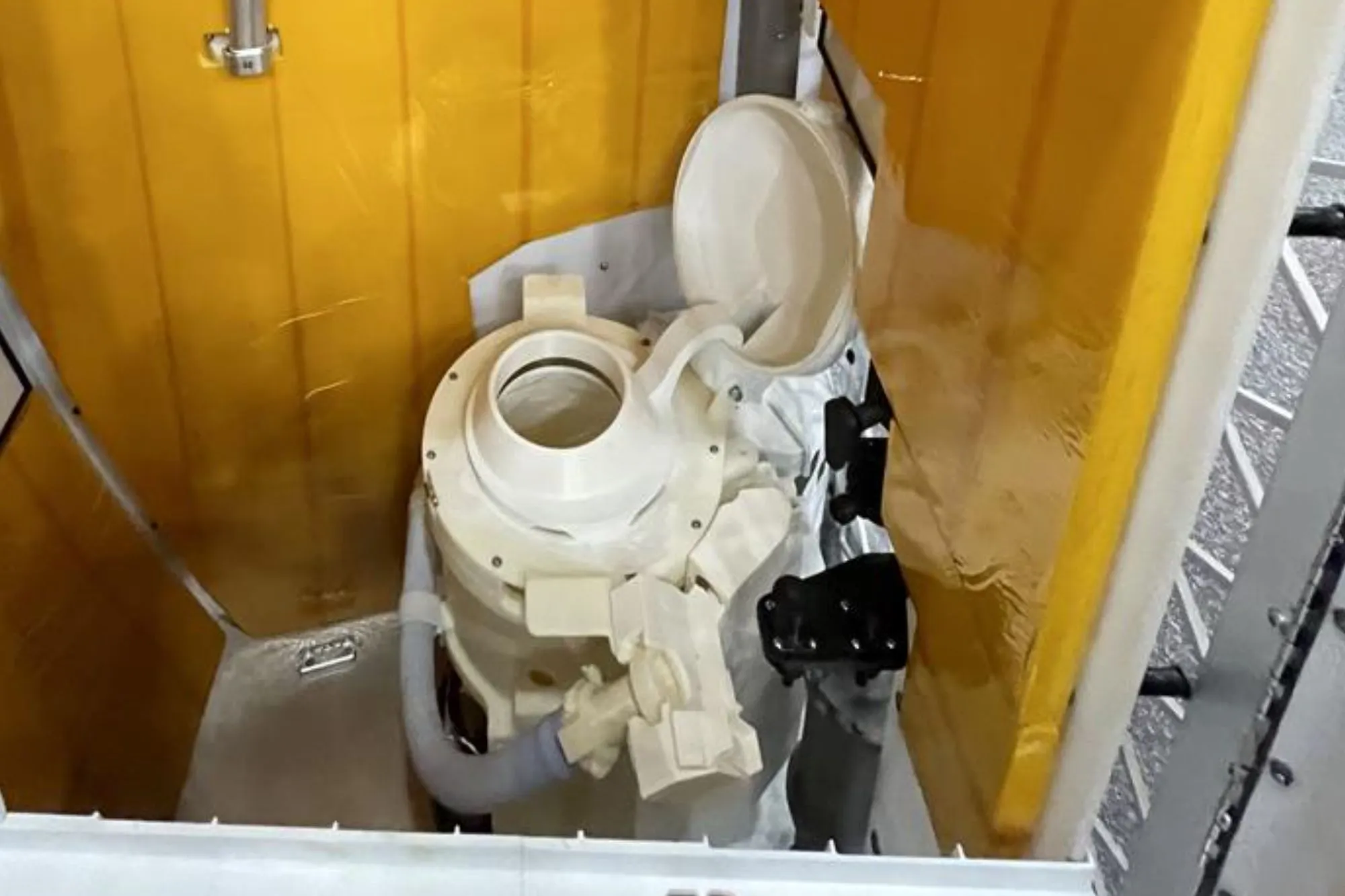
The toilet on Artemis II is called the Universal Waste Management System, or UWMS, and it represents more than a decade of engineering effort by Collins Aerospace under a roughly $30 million NASA contract. It was purpose-built to solve the problems that have dogged astronaut bathroom experiences since the Mercury program. And yet, four days into its first deep-space mission, the crew was rotating an entire spacecraft to thaw frozen pee out of a pipe. Some traditions, it seems, are harder to break than escape velocity.
The thing is, every generation of space toilet has malfunctioned on its first real outing. Every single one. The history of human waste management in space is less an arc of progress and more a recurring lesson in humility - a reminder that the most basic human functions become genuinely difficult engineering problems the moment you remove gravity from the equation.
The Bag Era
Before there were space toilets, there were bags. And before there were bags, there was Alan Shepard sitting on the launch pad for so long that he eventually just urinated in his spacesuit. NASA hadn’t planned for it. His Mercury flight was supposed to be a quick suborbital hop - why would an astronaut need to use the bathroom? But delays stacked up, and Shepard’s bladder didn’t care about launch windows. He asked mission control for permission to go, they hesitated, he went anyway, and America’s first crewed spaceflight launched with a damp astronaut.
Mercury and Gemini missions were short enough that NASA could largely avoid the problem through pre-flight “low residue” diets designed to minimize, well, output. But Apollo changed everything. You can’t send three men on a two-week trip to the Moon and back without addressing the obvious.
NASA’s solution was the Fecal Collection Device - a plastic bag with an adhesive ring that astronauts stuck to their bare skin, used, and then sealed after kneading in a packet of germicide to prevent bacterial gas buildup. Each bag also included a “finger cot,” a built-in glove finger that allowed the user to manually assist with separation, because in weightlessness, waste doesn’t know it’s supposed to leave your body. Walt Cunningham, who flew on Apollo 7, estimated the entire process took about 45 minutes. Most crew members stripped nearly naked and floated down beneath the crew seats for whatever privacy the cramped capsule could offer while their crewmates pretended very hard not to notice.
The system was, by NASA’s own later assessment, “marginally functional” and “very distasteful.” The bags had no odor control. Leaks were routine. And on Apollo 10 - the lunar dress rehearsal that flew the same trajectory Artemis II is retracing right now - Commander Tom Stafford made one of the most memorable calls in spaceflight history when he spotted an unaffiliated piece of waste drifting through the cabin. All three crew members immediately denied responsibility.
I used to want to be the first man to Mars. This has convinced me that, if we got to go on Apollo, I ain’t interested.
The urine collection system was marginally better - a condom-like device connected to a tube that vented liquid overboard into space, where it would freeze instantly into glittering crystals. Astronauts on several missions reported that vented urine, catching sunlight against the black of space, was one of the most beautiful things they’d ever seen. Koch apparently agrees - she filmed urine venting from Orion’s waste system earlier this week, describing the frozen droplets drifting past the windows.
But beauty aside, Apollo’s waste management was so miserable that astronauts would eat less than half their available food rations just to reduce how often they’d have to use the system. The crew of Apollo 8 had to chase down escaped blobs of vomit and fecal matter floating through the cabin. NASA knew this couldn’t continue.
The Shuttle’s Toilet - A Complicated Upgrade
When the Space Shuttle debuted in 1981, it brought the first real toilet to American spaceflight. The Waste Collection System used airflow instead of gravity to direct waste into a pressurized commode, with high-speed fans separating liquid from solid material. Liquid waste was vented overboard. Solid waste was vacuum-dried by exposure to space and stored on board. It was, on paper, a massive improvement.
There were catches. The toilet seat’s opening was about four inches in diameter - far smaller than anything on Earth - and astronauts had to position themselves with surgical precision. NASA built a “positional trainer” equipped with a downward-facing camera so trainees could practice alignment using a video monitor and crosshairs. This device was reportedly referred to internally as NASA’s “deepest, darkest secret.”
The shuttle toilet also malfunctioned with troubling regularity. On STS-1, the very first shuttle flight, the fecal containment side of the system failed due to a clogged charcoal filter that killed the odor filter and destroyed the airflow needed to separate waste. By mission’s end, the toilet was unusable. Worse, the vacuum-drying process generated fecal dust, and during reentry some of that dust migrated into the environmental control system and entered the cabin. John Young and Bob Crippen landed Columbia having breathed aerosolized fecal matter.
On STS-51-D, Discovery’s maiden flight, a buildup of frozen waste on the orbiter’s exterior had to be removed using the Canadarm. The shuttle program’s toilet history reads like a plumber’s nightmare journal - fan malfunctions, clogged separators, jammed valves, and the constant threat that a bathroom malfunction could end a mission early.
And the shuttle toilet was never designed for female anatomy. When NASA’s astronaut corps expanded to include women in 1978, the toilet had to accommodate both sexes, but the urine collection system - a funnel-and-hose arrangement - was primarily designed around male physiology. Female astronauts had to adapt to hardware that hadn’t been built with them in mind.
The ISS Improvises
The International Space Station inherited the shuttle’s basic approach - fans, airflow, vacuum drying - but added recycling. The station’s Water Recovery System processes urine into drinking water, recovering about 80-85% of the liquid. Solid waste gets packed into containers and loaded onto cargo ships that burn up in the atmosphere. The station eventually operated with two and then three toilets across its Russian and American segments, but reliability remained an ongoing concern.
In 2008, one of the Russian-built toilets failed when a pump broke, leaving 13 people (a record crew at the time) sharing a single working commode and the one aboard the docked Space Shuttle. NASA paid roughly $19 million for a Russian-built backup toilet. In 2009, another failure occurred when a flooded liquid separator took one of the station’s toilets offline. These weren’t catastrophic failures, but they reinforced a pattern: space toilets break, and when they do, things get uncomfortable fast.
Alan Shepard Wets His Spacesuit
NASA hadn't planned for bathroom needs on short flights. Shepard urinated in his suit on the pad before launch.
Apollo 10's Floating Incident
Tom Stafford reports an unidentified turd floating through the cabin during the lunar dress rehearsal. All three crew members deny ownership.
STS-1 Toilet Fails
The first shuttle toilet's fecal system clogs by mission's end. Fecal dust enters the cabin ventilation during reentry.
STS-33 Thanksgiving Crisis
Shuttle toilet breaks on Flight Day 1. An accidental vent-to-vacuum event nearly depressurizes the cabin. Crew finishes mission operating the toilet with pliers.
Collins Aerospace UWMS Contract
NASA awards roughly $30 million to develop a next-generation toilet for Orion and the ISS.
UWMS Arrives at ISS
The first Universal Waste Management System launches to the station for testing. It barely sees use.
Orion UWMS Installed
The Orion-specific version of the UWMS is installed in the Artemis II vehicle, five years before launch.
Artemis II Launch - Toilet Fails Within Hours
The UWMS fan jams about an hour after launch. Koch fixes it in six hours. The crew had to use backup bags in the interim.
Frozen Vent Line
Urine freezes in the vent line 200,000 miles from Earth. Mission control rotates the capsule to thaw it with sunlight.
The UWMS - Built to Fix Everything
The Universal Waste Management System was supposed to be the toilet that finally got it right. Collins Aerospace won the contract in 2015, and the design incorporated lessons from every previous failure. The unit is 3D-printed from titanium, making it both lightweight and durable. It’s 65% smaller and 40% lighter than the ISS toilet it was designed to eventually replace. It can process urine and feces simultaneously - a genuine first, since every previous space toilet required one function at a time. And it was designed from the start to work for both male and female astronauts, with a redesigned seat geometry and urine collection system.
The UWMS also brought something no deep-space toilet had ever offered: a door. Previous systems used curtains at best. On Orion, the toilet sits in a dedicated hygiene bay built into the capsule floor, with an actual door and curtain for privacy. In a vehicle that’s 16.5 feet across and shared by four people for ten days, a door matters.
Space Toilet Evolution
| Apollo Fecal Bag | Shuttle WCS | Orion UWMS Current | |
|---|---|---|---|
| Simultaneous Use | No | No | Yes |
| Privacy | None | Curtain | Door + curtain |
| Time Per Use | ~45 minutes | ~10-15 minutes | ~5-10 minutes |
| Female-Friendly | No | Partially | Yes |
| Weight | Negligible | ~140 kg | ~84 kg (est.) |
| Failure Mode | Escaped waste | Fecal dust, clogs | Fan jams, frozen lines |
- Simultaneous Use
- No
- Privacy
- None
- Time Per Use
- ~45 minutes
- Female-Friendly
- No
- Weight
- Negligible
- Failure Mode
- Escaped waste
- Simultaneous Use
- No
- Privacy
- Curtain
- Time Per Use
- ~10-15 minutes
- Female-Friendly
- Partially
- Weight
- ~140 kg
- Failure Mode
- Fecal dust, clogs
- Simultaneous Use
- Yes
- Privacy
- Door + curtain
- Time Per Use
- ~5-10 minutes
- Female-Friendly
- Yes
- Weight
- ~84 kg (est.)
- Failure Mode
- Fan jams, frozen lines
At the system’s heart is the Dual Fan Separator, or DFS - a single motor driving two impellers on a shared disc. One fan pulls air through the commode to capture solid waste. The other pulls air through the urine collection system. A centrifugal separator spins the urine away from the air stream, and the separated urine gets pumped into a wastebasket-sized tank for eventual overboard venting. Solid waste goes into sealed bags inside fecal canisters, which are compacted and brought home with the crew. The whole system is controlled by a single electronic controller that handles power management, fault detection, and data logging.
That single-controller design is also the system’s most obvious vulnerability. Unlike the shuttle toilet, which had redundant motors and fans, the UWMS was designed as “largely zero-fault-tolerant” to save weight and volume - critical constraints for a deep-space vehicle. If the one motor fails, the one fan stops, and the one controller can’t recover it, the crew is back to bags.
The ISS Test That Wasn’t
Before Artemis II, the UWMS was supposed to prove itself on the International Space Station. A version was shipped up in October 2020 and installed in 2021. The plan was to run a multi-crew, multi-day demonstration mimicking the Orion mission’s duration and crew size - an operational dress rehearsal for the toilet, essentially.
It didn’t go well. During initial checkout, crew members reported that the system smelled bad - though this may have been partly due to improperly seated seals on the Odor Bacteria Filter. More seriously, during a startup attempt, the Dual Fan Separator refused to spin. On-orbit data showed a “locked rotor” fault. The crew tried to dislodge the impeller by forcing air through it with an onboard vacuum cleaner. That didn’t work either. Engineers eventually swapped the DFS unit with a spare, which did work - confirming the problem was a hardware defect in the original unit, not a system design flaw.
But the ISS testing program never fully completed its objectives. A demonstration attempt in 2023 stopped after three days when a dose pump failed. A second attempt in 2024 hit another DFS startup problem, traced to controller circuit issues. Ground testing also revealed that the Odor Bacteria Filter couldn’t meet its 84-crew-day capacity requirement for the Artemis III mission - it failed somewhere between 50% and 75% of the way through testing due to odor breakthrough.
The Orion-specific UWMS unit was delivered in December 2019 and installed in the Artemis II vehicle in March 2021. It sat inside the capsule for five years before launch. Collins Aerospace updated the commode seats and fecal bags based on ISS crew feedback, but the core system - the DFS, the controller, the vent lines - was the same design that had struggled on the station.
What Actually Went Wrong on Artemis II
The first failure hit about an hour after launch on April 1. Koch spotted a blinking fault light on the UWMS panel and called it in to Houston. NASA spokesperson Gary Jordan relayed the initial diagnosis during live coverage: the toilet fan had jammed. Associate Administrator Amit Kshatriya later clarified it was a controller issue - the electronic brain that runs the DFS had malfunctioned, preventing the fan from spinning up.
Without the fan, the system couldn’t generate the airflow needed to pull waste away from the user’s body. Urine collection was completely offline. Fecal collection could still technically work, but only barely. The crew broke out their Collapsible Contingency Urinals - CCUs - which are essentially reusable, sealable containers that use capillary forces to manage the urine-air interface. Each crew member carried two. Veteran astronaut Don Pettit, watching from home, helpfully tweeted that a CCU works on the same principle as his space coffee cup.
Late Wednesday night, Koch took on the repair. Mission control walked her through removing parts from the toilet and executing a sequence of troubleshooting steps while ground controllers monitored telemetry and tried remote fixes, including cycling the system’s power. The combination worked. CapCom Amy Dill delivered the good news: the toilet was go for use. The crew had been without a functioning commode for roughly six hours.
The relief lasted about two days. On the night of Day 3, as the crew was preparing for sleep roughly 200,000 miles from Earth, mission control attempted a routine dump of the wastewater tank - venting accumulated urine overboard. The vent line was blocked. Flight Director Judd Frieling told reporters Saturday morning that the most likely culprit was frozen urine in the line. In the thermal environment of deep space, any exposed plumbing on the shadow side of the spacecraft can drop to temperatures cold enough to freeze liquid waste solid.
Mission control’s fix was elegant in a brute-force kind of way: they rotated the Orion capsule to put the blocked vent line in direct sunlight. The solar heating thawed the pipe, and some urine was successfully expelled into space. But the clog proved stubborn. For hours, the toilet was cleared only for solid waste, with the crew back on CCUs for liquid. The crew also reported a burning smell from the bathroom, which controllers attributed to the gasket material around the door rather than anything more concerning.
By around midnight Eastern time on Day 4, mission control finally delivered the update everyone had been waiting for. CapCom Jacki Mahaffey radioed: “You are go for all types of use of the toilet.” Koch’s response captured the mood perfectly: “And the crew rejoices!”
Why This Keeps Happening
Space toilet failures aren’t just bad luck. They’re a consequence of trying to engineer around a problem that Earth solved with gravity roughly four billion years ago. Every space toilet ever built has relied on fans and airflow to do what gravity handles effortlessly on the ground - pulling waste away from the body and directing it to the right place. Fans have moving parts. Moving parts wear out, jam, and fail. Controller circuits degrade. Fluids freeze in lines exposed to the vacuum of space.
The UWMS’s specific vulnerabilities track directly to its design compromises. The zero-fault-tolerant architecture saved critical mass and volume, but it means a single component failure takes the whole system offline. The consolidated DFS - combining two fans and a separator into one motor-driven assembly - was brilliant packaging that also created a single point of failure. And the vent line that carries liquid waste to the overboard dump is exposed to the thermal extremes of deep space in ways that simply don’t apply in low Earth orbit, where the station maintains a more moderate thermal environment.
There’s also the testing gap. The ISS demonstration program was supposed to wring out these problems before Artemis II flew, but it never achieved its full objectives. The system that launched on April 1 was, in some ways, still an untested flight article on a test mission - which is, to be fair, exactly what test flights are for. As Kshatriya put it after launch: “Artemis II is a test flight, and the test has just begun.”
Mission Management Team Chairman John Honeycutt acknowledged the public fascination with the toilet during a Saturday briefing. People’s fixation on the commode is “kind of human nature,” he said. Everyone understands how important this is, and it’s harder to manage in space. But he emphasized that contingency layers held - the crew was never in danger, just uncomfortable. In a 330-cubic-foot capsule three days from Earth, the margin between a plumbing annoyance and something worse is measured in backup systems, and on this flight, those backups did their job.
The UWMS will almost certainly need design modifications before Artemis III, the mission that’s supposed to land two astronauts on the lunar surface for an extended stay. A toilet that malfunctions repeatedly during a ten-day flyby isn’t acceptable for a mission profile that demands weeks of reliable operation. Collins Aerospace and NASA’s UWMS team will be studying every data point from this flight closely. Melissa McKinley, the UWMS project manager, said before launch that the mission would drive waste management design for the entire lunar and Mars campaign. She wasn’t wrong - just perhaps not in the way she’d hoped.
The Most Important Piece of Equipment
Koch called it early in the mission, before the second failure, before the frozen vent line and the capsule rotation and the hours-long saga of partial fixes. “I like to say that it is probably the most important piece of equipment on board,” she said of the toilet during a Thursday media event. She wasn’t exaggerating for laughs.
For all the attention paid to SLS’s engines, Orion’s heat shield, and the navigation systems that will guide future crews to a lunar landing, waste management remains one of the hardest practical problems in human spaceflight. You can design around a navigation error. You can carry backup communications gear. But you cannot tell four people to stop producing waste for ten days. The toilet has to work. And when it doesn’t, everything else - crew morale, sleep schedules, mission timelines, cabin atmosphere - starts to erode.
The fact that Artemis II’s toilet problems have dominated headlines isn’t a sign that the media is being frivolous. It’s a sign that the public intuitively understands something engineers have known since the Mercury program: the most fundamental systems are often the hardest ones to get right. Sixty-five years of spaceflight, hundreds of billions of dollars in technology, and we’re still figuring out how to flush.
The Artemis II crew is currently approaching the Moon for their historic flyby on April 6, the first humans to see the far side up close since Apollo 17’s crew in December 1972. Their toilet appears to be working. For now.
References(12)
- Artemis II Toilet Malfunction Coverage - CNN
- Artemis II Flight Update: Toilet Troubleshooting - NASA
- Artemis II's Toilet Is a Moon Mission Milestone - Scientific American
- NASA Universal Waste Management System: ISS Operations, Issues, and Accomplishments (2022) - NASA Technical Reports
- Artemis II Crew Barred From Space Toilet - Prism News
- Orion's New Space Toilet Aims to Handle Deep Space Waste - Prism News
- Artemis II Crew Fixes Toilet - Astronomy.com
- Artemis II Toilet Coverage - CBS News
- The Trouble With Fecal Containment Systems - Popular Science
- Space Toilet History - Wikipedia
- Dual Fan Separator UWMS Design Paper - NASA Technical Reports
- UWMS Development Paper (2020) - Collins Aerospace / ICES