Community Ideas in Action
Hey space enthusiasts! I recently got an interesting email from Gianluca that sparked some late-night coding. He suggested adding graphs to show the distribution of satellites, debris, and unknown objects across various orbits. It was a great idea, so I decided to implement it.
New Orbital Distribution Graphs
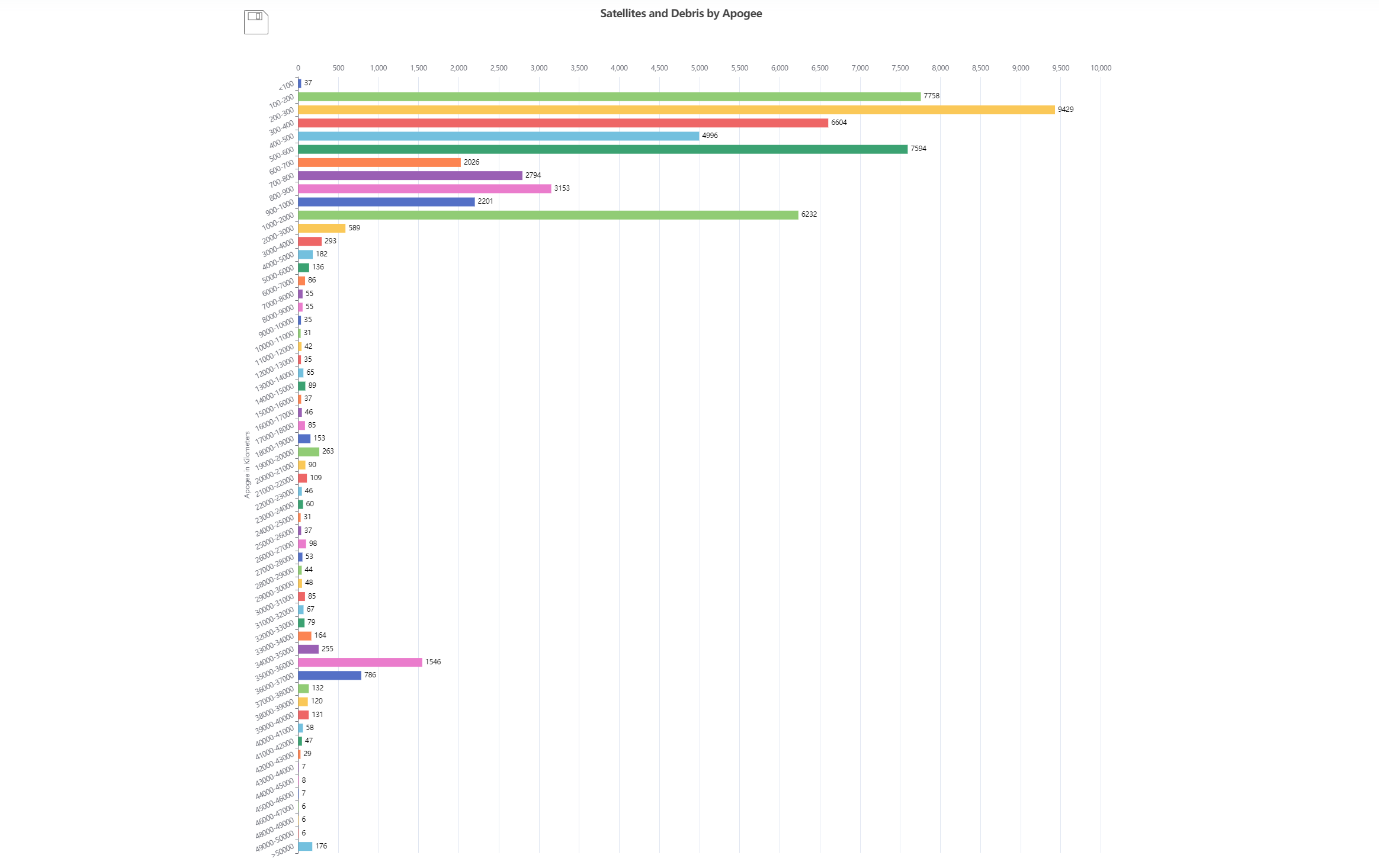
Based on Gianluca’s suggestion, I’ve added three new graphs to KeepTrack:
- Satellites by Apogee: Showing object distribution at their highest orbital points.
- Satellites by Perigee: Illustrating where objects come closest to Earth.
- Satellites by Average Altitude: Giving an overview of typical orbital altitudes.
These graphs include active satellites, space debris, and unidentified objects, offering a quick glance at orbital populations.
Additionally there are text and csv formats that are automatically updated daily when new satellite data is added.
3D Visualization
While these graphs are helpful, the real eye-opener is in the 3D application. I strongly encourage you to explore this feature. In the settings menu, you can toggle different orbits on and off. It’s particularly striking to see just how crowded Low Earth Orbit (LEO) is compared to higher orbits.
Try this: Turn off all orbits except LEO in the 3D view. The sheer number of objects might surprise you. It’s a great way to visualize the growing concerns about orbital congestion and space debris.
What This Means for Users
With these additions, you can:
- Get a quick overview of orbital object distribution
- Compare populations of active satellites versus debris
- But most importantly, use the 3D view to really grasp the current state of our orbital environment
Community-Driven Development
A big thank you to Gianluca for this suggestion! It’s user ideas like this that help shape KeepTrack’s development. While I can’t implement every suggestion, I always appreciate hearing your thoughts on how to make the tool more useful and insightful.
Thanks again, Gianluca, and to all of you who use KeepTrack. Your engagement and ideas are what keep this project moving forward.